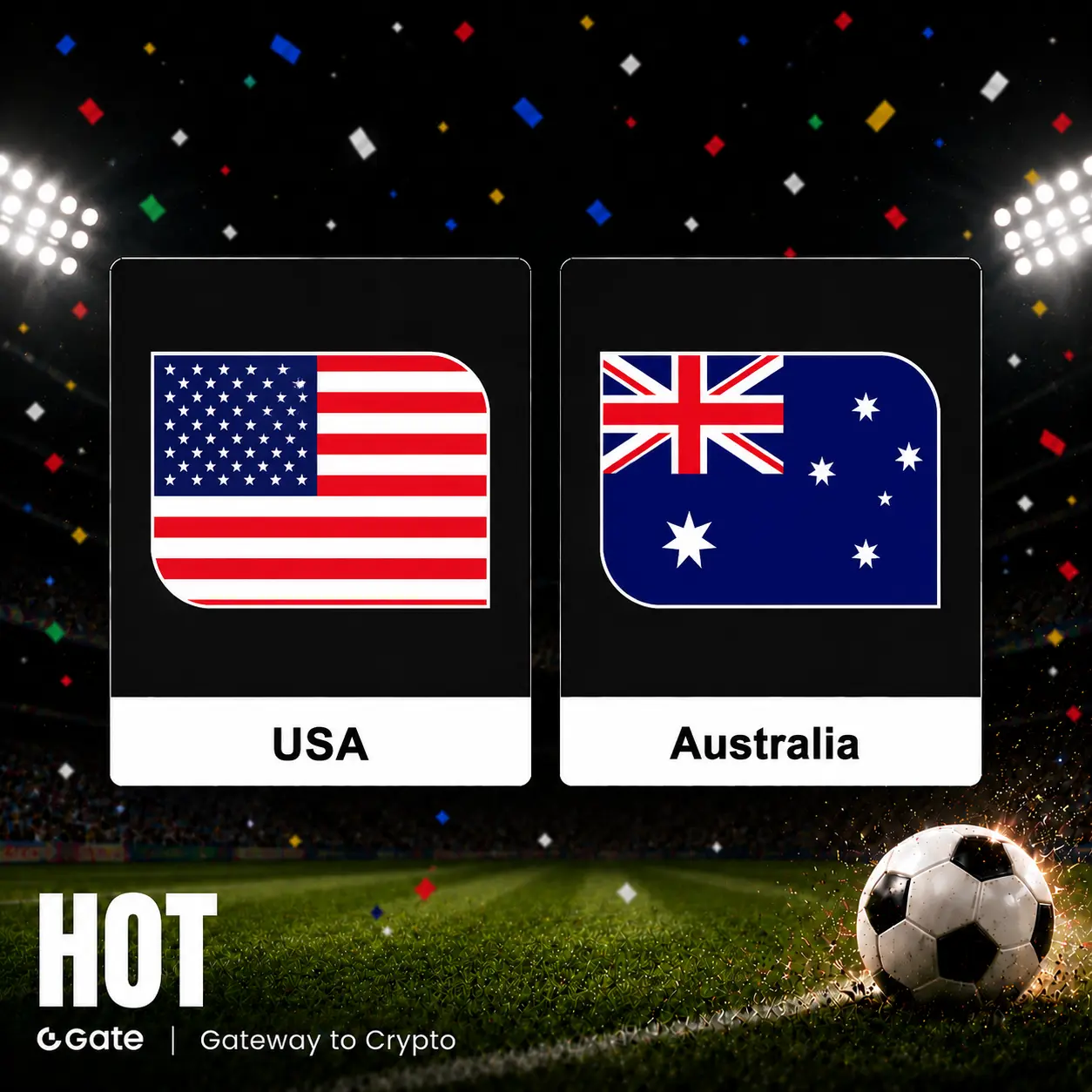
What the win-rate distribution in the prediction market reflects about the gap in strength
61% vs 18%—this is a win-rate spread that’s clearly significant. A prediction market is not a simple public-opinion poll; it’s a price-discovery mechanism where participants express their views with real money. The USA’s win probability of as high as 61% is built on multiple factors.
First is home advantage. As co-host, the U.S. team benefits from the Seattle home crowd, and the support of more than 60,000 home fans creates a quantifiable competitive boost. Next is squad strength. The U.S. team includes multiple players who play in Europe’s top leagues, such as Christian Pulisic, Weston McKennie, and Tyler Adams. Their overall market value and major tournament experience are stronger than Australia’s. The opening 4-1 demolition of Paraguay further reinforces the market’s confidence in the team.
However, the 22% draw probability cannot be ignored either. This value is noticeably higher than what would be expected under a random distribution, indicating that the market fully recognizes Australia’s defensive resilience and the tactical complexity of the match.
How the two teams’ first-round performances influenced market expectations
In its first match against Paraguay, the U.S. displayed highly convincing attacking strength. Folarin Barlogun scored twice, while Pulisic repeatedly created threats down the flank. The team led 3-0 already by halftime. This win brought not only 3 points, but also a clear signal to the market: under Pochettino, this U.S. side has the ability to break down compact defenses.
Australia’s performance was equally impressive. Against Turkey, the “Socceroos” controlled the ball at only 37% and were far behind in shots, 9 to 30, yet still completed a 2-0 clean-sheet victory. Goalkeeper Patrick Begich contributed 8 crucial saves, while the three-center-back system led by Harry Suta demonstrated extremely strong aerial contest ability.
The two wins had sharply different styles—USA relied on attacking suppression, while Australia relied on defense and counterattacking. When pricing the match, the market must evaluate which style gains the upper hand in the face-off.
How the “contradictory clash” of tactical styles affects capital decisions
The match has been described by the media as a “clash of contradictions”—USA’s spear vs Australia’s shield. Under Pochettino, the U.S. favors ground build-up and attacks down the flanks. In attack, the formation shifts from 4-2-3-1 to 3-2-4-1, with right-back Alex Freeman pushing forward into a three-center-back setup, while left-back Anthony Robinson pushed high to create a numerical advantage.
Australia follows an entirely opposite tactical philosophy. Tony Popovich’s team sets up in a low 5-4-1 “iron bucket” formation when defending. The heights of the three center-backs are all over 1.9 meters, giving them very strong air-defense capability. In attack, they rely on Inesto Irlanquda’s pace and one-on-one ability, looking for opportunities through long-ball counterattacks.
With the prediction market pricing USA’s win rate at 61%, the implication is that the market believes USA’s attacking firepower is enough to break through Australia’s defensive line. But the 22% draw probability also shows the market gives sufficient respect to Australia’s “iron bucket” and its ability to wear opponents down.
Does the history of head-to-head meetings provide a reference for the market?
The U.S. and Australia have met four times previously, all in friendlies. The U.S. finished with 2 wins, 1 draw, and 1 loss, scoring 5 and conceding 3. Australia’s only win came in 1992; since then, the U.S. has remained unbeaten in three straight matches. The most recent meeting was in October 2025, when the U.S. beat Australia 2-1 in Denver; Haji Wright scored twice, ending Australia’s prior run of 12 unbeaten games.
However, the value of head-to-head history as a reference is limited. The four previous meetings were all friendlies, while this match is the first time the two teams meet in an official major competition. The intensity, commitment to winning, and tactical setup of friendlies are not comparable to a World Cup group-stage match. When pricing, the prediction market relies more on the teams’ current competitive condition, squad strength, and tactical matchup than on historical results.
How group-stage qualification scenarios influence each team’s game strategy
In the Group D standings, the U.S. and Australia are level on 3 points each. The U.S. currently sits top thanks to goal difference. The winner of this match will basically lock in first place in the group, thereby avoiding other group-seed teams in the first round of the knockout stage.
This qualification situation strongly affects match strategy. Both teams already have 3 points; as long as they avoid defeat in this game, they still have a good chance of qualifying in the final round against a weaker group opponent. This means neither side necessarily has to throw everything into attack from the start—USA may be wary of Australia’s counterattack speed, while Australia may find a draw acceptable.
The prediction market’s 22% draw probability partly reflects this “if we don’t lose, we’re fine” strategic consideration. If the match enters a stalemate, both sides will be less willing to take risks in pushing forward, and the likelihood of a draw will rise significantly.
Is there disagreement in the market, and where could the potential variables be?
Although Gate’s prediction market provides a clear probability distribution, the market is not a single block internally. Some analysis suggests that early-morning retail capital is concentrated on a USA win, while late professional capital has shown a slight shift aimed at hedging against the draw. This divergence in capital structure indicates that different types of participants have different understandings of where the match may go.
Potential variables mainly center on two areas. First is Pulisic’s injury status—this key U.S. attacking player was reported prior to the match as possibly being forced to miss due to injury. If he cannot play or if his condition is limited, the U.S.’s attacking creativity would be greatly reduced. Second is Australia’s counterattack efficiency—Inesto Irlanquda versus Freeman’s matchup could become the deciding factor. If Australia can exploit the space left behind after the U.S. pushes its defense forward, an upset is not out of the question.
The prediction market data is dynamic. As more information is released before kickoff—such as the starting lineup, player injury updates, and weather conditions—the probability distribution may still fluctuate.
FAQ
Q: How is Gate’s prediction market data’s USA win probability of 61% derived?
A: The prediction market’s win rate is not a subjective prediction; it comes from market prices formed by participants buying and selling “Yes/No” shares. As of June 19, 2026, trading activity by market capital prices the implied probability of a USA win at 61%.
Q: Why is Australia’s win probability only 18%, and why is the gap so large?
A: Australia’s 18% win probability reflects the market’s combined assessment of multiple factors: USA’s home advantage, squad strength advantage, the dominant 4-1 opening win, and Australia’s objective gaps in strength and resources.
Q: What does a 22% draw probability mean?
A: A 22% draw probability is significantly higher than a random baseline, showing that the market fully recognizes that Australia’s defensive resilience may sap USA’s offense, and that the group-stage qualification strategy of “if we don’t lose, we’re fine” for both teams may lead to a more cautious match tempo.
Q: Will the prediction market’s win probability change?
A: Yes. Prediction market prices are dynamic. As more pre-match information is released (such as the starting lineup, player injury status, weather, etc.), market participants will reprice, and the win-rate distribution may adjust accordingly.