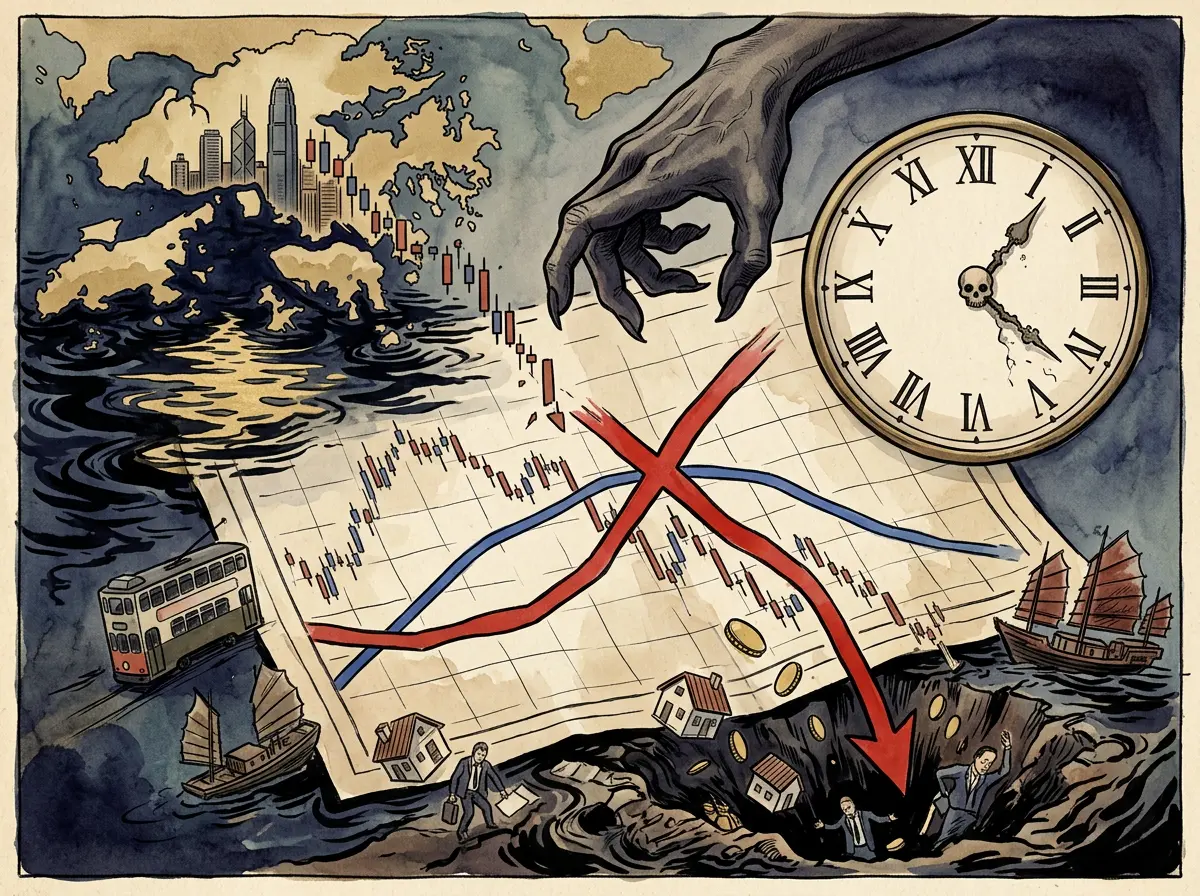
Caitax Media Chairman Xie Jinhe posted on Facebook on June 17 under the title “Hong Kong stocks have already fallen into a bear market,” noting that after SpaceX’s listing, global equity markets entered a correction phase. Taiwan, Japan, and South Korea’s stock markets are again nearing new highs, but Hong Kong stocks’ downtrend has intensified; both the Hang Seng Index and the H-share index have entered a bearish “death cross” trend.
Hang Seng stock individual names listed by Xie Jinhe: price declines
The following are the verified figures Xie Jinhe cited in his Facebook post:
Tencent: HK$683 → HK$420.4
Alibaba: HK$186.2 → HK$106.2
Xiaomi: HK$61.45 → HK$25.85
BYD: HK$412.8 (before the spin-off) → HK$83.4
SEA Technology: HK$1,330 → HK$411.2
Xie Jinhe also mentioned that AI stocks such as iSang Pu, SEA Technology, Biren, and Zhaoyi’s share prices rose sharply first, but recently have also shown selling pressure from arbitrage, and the share prices have gradually fallen. New energy vehicle companies such as Li Auto, XPeng, Leapmotor, and NIO have frequently hit new lows; the share price declines for Meituan and JD.com are also clearly evident. The prices above are personal observation figures cited in Xie Jinhe’s article, and no specific quote time is indicated.
Historical comparison between Taiwan and Hong Kong indices: market shift confirmed by Xie Jinhe
In his post, Xie Jinhe pointed out that around 2018, the Hang Seng Index once reached 33,844 points, while Taiwan’s stock market was at 11,211 points, with a gap of more than 20,000 points. Today, however, Taiwan’s weighted index is instead ahead of the Hang Seng Index by more than 20,000 points. He said, “This change cannot be said to be not big.” This comparison is part of Xie Jinhe’s personal observation and analysis framework.
FAQ
What does the “death cross” referred to by Xie Jinhe mean?
A death cross (Death Cross) is a technical analysis term, usually meaning that a short-term moving average line (such as the 50-day line) falls below a long-term moving average line (such as the 200-day line). Technical analysts view it as a bearish signal. In his Facebook post, Xie Jinhe confirmed that both the Hang Seng Index and the H-share index have shown a death cross bearish trend. This is his personal technical analysis judgment, not an independent institutional rating.
What does “northbound funds southbound is constrained” mean?
In his post, Xie Jinhe said that the Communist Party of China Central Committee has tightened funds investment into overseas markets. Brokerage firms serving overseas clients are restricted, so “northbound funds southbound” (referring to mainland China funds flowing into Hong Kong’s stock market through channels such as Shanghai-Hong Kong Stock Connect and Shenzhen-Hong Kong Stock Connect) has been affected. This is a statement in Xie Jinhe’s article; the specific policy details and scale were not further explained in his post.
What is Xie Jinhe’s identity and the nature of his statements?
Xie Jinhe is the chairman of Caitax Media and a well-known financial commentator in Taiwan. The Hong Kong stock analysis and individual stock figures cited in this article come from his personal Facebook post on June 17, 2026. They are his personal views, not a research institution report or an official market assessment.


