#MyGateTradeStory
The Velocity Trap: How SOL's $64.70 Pivot Almost Cost Me Everything
The Paradox of Precision
Here is the uncomfortable truth that haunts every trader who has ever nailed an entry: being right at the wrong scale is more dangerous than being wrong. I learned this staring at my screen on a Thursday afternoon, watching Solana hover at $64.70, convinced I had decoded the matrix. What I had actually decoded was my own ego dressed in technical clothing.
The Setup: Reading the $64.70 Tea Leaves
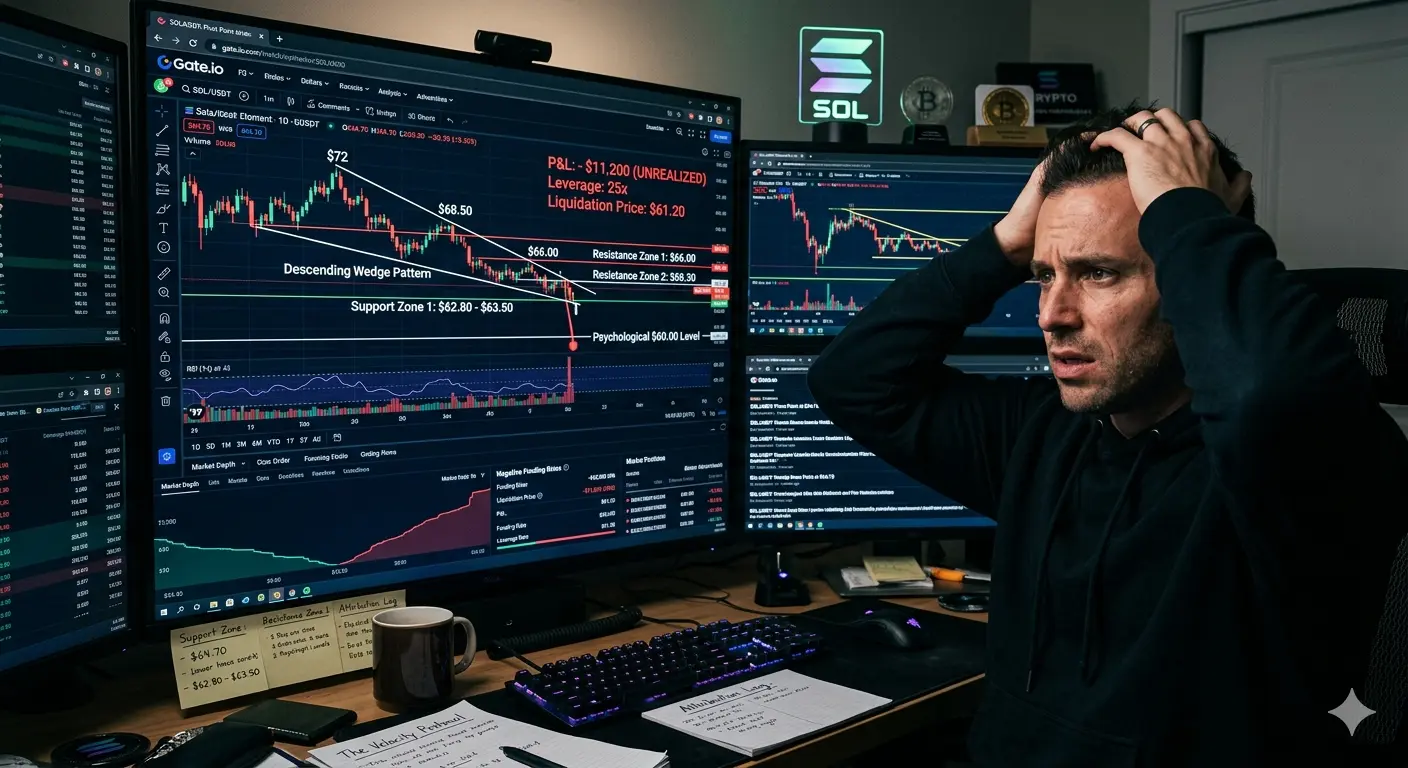
SOL had been dancing around the $64.70 level for days, and the technical picture was speaking clearly if you knew how to listen. The price action had formed a descending wedge pattern from the $72 rejection, with lower highs compressing against a stubborn support floor at $62.80. The 14-day RSI sat at 43, neither oversold nor overbought, but the funding rates on perpetuals told a different story—negative funding meant shorts were paying longs, a classic contrarian signal that smart money was positioning for upside.
My analysis identified three critical levels. Support Zone 1 sat at $62.80 to $63.50, a previous accumulation range that had held through three separate tests. Support Zone 2 was the psychological $60 level, reinforced by the 200-day moving average hovering at $60.40. Resistance Zone 1 waited at $66.00, the recent local high and a liquidity magnet. Resistance Zone 2 loomed at $68.50, where the descending trendline from the $72 peak would create a make-or-break decision point.
The forecast painted two scenarios. In the bullish case, a break above $66.00 with volume would target $68.50, then $70.00, with a stretch potential toward $72.50 if momentum caught. In the bearish case, a loss of $62.80 would accelerate toward $60.00, then $58.50, with a capitulation wick possible at $56.00.
I entered long at $64.70 with a clear plan: half position at market, half on a dip to $63.50 if it came. Stop loss at $62.20, just below Support Zone 1. Take profit targets at $66.00, $68.00, and $70.00, scaling out at each level.
The Trade: When Mathematics Meets Emotion
The entry was surgical. SOL had just bounced from $63.80, volume was climbing, and the 4-hour candle was printing a bullish engulfing pattern. I opened my position—$2,000 at 25x leverage, giving me $50,000 notional exposure. My liquidation sat at $61.20, a comfortable $3.50 buffer below my stop.
Within six hours, SOL punched through $66.00. I closed 30% of my position at $66.20, locking in $1,200 profit. The momentum felt unstoppable. By Friday morning, price had reached $68.40, and I closed another 40% at $68.20, adding $3,500 to my running total. I held the final 30%, trailing stop moved to breakeven, dreaming of $70.00 and beyond.
The trade was working perfectly. My technical analysis had identified the levels correctly. My execution had been disciplined. My risk management had protected my downside. I was proving that skill could triumph over chance.
The Velocity Distortion Effect
This is where I introduce the framework that now governs my every trade: the **Velocity Distortion Effect**. This is the psychological phenomenon where traders who capture high-velocity moves begin to confuse market momentum with personal mastery. The faster the price moves in your favor, the more your brain rewires to believe you caused the movement rather than merely participated in it.
The Velocity Distortion Effect operates on three levels. First, temporal compression: rapid gains feel like condensed expertise, making weeks of preparation feel like minutes of genius. Second, attribution error: successful outcomes are credited to skill while unsuccessful outcomes await their turn to be blamed on bad luck. Third, scale inflation: each successful trade recalibrates your acceptable position size upward, not because edge has improved, but because confidence has.
By Saturday morning, I was deep in the Velocity Distortion. SOL had pulled back to $67.00, and instead of respecting my trailing stop, I saw opportunity. The $70.00 target was still valid, I told myself. The fundamentals hadn't changed. The technical structure remained intact. I added to my position at $67.20, doubling my exposure. I moved my stop to $65.50, giving the trade room to breathe.
I had transformed from a trader executing a plan into a believer defending a thesis.
The Breakdown: When Support Becomes a Trap
Sunday brought the reversal I had refused to see. SOL broke below $66.00 with authority, then sliced through $65.00 like it wasn't there. My new stop at $65.50 triggered, but slippage on the weekend low liquidity filled me at $64.80. The position I had added was now underwater. Instead of accepting the loss, I averaged down at $64.50, convinced $62.80 would hold.
It didn't. SOL continued falling through $64.00, then $63.00, then crashed through Support Zone 1 at $62.80 like it was paper. I watched my unrealized loss balloon from $2,000 to $8,000 to $14,000. I didn't cut it. I couldn't. The Velocity Distortion had convinced me that my original analysis was so correct that even a $10,000 drawdown was just noise.
By the time I finally closed the position at $61.50, my original $5,700 profit had transformed into an $11,200 loss. The trade that should have defined my month had destroyed it.
The Rebuild: Escaping the Velocity Trap
Recovery required more than risk management—it demanded psychological architecture. I developed the **Velocity Protocol**, a systematic approach to neutralizing the Velocity Distortion Effect before it can take root.
The protocol has four pillars. First, the Speed Tax: any trade that reaches 50% of target profit within 24 hours triggers an automatic 50% position reduction, regardless of remaining upside potential. Speed kills because it breeds attachment. Second, the Attribution Log: before entering any trade after a winner, I must write 200 words distinguishing between market conditions I exploited and skills I demonstrated. Third, the Scale Freeze: position size cannot increase for seven days following any trade exceeding 20% returns. Fourth, the Reversal Rehearsal: before adding to any winning position, I must mentally rehearse closing the entire trade at a loss, feeling the emotional impact before committing capital.
These aren't trading rules. They are cognitive antibodies against the biases that winning activates.
The Technical Framework for SOL Traders
For traders watching SOL at current levels, here is the framework I wish I had followed. Support and resistance are not lines—they are zones of probability where order flow concentrates. At $64.70, SOL sits at a decision point. A sustained hold above $65.00 opens a path to $66.50 and potentially $68.00. A breakdown below $63.50 accelerates toward $61.00 and the critical $60.00 psychological level.
The entry strategy is patience. Wait for confirmation. A 4-hour close above $65.20 with volume above the 20-period average suggests bullish continuation. A rejection at $65.00 with bearish divergence on the RSI warns of downside. The forecast favors range-bound action between $62.00 and $68.00 until a catalyst emerges, but the path of least resistance remains tilted downward while SOL trades below the 50-day moving average at $68.50.
**HighAmbition** is not about capturing every move. It is about surviving to capture the moves that matter. The trader who understands this distinction builds wealth. The one who doesn't builds stories.
The Question
When your last trade moved fast in your favor, did you take profits—or did you take credit?
---
Current SOL Technical Summary for Traders:
Entry Zones: $63.50-$64.50 (support test), $65.20+ (breakout confirmation)
Stop Loss: $62.20 (below major support)
Target 1: $66.00 (local resistance)
Target 2: $68.00-$68.50 (trendline resistance)
Target 3: $70.00+ (momentum extension)
Risk Warning: SOL remains below key EMAs. Bearish sentiment dominates. Trade with reduced size until $68.50 is reclaimed.
*#MyGateTradeStory #SOL #SolanaTrading #CryptoTechnicalAnalysis #TradingPsychology*
The Velocity Trap: How SOL's $64.70 Pivot Almost Cost Me Everything
The Paradox of Precision
Here is the uncomfortable truth that haunts every trader who has ever nailed an entry: being right at the wrong scale is more dangerous than being wrong. I learned this staring at my screen on a Thursday afternoon, watching Solana hover at $64.70, convinced I had decoded the matrix. What I had actually decoded was my own ego dressed in technical clothing.
The Setup: Reading the $64.70 Tea Leaves
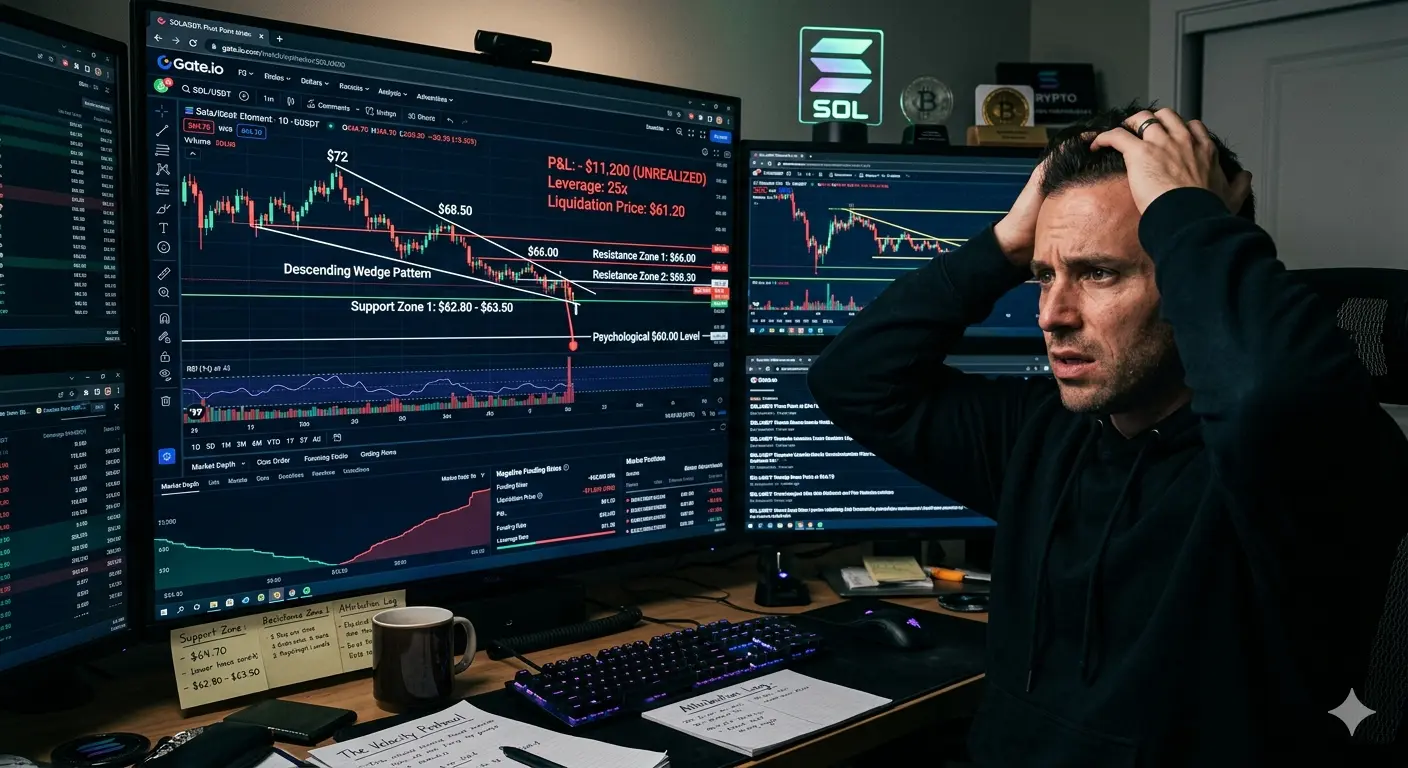
SOL had been dancing around the $64.70 level for days, and the technical picture was speaking clearly if you knew how to listen. The price action had formed a descending wedge pattern from the $72 rejection, with lower highs compressing against a stubborn support floor at $62.80. The 14-day RSI sat at 43, neither oversold nor overbought, but the funding rates on perpetuals told a different story—negative funding meant shorts were paying longs, a classic contrarian signal that smart money was positioning for upside.
My analysis identified three critical levels. Support Zone 1 sat at $62.80 to $63.50, a previous accumulation range that had held through three separate tests. Support Zone 2 was the psychological $60 level, reinforced by the 200-day moving average hovering at $60.40. Resistance Zone 1 waited at $66.00, the recent local high and a liquidity magnet. Resistance Zone 2 loomed at $68.50, where the descending trendline from the $72 peak would create a make-or-break decision point.
The forecast painted two scenarios. In the bullish case, a break above $66.00 with volume would target $68.50, then $70.00, with a stretch potential toward $72.50 if momentum caught. In the bearish case, a loss of $62.80 would accelerate toward $60.00, then $58.50, with a capitulation wick possible at $56.00.
I entered long at $64.70 with a clear plan: half position at market, half on a dip to $63.50 if it came. Stop loss at $62.20, just below Support Zone 1. Take profit targets at $66.00, $68.00, and $70.00, scaling out at each level.
The Trade: When Mathematics Meets Emotion
The entry was surgical. SOL had just bounced from $63.80, volume was climbing, and the 4-hour candle was printing a bullish engulfing pattern. I opened my position—$2,000 at 25x leverage, giving me $50,000 notional exposure. My liquidation sat at $61.20, a comfortable $3.50 buffer below my stop.
Within six hours, SOL punched through $66.00. I closed 30% of my position at $66.20, locking in $1,200 profit. The momentum felt unstoppable. By Friday morning, price had reached $68.40, and I closed another 40% at $68.20, adding $3,500 to my running total. I held the final 30%, trailing stop moved to breakeven, dreaming of $70.00 and beyond.
The trade was working perfectly. My technical analysis had identified the levels correctly. My execution had been disciplined. My risk management had protected my downside. I was proving that skill could triumph over chance.
The Velocity Distortion Effect
This is where I introduce the framework that now governs my every trade: the **Velocity Distortion Effect**. This is the psychological phenomenon where traders who capture high-velocity moves begin to confuse market momentum with personal mastery. The faster the price moves in your favor, the more your brain rewires to believe you caused the movement rather than merely participated in it.
The Velocity Distortion Effect operates on three levels. First, temporal compression: rapid gains feel like condensed expertise, making weeks of preparation feel like minutes of genius. Second, attribution error: successful outcomes are credited to skill while unsuccessful outcomes await their turn to be blamed on bad luck. Third, scale inflation: each successful trade recalibrates your acceptable position size upward, not because edge has improved, but because confidence has.
By Saturday morning, I was deep in the Velocity Distortion. SOL had pulled back to $67.00, and instead of respecting my trailing stop, I saw opportunity. The $70.00 target was still valid, I told myself. The fundamentals hadn't changed. The technical structure remained intact. I added to my position at $67.20, doubling my exposure. I moved my stop to $65.50, giving the trade room to breathe.
I had transformed from a trader executing a plan into a believer defending a thesis.
The Breakdown: When Support Becomes a Trap
Sunday brought the reversal I had refused to see. SOL broke below $66.00 with authority, then sliced through $65.00 like it wasn't there. My new stop at $65.50 triggered, but slippage on the weekend low liquidity filled me at $64.80. The position I had added was now underwater. Instead of accepting the loss, I averaged down at $64.50, convinced $62.80 would hold.
It didn't. SOL continued falling through $64.00, then $63.00, then crashed through Support Zone 1 at $62.80 like it was paper. I watched my unrealized loss balloon from $2,000 to $8,000 to $14,000. I didn't cut it. I couldn't. The Velocity Distortion had convinced me that my original analysis was so correct that even a $10,000 drawdown was just noise.
By the time I finally closed the position at $61.50, my original $5,700 profit had transformed into an $11,200 loss. The trade that should have defined my month had destroyed it.
The Rebuild: Escaping the Velocity Trap
Recovery required more than risk management—it demanded psychological architecture. I developed the **Velocity Protocol**, a systematic approach to neutralizing the Velocity Distortion Effect before it can take root.
The protocol has four pillars. First, the Speed Tax: any trade that reaches 50% of target profit within 24 hours triggers an automatic 50% position reduction, regardless of remaining upside potential. Speed kills because it breeds attachment. Second, the Attribution Log: before entering any trade after a winner, I must write 200 words distinguishing between market conditions I exploited and skills I demonstrated. Third, the Scale Freeze: position size cannot increase for seven days following any trade exceeding 20% returns. Fourth, the Reversal Rehearsal: before adding to any winning position, I must mentally rehearse closing the entire trade at a loss, feeling the emotional impact before committing capital.
These aren't trading rules. They are cognitive antibodies against the biases that winning activates.
The Technical Framework for SOL Traders
For traders watching SOL at current levels, here is the framework I wish I had followed. Support and resistance are not lines—they are zones of probability where order flow concentrates. At $64.70, SOL sits at a decision point. A sustained hold above $65.00 opens a path to $66.50 and potentially $68.00. A breakdown below $63.50 accelerates toward $61.00 and the critical $60.00 psychological level.
The entry strategy is patience. Wait for confirmation. A 4-hour close above $65.20 with volume above the 20-period average suggests bullish continuation. A rejection at $65.00 with bearish divergence on the RSI warns of downside. The forecast favors range-bound action between $62.00 and $68.00 until a catalyst emerges, but the path of least resistance remains tilted downward while SOL trades below the 50-day moving average at $68.50.
**HighAmbition** is not about capturing every move. It is about surviving to capture the moves that matter. The trader who understands this distinction builds wealth. The one who doesn't builds stories.
The Question
When your last trade moved fast in your favor, did you take profits—or did you take credit?
---
Current SOL Technical Summary for Traders:
Entry Zones: $63.50-$64.50 (support test), $65.20+ (breakout confirmation)
Stop Loss: $62.20 (below major support)
Target 1: $66.00 (local resistance)
Target 2: $68.00-$68.50 (trendline resistance)
Target 3: $70.00+ (momentum extension)
Risk Warning: SOL remains below key EMAs. Bearish sentiment dominates. Trade with reduced size until $68.50 is reclaimed.
*#MyGateTradeStory #SOL #SolanaTrading #CryptoTechnicalAnalysis #TradingPsychology*