BlockRider

vip
Age 1.3 Year
Peak Tier 0
No content yet
#TradFiCFDGoldMasters
TradFi CFD Gold Masters: Your Gateway to Professional Gold Trading
Gate has opened an exceptional opportunity for traders worldwide to become masters in gold trading through Contracts for Difference (CFD). This innovative platform allows traders to speculate on gold price movements without physically owning the precious metal, providing a professional and accessible pathway to financial success in the traditional finance markets.
Understanding TradFi CFD Trading
TradFi CFD stands for Traditional Finance Contracts for Difference, a sophisticated trading instrument that en
XAUUSD0.18%
XAGUSD0.98%
HighAmbition
#TradFiCFDGoldMasters
TradFi CFD Gold Masters: Your Gateway to Professional Gold Trading
Gate has opened an exceptional opportunity for traders worldwide to become masters in gold trading through Contracts for Difference (CFD). This innovative platform allows traders to speculate on gold price movements without physically owning the precious metal, providing a professional and accessible pathway to financial success in the traditional finance markets.
Understanding TradFi CFD Trading
TradFi CFD stands for Traditional Finance Contracts for Difference, a sophisticated trading instrument that enables traders to profit from price fluctuations in traditional financial assets. Unlike conventional trading where you purchase actual gold, CFD trading allows you to enter agreements based on the difference between the opening and closing prices of gold. This approach eliminates the complexities of physical storage, insurance, and security concerns associated with owning real gold bars or coins.
Gate TradFi contracts utilize USDx as the margin and settlement unit, creating a seamless bridge between cryptocurrency holdings and traditional financial markets. The platform offers leverage up to 500x for core products including gold and forex, providing traders with significant buying power while requiring only a fraction of the total position value as margin.
How to Start Trading Gold via TradFi CFD
Getting started with gold trading on Gate is straightforward and accessible. First, ensure you have the Gate App version 8.4.0 or above installed on your device. Open the application and navigate to the TradFi section through the bottom navigation bar, then select CFD to access the trading interface.
Upon entering the CFD trading page, you will need to agree to the trading protocol and open your CFD trading account. The next step involves funding your account by tapping the Transfer button at the top of the screen, which allows you to move funds from your main wallet to your dedicated CFD account instantly and without fees.
Once your account is funded, select the gold trading pair XAUUSD from the available traditional assets. This represents the international gold price quoted in US dollars. Choose your trading direction by selecting Buy if you anticipate gold prices will rise, or Sell if you expect prices to decline. Enter your desired trading amount and execute your order.
The Impact on Professional Traders
Gate TradFi CFD trading creates significant opportunities for experienced traders to expand their portfolios and diversify their strategies. The platform enables traders to access global markets 24 hours a day, five days a week, aligning with international gold market hours that span from Sydney to New York.
Professional traders benefit from the ability to apply both long and short strategies, allowing them to profit regardless of whether gold prices are rising or falling. This flexibility is particularly valuable during periods of market volatility when traditional buy-and-hold strategies may underperform.
The high leverage options available on Gate allow traders to control larger positions with smaller capital outlays, amplifying potential returns. However, this also requires disciplined risk management practices including the use of stop-loss orders and position sizing strategies to protect capital.
Becoming a Gold Master Through TradFi CFD
Gate provides numerous pathways for traders to achieve gold master status through its comprehensive trading ecosystem. The platform regularly hosts trading contests and promotional events specifically designed for gold and other precious metals trading.
Recent events have included the TradFi CFD Popular Assets Trading Contest, where participants could earn rewards up to 10,000 USDT per user based on their trading volume in gold, silver, and oil assets. First-time traders completing CFD trades of 1,000 USDT or more in eligible assets received 200 USDT CFD Position Vouchers, with limited availability for the first 2,000 qualified participants.
Cumulative trading tasks offered additional rewards based on volume milestones, ranging from 200 USDT vouchers for 200,000 USDT in trading volume up to 10,000 USDT vouchers for 200,000,000 USDT in cumulative volume. These incentives demonstrate Gate commitment to rewarding active and successful traders.
Advantages of Gate TradFi Platform
Gate stands out in the cryptocurrency exchange landscape by offering the most comprehensive TradFi product suite available. The platform integrates perpetual futures, CFDs, and tokenized assets across global indices, equities, forex, precious metals, and commodities within one unified account structure.
Traders benefit from competitive commission structures and transparent fee schedules that include trading commissions, overnight financing fees, and spreads. The platform emphasizes professional risk management tools including mandatory stop-loss features to help traders avoid liquidation during adverse market movements.
The mobile accessibility of Gate TradFi ensures that traders can monitor positions, execute trades, and manage their portfolios from anywhere in the world. This flexibility is essential for gold trading, where market conditions can change rapidly based on economic data releases, central bank decisions, and geopolitical events.
Risk Management and Best Practices
Successful gold trading through CFD requires disciplined risk management strategies. Professional traders on Gate utilize stop-loss orders to limit potential losses on each trade, ensuring that no single position can significantly impact their overall portfolio.
Position sizing is another critical consideration, with experienced traders typically risking only a small percentage of their account balance on any individual trade. This approach allows for sustainable trading over the long term, even during periods of increased market volatility.
Understanding market fundamentals that drive gold prices is essential for making informed trading decisions. Factors including interest rates, inflation expectations, currency movements, and geopolitical tensions all influence gold price dynamics and should be monitored regularly.
Conclusion
Gate TradFi CFD platform represents a significant advancement in making professional gold trading accessible to traders worldwide. By eliminating the barriers associated with physical gold ownership while maintaining exposure to price movements, the platform enables traders to pursue gold master status through sophisticated trading strategies.
The combination of high leverage options, comprehensive risk management tools, competitive fee structures, and regular promotional events creates an environment where dedicated traders can develop their skills and achieve their financial objectives. Whether you are an experienced trader seeking to diversify your portfolio or a newcomer interested in exploring gold trading, Gate provides the infrastructure and support necessary for success in the traditional finance markets.
Start your journey to becoming a TradFi CFD Gold Master today by downloading the Gate App and exploring the opportunities available in professional gold trading.
@Gate_Square #MyGateTradeStory

repost-content-media
  • Reward
  • Comment
  • Repost
  • Share
#MarvellSurgesOver11%LeadingChipSectorWithAI
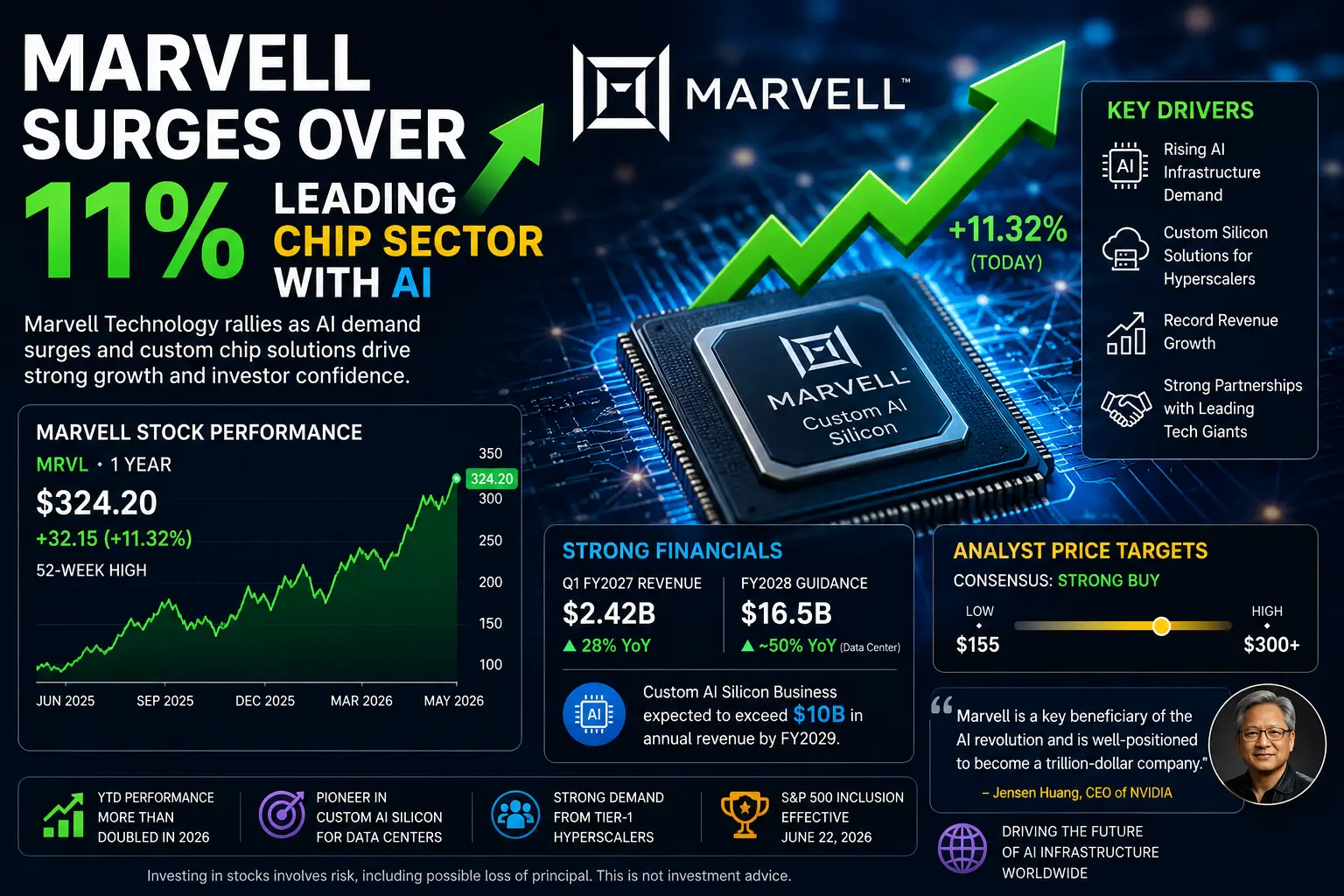
Marvell Technology has emerged as one of the most talked-about stocks in the semiconductor sector, with its shares experiencing remarkable momentum throughout 2026. The company has positioned itself at the forefront of the artificial intelligence revolution, and this strategic positioning has translated into extraordinary price performance that has captured the attention of traders and investors worldwide.
Understanding the 11% Surge and Broader Rally
The recent surge in Marvell stock represents more than just a single-day movement. The company has
HighAmbition
#MarvellSurgesOver11%LeadingChipSectorWithAI
Marvell Technology has emerged as one of the most talked-about stocks in the semiconductor sector, with its shares experiencing remarkable momentum throughout 2026. The company has positioned itself at the forefront of the artificial intelligence revolution, and this strategic positioning has translated into extraordinary price performance that has captured the attention of traders and investors worldwide.
Understanding the 11% Surge and Broader Rally
The recent surge in Marvell stock represents more than just a single-day movement. The company has witnessed an extraordinary year-to-date performance, with shares more than doubling in value during 2026. This remarkable ascent reached new heights when Nvidia CEO Jensen Huang publicly endorsed Marvell at Computex 2026, calling it the next trillion-dollar company. This endorsement triggered a massive rally, with the stock gaining approximately 32% in a short period following the statement.
The fundamental driver behind this surge is Marvell's strategic positioning in the custom AI silicon market. Unlike traditional semiconductor companies that focus on general-purpose processors, Marvell has carved out a specialized niche in custom ASICs designed specifically for AI data centers. This positioning has become increasingly valuable as hyperscalers seek optimized solutions for their massive AI infrastructure investments.
Core Business Fundamentals and AI Opportunity
Marvell's transformation from a broad-based analog and mixed-signal semiconductor company to a core enabler of AI infrastructure represents a fundamental shift in its business model. The company's data center segment now accounts for more than three-quarters of total revenue, reflecting successful execution of its AI-focused strategy.
In its fiscal first quarter of 2027, Marvell reported record revenue of $2.42 billion, representing a 28% year-over-year increase. This growth was primarily driven by the data center segment, which continues to benefit from the massive buildout of AI infrastructure by major technology companies. The company has guided for fiscal year 2028 revenue approaching $16.5 billion, with data center revenue expected to grow close to 50% year-over-year.
The custom silicon opportunity represents a multi-billion dollar addressable market. Marvell's ASIC programs with major hyperscalers are ramping rapidly, and the company expects its custom AI silicon business to exceed $10 billion in annual revenue by fiscal year 2029. This growth trajectory is supported by design wins with tier-one customers who are actively building custom silicon solutions for their AI workloads.
Technical Analysis: Support and Resistance Levels
From a technical perspective, Marvell stock has entered a phase of heightened volatility following its rapid ascent. The stock has established a new trading range between $280 and $325, with the recent 52-week high of $324.20 serving as immediate resistance. The psychological $300 level has provided support during recent consolidation phases.
Analysts have identified several key technical levels for traders to monitor. The $280 level represents near-term support, with stronger support expected around $250 based on previous consolidation zones. On the upside, a breakout above $325 could open the path toward $350 and potentially $400, though such moves would require sustained momentum in the AI sector.
The stock's relative strength index has moved into overbought territory following the recent surge, suggesting potential for short-term consolidation. However, the underlying trend remains strongly bullish, supported by fundamental growth in the AI infrastructure market.
Analyst Price Targets and Wall Street Sentiment
Wall Street remains overwhelmingly bullish on Marvell, with the consensus rating standing at Strong Buy. The average analyst price target has been continuously revised upward as the company demonstrates execution on its AI strategy. Recent analyst actions have seen price targets raised to $300 and beyond, with some analysts projecting even higher valuations based on the company's growth trajectory.
The analyst community has been playing catch-up with the stock's rapid appreciation. As of the most recent updates, price targets range from approximately $155 to over $300, reflecting the wide range of views on the company's valuation and growth potential. The forward price-to-earnings ratio of 65 reflects premium valuation, though this is justified by the company's positioning in the high-growth AI market.
Impact on Traders and Market Sentiment
The Marvell surge has had significant implications for traders across multiple asset classes. For equity traders, the stock has become a bellwether for AI infrastructure sentiment, with movements in MRVL often leading broader semiconductor sector performance. Options traders have noted elevated implied volatility, with the options market pricing in approximately 13.5% moves around earnings events, significantly higher than historical averages.
The stock's inclusion in the S&P 500 index, effective June 22, 2026, has created additional demand from passive index funds and ETFs. This inclusion triggered an immediate 9% pre-market jump, demonstrating the impact of institutional flows on the stock price.
Cryptocurrency Market Correlation and Impact
The relationship between AI chip stocks and cryptocurrency markets has become increasingly relevant for traders. While traditional correlations between semiconductor stocks and digital assets have been limited, the current market environment shows interesting dynamics. The massive capital flows into AI infrastructure stocks have created a rotation effect, with some investors reallocating from cryptocurrency positions to participate in the AI boom.
Reuters data indicates that while semiconductor stocks have surged approximately 170% over the past year, Bitcoin has experienced a 40% decline, suggesting a potential shift in risk appetite toward AI-related equities. However, this relationship is not purely inverse, as both sectors benefit from broader technology adoption trends.
Bitcoin mining companies have actually outperformed despite cryptocurrency price weakness, as these firms pivot toward AI data center opportunities. Nearly $90 billion in AI partnerships have been signed by mining companies, with Bernstein projecting the sector's AI revenue to grow ninefold by 2030. This trend suggests that the AI infrastructure boom may ultimately benefit cryptocurrency markets through shared infrastructure and technology advances.
Trading Strategy Considerations
For traders considering Marvell positions, several strategic approaches merit consideration. Momentum traders may look for breakout entries above the $325 resistance level, with targets extending toward $350 and $400. However, given the stock's extended valuation and overbought technical conditions, risk management becomes paramount.
Swing traders might consider waiting for pullbacks to the $280-$300 support zone before establishing long positions. This approach allows for better risk-reward ratios while maintaining exposure to the AI growth theme.
Options strategies could include selling covered calls against existing positions to generate income from elevated implied volatility, or purchasing protective puts to hedge downside risk during potential consolidation phases.
Future Outlook and Key Catalysts
Looking ahead, Marvell's trajectory will be influenced by several key factors. The company's ability to execute on its custom ASIC programs with hyperscalers remains critical. Any announcements regarding new design wins or expansions of existing programs could serve as catalysts for further price appreciation.
The broader AI infrastructure spending environment will also play a significant role. As hyperscalers continue their massive data center buildouts, demand for Marvell's connectivity and custom silicon solutions should remain robust. However, any signs of slowing AI capital expenditure could pressure the stock.
Competitive dynamics in the custom silicon market warrant monitoring. While Marvell has established strong positions with key customers, competition from other semiconductor companies and in-house silicon development by hyperscalers could impact long-term growth prospects.
Risk Factors and Considerations
Despite the bullish outlook, several risks warrant consideration. The stock's valuation has expanded significantly, with trailing price-to-earnings ratios exceeding 90 and price-to-sales ratios above 25. This elevated valuation leaves limited room for execution missteps or changes in market sentiment toward AI stocks.
Customer concentration represents another risk factor, with a significant portion of revenue coming from a limited number of large hyperscale customers. Any changes in these relationships or shifts in their silicon strategies could materially impact Marvell's results.
The semiconductor industry remains cyclical, and while AI demand appears structural, macroeconomic factors could influence capital spending patterns. Rising interest rates and inflation concerns have already contributed to volatility in growth stocks, and Marvell would not be immune to broader market pressures.
Conclusion
Marvell Technology represents a compelling case study in how strategic positioning within the AI revolution can drive extraordinary shareholder returns. The company's focus on custom silicon for AI data centers has positioned it at the center of one of the most significant technology infrastructure buildouts in history. While the stock's rapid appreciation has created valuation concerns, the underlying growth trajectory remains intact supported by multi-billion dollar opportunities with tier-one customers.
For traders and investors, Marvell offers exposure to the AI infrastructure theme through a specialized player with established relationships and proven execution. However, the elevated valuation and technical conditions suggest that careful risk management and selective entry points will be essential for success. The stock's future performance will depend on continued execution of its growth strategy and the sustained expansion of AI infrastructure investment by the world's largest technology companies.
The broader implications extend beyond individual stock performance, as Marvell's success reflects the transformative impact of AI on the semiconductor industry and the technology sector as a whole. As this transformation continues, companies that successfully navigate the shift toward AI-optimized solutions will likely remain at the forefront of investor attention and market performance.
@Gate_Square #MyGateTradeStory
repost-content-media
  • Reward
  • 1
  • Repost
  • Share
HighAmbition:
good information 👍👍
#USPPIHits2.5YearHigh
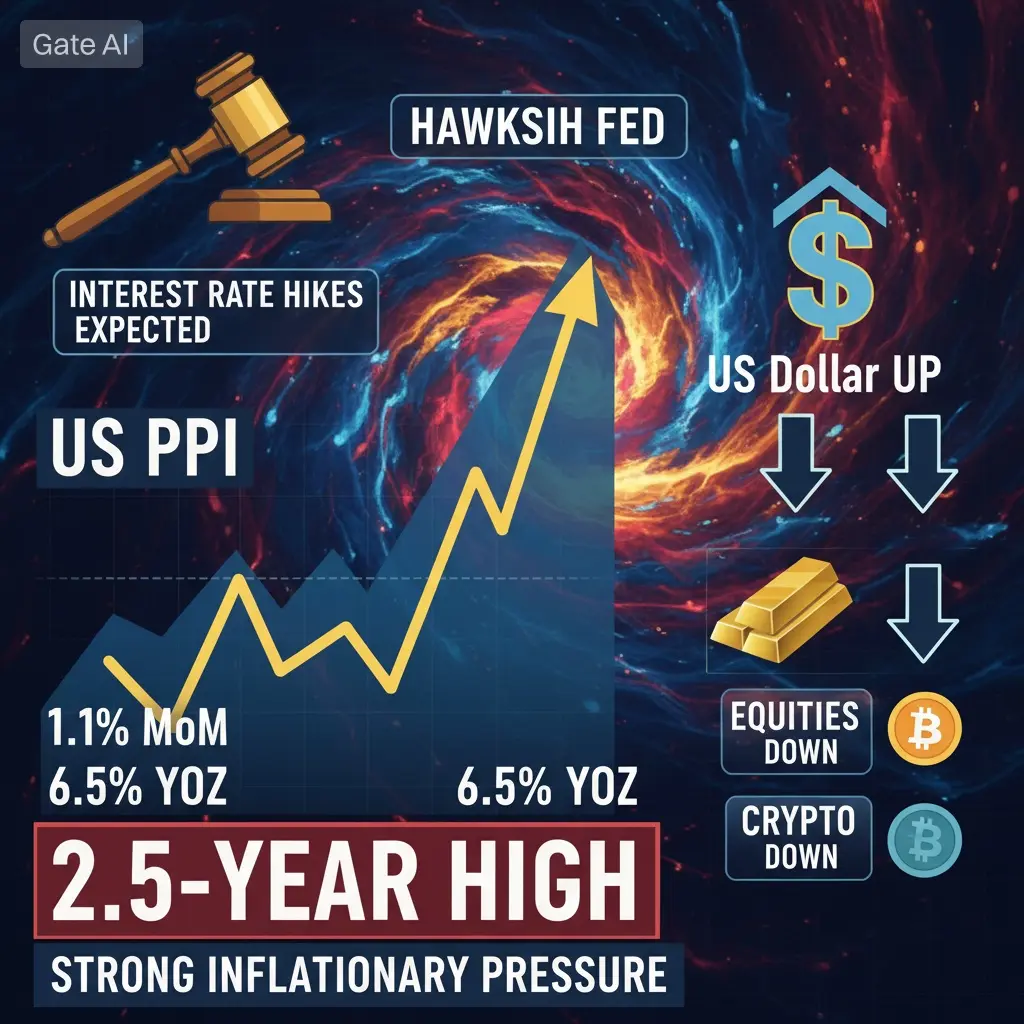
The United States Producer Price Index (PPI) has surged to its highest level in two and a half years, sending shockwaves through global financial markets. According to the latest data from the Bureau of Labor Statistics released on June 11, 2026, the headline PPI rose by 1.1% in May, pushing the annual inflation rate to 6.5%, the highest since November 2022. This significant development has far-reaching implications for Federal Reserve policy, currency markets, precious metals, equities, and the cryptocurrency sector.
Understanding the Producer Price Index
The Producer P
HighAmbition
#USPPIHits2.5YearHigh
The United States Producer Price Index (PPI) has surged to its highest level in two and a half years, sending shockwaves through global financial markets. According to the latest data from the Bureau of Labor Statistics released on June 11, 2026, the headline PPI rose by 1.1% in May, pushing the annual inflation rate to 6.5%, the highest since November 2022. This significant development has far-reaching implications for Federal Reserve policy, currency markets, precious metals, equities, and the cryptocurrency sector.
Understanding the Producer Price Index
The Producer Price Index serves as a critical economic indicator that measures the average change over time in the selling prices received by domestic producers for their output. Unlike the Consumer Price Index (CPI) which tracks prices paid by consumers, the PPI captures inflation at the production level, making it a leading indicator of future consumer price trends. When producer costs increase substantially, businesses typically pass these additional expenses to consumers, creating a ripple effect throughout the economy.
The May 2026 PPI report revealed particularly concerning trends. Energy prices surged by 10.7% year-over-year, while gasoline costs spiked by an alarming 23.4%. Core PPI, which excludes volatile food and energy components, rose by 0.4% monthly. The transportation and warehousing sector experienced a 2.6% increase, while unprocessed goods jumped by 4.9%. These figures suggest that inflationary pressures are building across multiple sectors of the economy.
Impact on Federal Reserve Interest Rate Policy
The hotter-than-expected PPI data has significantly altered market expectations regarding Federal Reserve monetary policy. Previously, investors had anticipated potential rate cuts later in 2026. However, the latest inflation readings have shifted sentiment dramatically. According to the CME FedWatch tool, markets are now pricing in a 43.2% probability of 25 basis points in rate hikes by year-end, rather than cuts.
Federal Reserve Chair Kevin Warsh, who recently assumed leadership, faces a challenging policy environment. The central bank must balance controlling inflation against supporting economic growth. With PPI at 6.5% and CPI at 4.2%, both significantly above the Fed's 2% target, the pressure to maintain restrictive monetary policy has intensified. The Federal Reserve's next meeting will be crucial in determining the trajectory of interest rates for the remainder of 2026.
Impact on the US Dollar
The US Dollar Index (DXY) has experienced heightened volatility following the PPI release. Higher inflation typically supports dollar strength as it reduces the likelihood of aggressive rate cuts. However, the situation remains complex. If the Federal Reserve is forced to raise rates further to combat inflation, the dollar could strengthen significantly against major currencies including the Euro, Japanese Yen, and British Pound.
Currency traders are closely monitoring the dollar's reaction to inflation data. A stronger dollar generally makes American exports more expensive and imports cheaper, potentially widening the trade deficit. Conversely, if inflation concerns trigger risk-off sentiment in global markets, the dollar's safe-haven status could drive additional appreciation.
Impact on Gold Prices
Gold has experienced significant pressure following the PPI announcement. The precious metal, traditionally viewed as an inflation hedge, has paradoxically declined as rising inflation expectations have increased real yields and strengthened the dollar. Gold prices dropped from recent highs above $4,600 per ounce to approximately $4,083, representing a decline of roughly 12% over nine trading sessions.
The relationship between gold and inflation has become complicated in the current environment. While inflation typically supports gold prices, the prospect of higher interest rates and a stronger dollar has created headwinds. Additionally, geopolitical tensions in the Middle East, particularly the conflict involving Iran and potential disruptions to oil shipments through the Strait of Hormuz, have added volatility to precious metals markets.
Analysts at Kitco note that gold is testing critical support levels around $4,000 per ounce. If this level fails to hold, further declines toward $3,800 could materialize. However, some market participants view the current weakness as a potential buying opportunity, anticipating that sustained inflation will eventually drive renewed interest in gold as a store of value.
Impact on Stock Markets
Equity markets have reacted negatively to the elevated PPI readings. The S&P 500 and other major indices have faced selling pressure as investors recalibrate expectations for corporate earnings and economic growth. Higher producer costs squeeze profit margins for businesses, particularly in sectors with limited pricing power.
Technology stocks, which are sensitive to interest rate expectations, have experienced notable weakness. The prospect of higher rates for longer reduces the present value of future earnings, disproportionately affecting growth companies. Financial stocks have shown mixed performance, with banks potentially benefiting from higher interest margins but facing concerns about loan quality in an inflationary environment.
Energy sector stocks have outperformed relative to the broader market, benefiting from elevated oil and gas prices. However, the overall market sentiment remains cautious as investors await further clarity on Federal Reserve policy direction.
Impact on Cryptocurrency Markets
The cryptocurrency market has faced significant headwinds following the PPI release. Bitcoin, the largest cryptocurrency by market capitalization, has declined from levels above $66,000 to approximately $63,500, representing a weekly decline of nearly 7%. Ethereum has experienced even more pronounced weakness, falling from above $2,000 to around $1,670, a decline of approximately 17% from recent highs.
The total cryptocurrency market capitalization has contracted to approximately $3.31 trillion, reflecting a 2% decline over the past day. Liquidation data reveals substantial forced selling, with Ethereum leading at $40 million in liquidations followed by Bitcoin at $32 million.
Several factors are driving the crypto market weakness. First, higher inflation and the prospect of continued restrictive monetary policy reduce the attractiveness of risk assets. Cryptocurrencies, being among the most speculative investments, typically suffer during periods of tightening financial conditions. Second, the strengthening dollar creates additional pressure on dollar-denominated crypto assets.
Current market prices as of June 12, 2026, show Bitcoin trading at approximately $63,550, Ethereum at $1,671, and Gold at $4,083 per ounce. These levels represent significant declines from recent peaks and reflect the market's reassessment of inflation and monetary policy trajectories.
The relationship between inflation and cryptocurrencies remains complex. While some investors view Bitcoin as a digital gold and inflation hedge, the asset has increasingly traded in correlation with technology stocks and risk assets. During the current inflationary episode, cryptocurrencies have not provided the protection that some proponents anticipated.
Geopolitical factors add another layer of complexity. The ongoing tensions between the United States and Iran, including threats to oil infrastructure and potential disruptions to global energy supplies, have created additional uncertainty. While such geopolitical risks might typically support safe-haven assets, the dominant narrative around inflation and interest rates has overshadowed these considerations.
Market liquidity conditions have also deteriorated. Trading volumes across major cryptocurrency exchanges have declined as institutional investors reduce exposure to risk assets. The combined stablecoin dominance, while remaining elevated, has shown signs of stress as market participants seek safety in dollar-denominated assets.
Looking ahead, cryptocurrency markets will remain sensitive to macroeconomic data releases. The upcoming Federal Reserve meeting will be particularly critical in determining near-term price direction. If the central bank signals a more hawkish stance, additional downside pressure on crypto assets could materialize. Conversely, any indication that inflation is peaking could trigger a relief rally.
Conclusion
The US PPI hitting a 2.5-year high represents a significant inflection point for financial markets. The data suggests that inflationary pressures remain persistent and are likely to influence Federal Reserve policy decisions in the coming months. For investors across asset classes, the implications are substantial.
Currency markets face the prospect of a stronger dollar if the Fed maintains or increases rates. Gold, despite its traditional role as an inflation hedge, has suffered from rising real yields and dollar strength. Equity markets must navigate the challenges of higher input costs and potentially slower growth. Cryptocurrency markets, already under pressure from various factors, face additional headwinds from restrictive monetary policy expectations.
The interconnected nature of these markets means that developments in one area quickly transmit to others. As investors reassess their portfolios in light of the new inflation reality, volatility across asset classes is likely to persist. The coming weeks will be critical in determining whether the current inflation surge represents a temporary spike or a more sustained trend requiring significant policy adjustments.
For market participants, the key takeaway is that the inflation narrative has shifted decisively. The era of easy monetary policy that supported asset prices across the board appears to be giving way to a more challenging environment characterized by higher rates, stronger currencies, and increased selectivity in risk-taking. Those who adapt their strategies to this new reality will be best positioned to navigate the evolving market landscape.
@Gate_Square #MyGateTradeStory

repost-content-media
  • Reward
  • Comment
  • Repost
  • Share
#USMayCPIHits3YearHigh
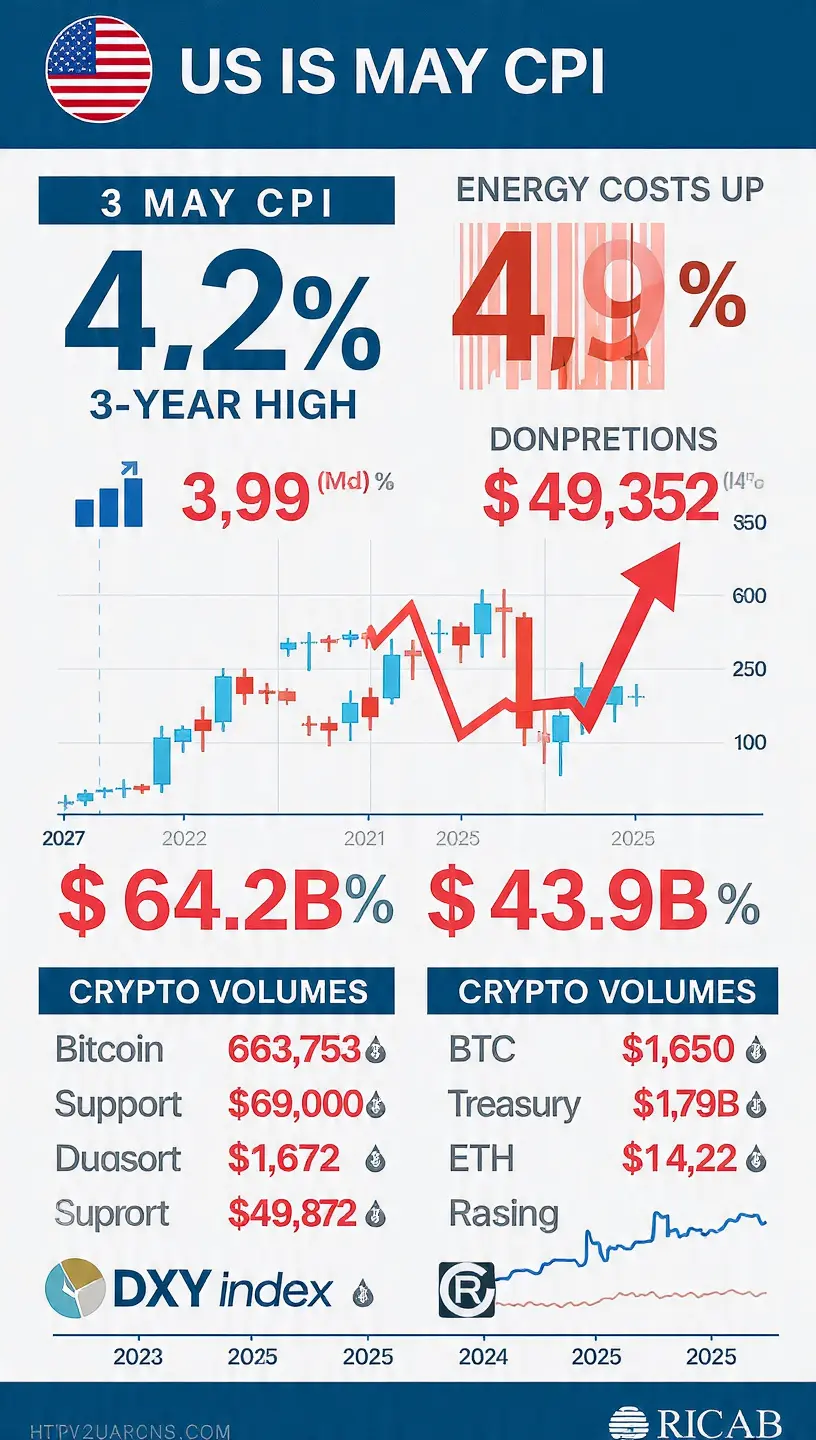
The United States Consumer Price Index for May 2026 has surged to a three-year high of 4.2% year-over-year, marking the highest inflation reading since April 2023. This significant economic development carries profound implications across multiple asset classes, with particular attention required for cryptocurrency markets that have already experienced substantial volatility in recent weeks.
Understanding the CPI Surge
The Consumer Price Index serves as the primary gauge of inflation, measuring the average change in prices over time that consumers pay for a basket of go
HighAmbition
#USMayCPIHits3YearHigh
The United States Consumer Price Index for May 2026 has surged to a three-year high of 4.2% year-over-year, marking the highest inflation reading since April 2023. This significant economic development carries profound implications across multiple asset classes, with particular attention required for cryptocurrency markets that have already experienced substantial volatility in recent weeks.
Understanding the CPI Surge
The Consumer Price Index serves as the primary gauge of inflation, measuring the average change in prices over time that consumers pay for a basket of goods and services. The May 2026 reading of 4.2% represents a notable acceleration from April's 3.8% and substantially exceeds the Federal Reserve's long-term target of 2%. This inflationary pressure stems primarily from escalating energy costs, with the Middle East conflict driving gasoline and related energy product prices upward. Energy goods prices jumped 3.9% in May alone, accounting for more than 60% of the monthly CPI increase.
The core CPI, which excludes volatile food and energy components, rose 0.2% month-over-month, slightly below expectations. However, the headline figure remains deeply concerning for monetary policymakers who have battled elevated inflation for over five years. The current inflation rate is roughly double the Fed's target, creating significant challenges for the central bank's policy trajectory.
Federal Reserve Policy Implications
The elevated CPI reading substantially complicates the Federal Reserve's monetary policy calculus. With inflation accelerating rather than moderating, the probability of interest rate cuts in the near term has diminished considerably. Market participants now anticipate the Fed may maintain current interest rate levels well into 2027, with some analysts even suggesting the possibility of rate hikes if inflationary pressures persist.
Higher interest rates typically strengthen the US dollar as foreign investors seek yield in dollar-denominated assets. A stronger dollar creates headwinds for risk assets, including cryptocurrencies, as it reduces the relative attractiveness of alternative investments and tightens global liquidity conditions.
Cryptocurrency Market Analysis
Bitcoin and Ethereum have demonstrated significant vulnerability to macroeconomic developments in recent weeks. Current market data reveals Bitcoin trading around $63,753, representing a recovery from recent lows near $59,000 but still substantially below previous highs above $80,000. Ethereum currently trades near $1,672, having recovered from lows around $1,500 but facing continued pressure.
The cryptocurrency market has experienced a severe correction, with Bitcoin declining approximately 23% from its January 2026 peak above $82,000. Ethereum has faced even more pronounced weakness, falling roughly 44% from highs above $2,400 to current levels. This bearish price action reflects deteriorating risk sentiment and concerns about tightening liquidity conditions.
Impact Assessment Across Market Segments
Bitcoin Price Dynamics
Bitcoin's price action demonstrates clear sensitivity to macroeconomic developments. The cryptocurrency has formed a bearish pennant pattern on daily charts, with key support now established around $61,000. A breakdown below this level could trigger further downside toward $49,000. The RSI indicator has fallen into oversold territory below 25, suggesting potential for technical bounces, though the broader trend structure remains bearish.
Current trading volume for Bitcoin futures exceeds $4.2 billion in daily quoted volume, with significant participation in perpetual contracts. The 24-hour price change shows modest recovery of approximately 0.45%, though this comes within a broader downtrend context.
Ethereum Performance
Ethereum has exhibited even greater volatility than Bitcoin, with sharper declines and more pronounced weakness in technical indicators. The cryptocurrency has broken below multiple support levels and faces ongoing pressure from bearish momentum indicators. Current daily trading volume exceeds $3.9 billion, reflecting sustained market interest despite declining prices.
Altcoin Sector
The broader altcoin market has experienced severe pressure as Bitcoin dominance increases. Total cryptocurrency market capitalization excluding Bitcoin and Ethereum remains under significant strain, with technical indicators suggesting continued downside risk. Stablecoin dominance has risen substantially, indicating risk-off positioning among market participants.
Liquidity and Volume Analysis
Cryptocurrency markets have maintained substantial trading volumes despite price declines, suggesting active repositioning by institutional and retail participants. Bitcoin daily trading volumes consistently exceed $4 billion across major exchanges, while Ethereum volumes regularly surpass $3.5 billion. This elevated volume during price declines indicates distribution rather than accumulation patterns.
Open interest in cryptocurrency derivatives has remained elevated, suggesting continued speculation and hedging activity. Funding rates have turned negative in recent sessions, reflecting bearish sentiment among perpetual futures traders.
Macroeconomic Correlation
The correlation between cryptocurrency prices and traditional macroeconomic indicators has strengthened significantly in 2026. Bitcoin and Ethereum now demonstrate clear sensitivity to Federal Reserve policy expectations, inflation readings, and dollar strength. This increased correlation reduces the diversification benefits historically associated with cryptocurrency investments.
The US Dollar Index has maintained a strong bullish trajectory, pressing toward key resistance levels. This dollar strength creates additional headwinds for dollar-denominated risk assets, including cryptocurrencies. Treasury yields have risen in response to inflation concerns, further tightening financial conditions.
Risk Assessment and Outlook
The current market environment presents elevated risks for cryptocurrency investors. The combination of persistent inflation, hawkish Federal Reserve policy, and dollar strength creates a challenging macroeconomic backdrop. Technical indicators suggest continued downside risk, with key support levels vulnerable to breakdown.
Potential Downside Scenarios
Should inflation remain elevated and the Federal Reserve maintain restrictive policy, cryptocurrency prices could face additional pressure. Bitcoin support at $61,000 represents a critical level; failure to hold this zone could trigger accelerated selling toward $49,000. Ethereum faces similar risks, with support near $1,650 representing a key technical level.
Recovery Catalysts
Potential catalysts for recovery include evidence of moderating inflation, dovish shifts in Federal Reserve rhetoric, or resolution of geopolitical tensions affecting energy markets. Additionally, institutional adoption developments and regulatory clarity could provide fundamental support for cryptocurrency valuations.
Trading Strategy Considerations
In the current environment, risk management assumes paramount importance. Traders should consider reduced position sizes, wider stop-loss placements, and heightened awareness of correlation risks. Dollar-cost averaging strategies may suit long-term investors, while active traders should remain attentive to macroeconomic calendar events and Federal Reserve communications.
The elevated CPI reading and its implications for monetary policy suggest continued volatility in cryptocurrency markets. Participants should maintain flexible positioning and remain prepared for rapid shifts in market sentiment as new economic data emerges.
Conclusion
The May 2026 CPI reading represents a significant inflection point for financial markets, with clear negative implications for cryptocurrency valuations in the near term. The combination of accelerating inflation, restrictive monetary policy, and dollar strength creates a challenging environment for risk assets. Bitcoin and Ethereum have already experienced substantial corrections, and technical indicators suggest continued vulnerability.
Market participants should closely monitor upcoming economic data releases, Federal Reserve communications, and developments in the Middle East conflict that could influence energy prices and inflation expectations. The current environment demands cautious positioning and robust risk management as markets navigate this period of elevated uncertainty and volatility.@Gate_Square #MyGateTradeStory

repost-content-media
  • Reward
  • Comment
  • Repost
  • Share
#BitmineAddsAnother25KEther
BitMine Immersion Technologies (BMNR), the Ethereum treasury company chaired by renowned crypto analyst Tom Lee, has once again made headlines with its aggressive accumulation strategy. The company recently added another 25,000 ETH to its already massive holdings, bringing its total Ethereum reserves to approximately 5.54 million ETH. This move represents a significant milestone in BitMine's ambitious "Alchemy of 5%" strategy, which aims to acquire 5% of Ethereum's total circulating supply.
BitMine's Current ETH Holdings and Historical Context
Before this latest pu
HighAmbition
#BitmineAddsAnother25KEther
BitMine Immersion Technologies (BMNR), the Ethereum treasury company chaired by renowned crypto analyst Tom Lee, has once again made headlines with its aggressive accumulation strategy. The company recently added another 25,000 ETH to its already massive holdings, bringing its total Ethereum reserves to approximately 5.54 million ETH. This move represents a significant milestone in BitMine's ambitious "Alchemy of 5%" strategy, which aims to acquire 5% of Ethereum's total circulating supply.
BitMine's Current ETH Holdings and Historical Context
Before this latest purchase, BitMine held approximately 5.52 million ETH. The addition of 25,000 ETH brings the company's total holdings to roughly 5.54 million ETH, representing approximately 4.59% of Ethereum's total circulating supply. This positions BitMine as the world's largest Ethereum treasury company and places it just 0.41% away from achieving its ambitious 5% ownership target. The company has been remarkably consistent in its accumulation strategy, having purchased over 125,000 ETH in just three days during early June 2026, demonstrating an unwavering commitment to its long-term vision.
BitMine's treasury strategy has evolved significantly over the past year. What began as a modest accumulation plan has transformed into one of the most aggressive corporate cryptocurrency adoption strategies in history. The company has successfully positioned itself as a proxy for Ethereum investment on traditional stock markets, with its NYSE listing providing institutional investors with regulated exposure to ETH price movements. This unique positioning has made BMNR one of the most actively traded stocks in the United States, with daily trading volumes frequently exceeding $3.5 billion.
Impact of the 25,000 ETH Purchase on BitMine (BMNR)
The recent 25,000 ETH acquisition, valued at approximately $41 million at current prices, has several implications for BitMine as a company. First and foremost, it strengthens the company's asset base and enhances its position as the premier Ethereum treasury play in the public markets. With total crypto and cash holdings now exceeding $9.6 billion, BitMine has established itself as a formidable force in the digital asset space.
From a corporate valuation perspective, each ETH purchase directly impacts BitMine's net asset value (NAV). Given that the company trades at a premium to its underlying ETH holdings, the consistent accumulation strategy reinforces investor confidence in the company's long-term vision. The fact that BitMine has been able to fund these purchases through a combination of equity offerings and operational cash flows demonstrates strong market support for its strategy.
Furthermore, BitMine has staked approximately 4.71 million of its ETH holdings, generating passive income through Ethereum's proof-of-stake consensus mechanism. This staking strategy provides the company with additional revenue streams while maintaining its long-term holdings. At current staking yields, this represents a significant annual income source that helps offset operational costs and provides additional value to shareholders.
Market Impact and ETH Demand Dynamics
The addition of 25,000 ETH to BitMine's treasury has tangible implications for Ethereum's market dynamics. When a single entity consistently removes substantial amounts of ETH from circulation, it creates supply pressure that can influence price action. BitMine's accumulation represents a persistent demand source that absorbs sell pressure from other market participants.
Currently, Ethereum's circulating supply stands at approximately 120.5 million ETH. BitMine's holdings of 5.54 million ETH represent a significant portion of the liquid supply, particularly when considering that a substantial percentage of ETH is locked in staking contracts, DeFi protocols, and long-term holder wallets. This concentration of supply in the hands of a single institutional buyer reduces the available float and can amplify price movements during periods of increased demand.
The psychological impact of BitMine's accumulation strategy should not be underestimated. As one of the most visible institutional ETH buyers, BitMine's continued purchases send a strong signal to the market about institutional confidence in Ethereum's long-term prospects. This can influence other institutional investors and retail participants to reconsider their ETH positions, potentially creating a self-reinforcing cycle of positive sentiment.
ETH Price Analysis and Future Outlook
Ethereum is currently trading around $1,669, having faced significant downward pressure in recent months. The price has declined approximately 65% from its all-time high of nearly $5,000 reached in August 2025. This correction has occurred within what BitMine Chairman Tom Lee describes as a "mini crypto winter" rather than a full bear market cycle.
From a technical analysis perspective, Ethereum is currently testing critical support levels around $1,650 to $1,700. The price action has formed a bearish pennant pattern, which typically resolves with a continuation of the prior trend. However, several analysts note that the current price levels may represent a capitulation bottom, with the potential for a significant reversal if key resistance levels are reclaimed.
Tom Lee has provided several price targets for Ethereum based on different scenarios. His conservative base case suggests ETH could reach $7,000 to $14,000 by the end of 2026, driven by continued institutional adoption and the growth of tokenized assets on the Ethereum network. In a more bullish scenario, Lee has suggested Ethereum could eventually reach $60,000 or even $250,000 in the long term, assuming Ethereum becomes the primary settlement layer for AI-driven transactions and tokenized securities.
Standard Chartered analyst Geoff Kendrick has also expressed optimism about Ethereum's prospects, predicting ETH could reach $40,000 by the end of the decade while Bitcoin potentially climbs to $500,000. This outlook is based on Ethereum's fundamental role in the emerging tokenized asset economy and its position as the leading smart contract platform.
Trading Strategy and Risk Management
For traders and investors considering ETH positions, the current market environment presents both opportunities and risks. The following strategic considerations may be relevant:
Accumulation Strategy: Dollar-cost averaging into ETH positions at current levels may be appropriate for long-term investors who believe in Ethereum's fundamental value proposition. The significant discount from all-time highs provides a favorable entry point for patient capital.
Support and Resistance Levels: Key support exists around $1,650, with a breakdown below this level potentially opening the door to further downside toward $1,500 or lower. On the upside, reclaiming $1,700 would be the first bullish signal, with $2,000 representing a major psychological resistance level.
Risk Management: Given the current bearish technical structure, position sizing should reflect the elevated volatility and downside risk. Stop-loss orders below key support levels can help protect capital in case of further declines.
Diversification: While ETH presents compelling long-term opportunities, maintaining a diversified portfolio across multiple asset classes remains prudent risk management practice.
BitMine's Strategic Vision and Market Position
BitMine's aggressive ETH accumulation strategy reflects Chairman Tom Lee's conviction that Ethereum represents the most important financial infrastructure of the coming decade. The company's "Alchemy of 5%" strategy is predicated on several key theses:
Tokenization Revolution: Lee believes Ethereum will become the primary settlement layer for tokenized real-world assets, potentially representing trillions of dollars in value.
AI-Driven Transactions: As artificial intelligence agents increasingly require automated payment systems, Ethereum's programmable money capabilities position it as the ideal infrastructure layer.
Institutional Adoption: The continued growth of ETH ETFs and institutional investment products will drive sustained demand for Ethereum as an asset class.
Network Effects: Ethereum's dominant position in smart contract platforms creates powerful network effects that reinforce its long-term value proposition.
Conclusion
BitMine's addition of 25,000 ETH to its treasury represents another step toward the company's ambitious goal of owning 5% of Ethereum's circulating supply. This accumulation has meaningful implications for both BitMine as a company and the broader Ethereum market. The persistent institutional demand created by BitMine's strategy provides a floor for ETH prices and signals strong confidence in Ethereum's long-term prospects.
While current market conditions remain challenging, with ETH trading significantly below its all-time highs, the fundamental case for Ethereum remains compelling. BitMine's continued accumulation, combined with growing institutional adoption and the expansion of tokenized assets, suggests that the current price levels may represent an attractive entry point for long-term investors.
Traders should remain cognizant of the technical risks in the short term, with key support levels needing to hold to prevent further downside. However, for those with a multi-year investment horizon, the confluence of institutional buying, technological development, and expanding use cases provides a strong foundation for optimism about Ethereum's future price appreciation.
The coming months will be critical in determining whether the current "mini crypto winter" gives way to a new bull market phase. BitMine's continued accumulation suggests that at least one major market participant believes the bottom is near and the next phase of Ethereum's growth story is about to begin.
@Gate_Square
repost-content-media
  • Reward
  • Comment
  • Repost
  • Share
#GateLaunchesHongKongStockTrading
Gate has officially launched Hong Kong stock trading, marking another significant milestone in the platform's evolution from a cryptocurrency exchange to a comprehensive global financial services provider. Following the successful introduction of US stock trading, Gate has now expanded its TradFi offerings to include Hong Kong-listed securities, enabling users to access one of Asia's most dynamic and influential financial markets.
Gate has transcended its origins as a cryptocurrency-only platform. What began as a digital asset exchange has now blossomed into
XAUUSD0.18%
XAGUSD0.98%
  • Reward
  • Comment
  • Repost
  • Share
#SpaceXIPOAttractsOver250BillionInOrders
SpaceX IPO Attracts Over $250 Billion in Orders - Investor Confidence Skyrockets
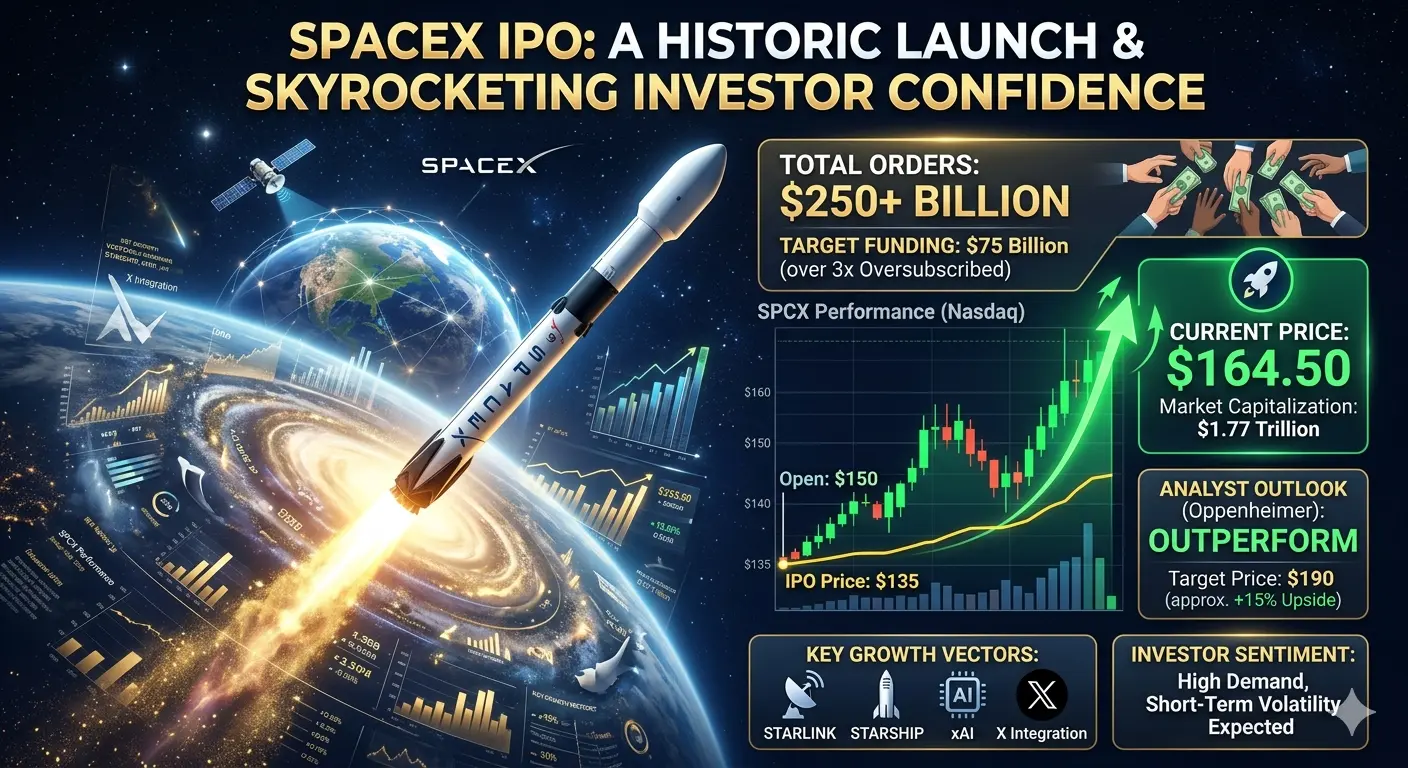
SpaceX's Initial Public Offering has made history. This landmark IPO has received investor orders exceeding $250 billion, which is more than three times the company's target of $75 billion. This overwhelming demand is clear evidence that global investors have tremendous confidence in SpaceX's future growth trajectory.
An IPO occurs when a company offers its shares to the public for the first time. In SpaceX's case, investors submitted requests totaling over $250 billion in
XAI-1.98%
HighAmbition
#SpaceXIPOAttractsOver250BillionInOrders
SpaceX IPO Attracts Over $250 Billion in Orders - Investor Confidence Skyrockets
SpaceX's Initial Public Offering has made history. This landmark IPO has received investor orders exceeding $250 billion, which is more than three times the company's target of $75 billion. This overwhelming demand is clear evidence that global investors have tremendous confidence in SpaceX's future growth trajectory.
An IPO occurs when a company offers its shares to the public for the first time. In SpaceX's case, investors submitted requests totaling over $250 billion in investment. This is a strong indicator that people have immense trust in the company's future prospects.
SpaceX set its IPO price at $135 per share, giving the company a total valuation of $1.77 trillion. However, when trading began on Nasdaq, the share price opened at $150, which is 11 percent above the IPO price. Currently, SPCX is trading around $164.5, which is extremely positive news for early investors.
This extraordinary demand indicates that both institutional and individual investors worldwide believe in SpaceX's vision. The company recently integrated xAI and the social media platform X into its portfolio, further increasing its valuation. Renowned brokerage houses like Oppenheimer have given SpaceX an "outperform" rating with a target price of $190, which is 41 percent higher than the IPO price.
At SPCX's current level of 164.5, market experts believe there is potential for further upside. However, investors should exercise caution because price volatility after an IPO is common. For long-term investment, SpaceX remains an interesting option, especially as the company advances in space exploration, satellite internet, and artificial intelligence sectors.
The massive investor interest demonstrates that SpaceX has captured the imagination of the global investment community. Elon Musk's vision of making humanity a multi-planetary species, combined with the company's proven track record in reusable rocket technology and satellite communications, has created unprecedented demand for this historic IPO.
Price Outlook for SPCX at $164.5:
Given the current price level of 164.5, several factors suggest potential for further upward movement. The stock opened at $150 on its first trading day, showing immediate strength above the $135 IPO price. Analyst price targets around $190 indicate room for approximately 15 percent upside from current levels.
However, investors should be aware that IPO stocks often experience significant volatility in their early trading days. The gap between the $135 IPO price and current trading levels has already created substantial gains for early participants. Short-term traders might see profit-taking pressure, while long-term investors may view any dips as accumulation opportunities.
The integration of xAI and the X platform adds additional growth vectors beyond SpaceX's core space business. As the company executes on its ambitious roadmap including Starship development and Starlink expansion, investor sentiment could remain supportive of higher valuations.
Key Considerations:
The $250 billion in demand versus $75 billion raised creates a supply-demand imbalance that could support prices in the near term. Institutional ownership is expected to increase as more brokerages initiate coverage. Retail investor enthusiasm remains high given the company's public profile and Musk's following.
Risk factors include execution challenges on complex engineering projects, competitive pressures in the space launch market, and the overall valuation level which some analysts consider stretched compared to traditional aerospace companies.
For those considering positions at current levels, dollar-cost averaging and position sizing appropriate to risk tolerance are prudent approaches given the inherent volatility of newly public companies in growth sectors.
@Gate_Square
repost-content-media
  • Reward
  • Comment
  • Repost
  • Share
#SpotSilverUp10PercentForTheWeek
Silver has experienced a remarkable week in the markets, with spot prices climbing approximately 10% as investors and traders respond to a complex mix of geopolitical tensions, industrial demand signals, and shifting monetary policy expectations. This significant price movement reflects the dual nature of silver as both a precious metal safe haven and a critical industrial commodity, creating unique opportunities for informed traders who understand the underlying market dynamics.
Understanding the Recent Price Surge
The 10% weekly gain in spot silver represent
HighAmbition
#SpotSilverUp10PercentForTheWeek
Silver has experienced a remarkable week in the markets, with spot prices climbing approximately 10% as investors and traders respond to a complex mix of geopolitical tensions, industrial demand signals, and shifting monetary policy expectations. This significant price movement reflects the dual nature of silver as both a precious metal safe haven and a critical industrial commodity, creating unique opportunities for informed traders who understand the underlying market dynamics.
Understanding the Recent Price Surge
The 10% weekly gain in spot silver represents one of the most substantial short-term rallies seen in the precious metals sector this year. Several interconnected factors have contributed to this upward momentum, creating what analysts describe as a convergence of bullish catalysts that have reignited investor interest in the white metal.
Geopolitical uncertainty remains a primary driver of precious metals demand. The ongoing tensions in the Middle East, particularly developments surrounding the Strait of Hormuz, have elevated risk premiums across commodity markets. When geopolitical instability increases, investors traditionally seek safe-haven assets, and silver benefits from this flight-to-safety dynamic alongside gold. The precious metal's historical role as a store of value during times of crisis has attracted renewed institutional and retail interest.
Central bank purchasing patterns have also supported silver prices indirectly. While central banks primarily accumulate gold for their reserves, the broader precious metals sentiment often lifts silver in tandem. Major central banks continue diversifying away from dollar-denominated assets, creating a supportive backdrop for the entire precious metals complex. This institutional demand provides a floor under prices even during periods of temporary market weakness.
The Federal Reserve's interest rate policy has created significant volatility in silver markets. Recent inflation data showing persistent price pressures has led markets to recalibrate expectations for monetary policy. Higher interest rates typically pressure non-yielding assets like precious metals, but the market has shown resilience as investors weigh the potential for rate cuts later in the year against current inflation concerns. This policy uncertainty has actually benefited silver, as traders position for multiple scenarios.
Industrial Demand: The Hidden Catalyst
What distinguishes silver from gold and makes its price trajectory particularly fascinating is its substantial industrial demand component. Unlike gold, which derives most of its value from investment and jewelry demand, silver serves critical functions across multiple industrial sectors, creating a unique supply-demand dynamic that pure precious metals lack.
The solar energy sector represents the largest industrial consumer of silver globally. Modern photovoltaic cells require approximately 130 milligrams of silver per watt of capacity, and with global solar installations exceeding 2,200 gigawatts and growing at 450 to 600 gigawatts annually, the demand pressure is substantial. This renewable energy transition has created a structural demand floor for silver that did not exist in previous decades.
However, the relationship between solar demand and silver prices has become more nuanced. As silver prices have risen significantly, manufacturers have accelerated efforts to reduce silver intensity in solar panels through a process called thrifting. Recent data indicates that silver use in photovoltaics declined approximately 6% last year to 186.6 million ounces as manufacturers sought to preserve margins amid rising input costs. The metal's share of solar cell costs has increased from roughly 8% to more than 20%, intensifying substitution pressures.
Despite these efficiency improvements, total silver demand from the solar sector remains robust. The Silver Institute's World Silver Survey 2026 projects continued deficits in the silver market, with supply struggling to keep pace with combined industrial and investment demand. Approximately 70% of global silver production occurs as a byproduct of copper, lead, zinc, and gold mining, meaning that higher silver prices alone cannot easily trigger rapid supply expansion. This supply inelasticity creates the potential for sharp price movements when demand accelerates.
Current Market Technical Analysis
From a technical perspective, silver's recent 10% weekly gain has pushed prices into critical resistance zones that will determine the sustainability of this rally. Traders should pay close attention to several key technical levels that are likely to influence price action in the coming sessions.
Immediate resistance is encountered in the $68.53 to $72.47 range, representing a significant supply zone where previous selling pressure emerged. A sustained break above this area would target the $74.00 level, followed by the more substantial resistance at $76.00, which coincides with the 50-day moving average. The 200-day moving average currently sits around $67.92, providing dynamic support that has contained recent pullbacks.
Support levels to monitor include the $66.09 area, with deeper support found at $62.15 and psychological support at $60.00. The price action around these levels will provide important clues about market sentiment and the strength of underlying demand. A break below the 200-day moving average would signal potential trend deterioration and warrant defensive positioning.
Volume analysis suggests that the recent rally has been accompanied by healthy participation, indicating genuine buying interest rather than thin-market manipulation. However, traders should remain vigilant for signs of exhaustion, such as declining volume on rallies or bearish divergences in momentum indicators.
Price Forecast and Market Outlook
Analysts maintain divergent views on silver's trajectory through the remainder of 2026, reflecting the metal's complex dual identity and the uncertain macroeconomic environment. Investment banks and research firms have published forecasts ranging from conservative targets around $56 to more optimistic projections exceeding $75 per ounce.
Bank of America analysts project silver averaging approximately $56 in 2026, with potential peaks reaching $65, reflecting a cautious stance on industrial demand growth and the impact of solar thrifting. Conversely, prominent investors like Robert Kiyosaki have suggested $75 is achievable, emphasizing silver's monetary attributes and the potential for currency debasement concerns to drive investment demand.
The Reuters consensus forecast from early February 2026 placed average silver prices at $79.50 for the full year, though these projections have been subject to revision as market conditions evolve. The wide dispersion in analyst forecasts underscores the difficulty in predicting silver prices, given the competing influences of industrial demand, investment flows, and macroeconomic factors.
From a fundamental perspective, the market structure supports higher prices over the medium term. The silver market has recorded annual deficits for six consecutive years, with supply shortfalls ranging from 100 million to 250 million ounces annually against total mine supply of approximately 800 to 850 million ounces. This persistent deficit has drawn down above-ground inventories and created the conditions for price appreciation when demand accelerates.
Trading Strategies for Current Market Conditions
For traders seeking to capitalize on silver's volatility while managing risk, several strategic approaches warrant consideration based on current market conditions and technical positioning.
Trend-following strategies remain appropriate given silver's established uptrend, though position sizing should account for the metal's inherent volatility. Entering on pullbacks to key support levels, such as the 200-day moving average or psychological round numbers, offers favorable risk-reward ratios. Stop-loss orders should be placed below recent swing lows or technical support levels to protect against adverse moves.
Range trading can be effective when silver consolidates between established support and resistance zones. The current $68 to $76 range provides opportunities for traders to buy near support and sell into resistance, though this approach requires disciplined execution and rapid response to breakout signals that would invalidate the range thesis.
Momentum traders should watch for volume-confirmed breakouts above resistance levels, particularly a sustained move above $72.47 that would target $74.00 and potentially $76.00. Breakout entries should be accompanied by trailing stops to capture extended moves while protecting accumulated profits.
Risk management is paramount when trading silver given its volatility characteristics. Position sizes should be calibrated to ensure that adverse moves do not exceed predetermined risk thresholds, typically 1% to 2% of trading capital per position. Diversification across multiple positions and asset classes can help mitigate silver-specific risks.
Long-Term Investment Considerations
Beyond short-term trading, silver presents compelling attributes for long-term investors seeking portfolio diversification and inflation protection. The metal's historical role as a store of value, combined with its growing industrial importance in the energy transition, creates a favorable demand outlook over multi-year timeframes.
Investors should consider dollar-cost averaging into silver positions rather than attempting to time market entries, given the difficulty of predicting short-term price movements. Physical silver, exchange-traded funds, and mining equities each offer distinct risk-return profiles that should align with individual investment objectives and risk tolerance.
The gold-to-silver ratio, currently elevated by historical standards, suggests silver may be undervalued relative to gold, potentially offering asymmetric upside if the ratio normalizes. However, this relationship can remain distorted for extended periods, so investors should not rely solely on mean reversion as an investment thesis.
Conclusion
Silver's 10% weekly gain reflects a confluence of factors including geopolitical risk, industrial demand resilience, and shifting monetary policy expectations. While short-term volatility is likely to persist, the underlying market structure characterized by supply deficits and growing industrial applications supports a constructive medium-term outlook.
Traders and investors should remain attentive to technical levels, particularly the $68 to $76 range that will likely define near-term price action. Risk management discipline and position sizing appropriate to silver's volatility characteristics are essential for navigating this dynamic market successfully.
The convergence of silver's precious metal attributes with its critical role in renewable energy technologies creates a unique investment proposition that distinguishes it from other commodities. As the global energy transition accelerates and monetary policy uncertainty persists, silver appears well-positioned to maintain investor interest and potentially extend its recent gains.
@Gate_Square
repost-content-media
  • Reward
  • Comment
  • Repost
  • Share
#MyGateTradeStory
#ETH
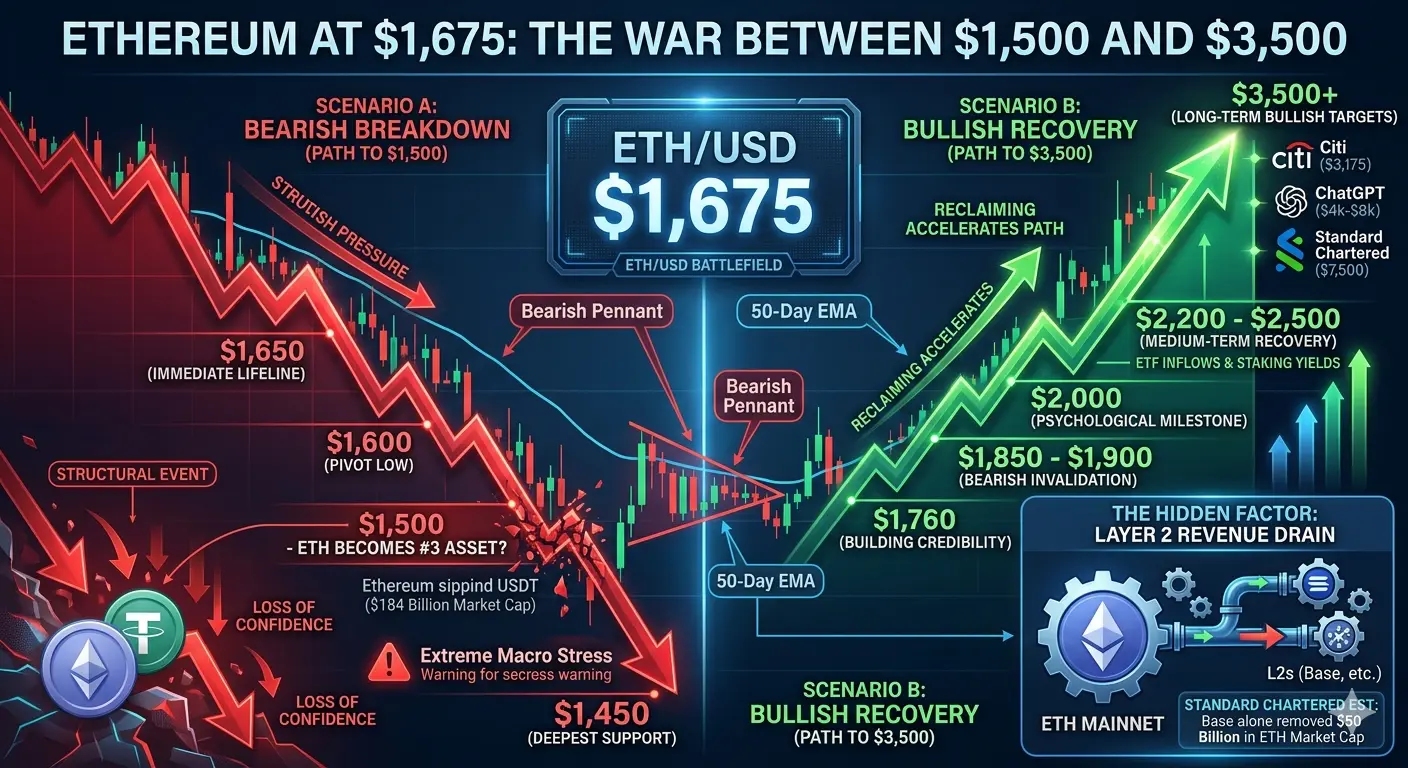
Ethereum at $1,675: The War Between $1,500 and $3,500
Ethereum is sitting at $1,675 right now, and that price is not just a number on a screen. It is the exact battlefield where two entirely different futures are fighting for control. One path leads down to $1,500 and a potential loss of Ethereum's number two market position. The other leads back toward $2,000, then $2,500, then eventually $3,500. This post breaks down every critical level, every scenario, and exactly what you should be watching.
Where ETH Stands Right Now
Current price: $1,675. ETH is hovering just $25
ETH-0.66%
BTC0.39%
HighAmbition
#MyGateTradeStory
#ETH
Ethereum at $1,675: The War Between $1,500 and $3,500
Ethereum is sitting at $1,675 right now, and that price is not just a number on a screen. It is the exact battlefield where two entirely different futures are fighting for control. One path leads down to $1,500 and a potential loss of Ethereum's number two market position. The other leads back toward $2,000, then $2,500, then eventually $3,500. This post breaks down every critical level, every scenario, and exactly what you should be watching.
Where ETH Stands Right Now
Current price: $1,675. ETH is hovering just $25 above the $1,650 critical support line. The bearish pennant formation is still valid. ETH is above its 50-day EMA at $1,662 but well below the 200-day moving average which sits much higher. The chart structure is materially weaker than Bitcoin's right now. ETH has tested short-term resistance but failed to close above it convincingly. Think of $1,675 as the last bench on a steep hillside. One slip and the drop accelerates fast.
Support Levels: The Floor Beneath ETH
Level 1: $1,650. This is the immediate lifeline. ETH was only about $13 away from closing below this level earlier this week. If ETH loses $1,650 on a daily close, the bearish pennant confirms its breakdown pattern and selling pressure intensifies rapidly.
Level 2: $1,600. Wednesday's pivot low sits here. This is where the next batch of buyers would step in if $1,650 fails. A bounce from $1,600 could be sharp but unreliable without volume confirmation.
Level 3: $1,500 to $1,580. This is the zone Polymarket's 60% probability scenario targets. If ETH hits $1,500, USDT's market cap at $184 billion could actually surpass ETH, meaning Ethereum loses its second-place ranking entirely. That would be a structural event, not just a price event. It would shift narratives, sentiment, and institutional allocation decisions.
Level 4: $1,450. The deepest support zone visible on current charts. Only extreme macro stress or a cascading liquidation event would push ETH here.
Resistance Levels: The Ceiling Above ETH
Level 1: $1,760. The immediate resistance tested recently. ETH needs a clean daily close above this level to start rebuilding bullish credibility.
Level 2: $1,850 to $1,900. The next resistance cluster where selling pressure from earlier declines still sits. Breaking through here would be the first real sign that the bearish pennant is invalidated.
Level 3: $2,000. The psychological milestone. Multiple analysts including TedPillows noted that reclaiming $2,000 opens a realistic path to $2,100 to $2,150. But the same analyst warned that even after reaching $2,150, Ethereum may resume its downtrend. So $2,000 is important but not a guarantee of continuation.
Level 4: $2,200 to $2,500. The zone where medium-term recovery becomes credible. InvestingHaven's forecast targets this area if the $2,000 support holds during any retest. Claude's AI model placed its upper 2026 bound at $3,700, meaning $2,500 is the midpoint of that recovery range.
Level 5: $3,500 to $4,500. The long-term bullish targets. Standard Chartered holds a $7,500 year-end call. Citi sits at $3,175. ChatGPT's model projected $4,000 to $8,000. These targets require ETF inflows to recover, macro conditions to improve, and ETH to prove its L2 revenue model can sustain value.
Two Scenarios Playing Out
Scenario A: Bearish Breakdown. ETH closes below $1,650, fails to recover $1,600, and slides toward $1,500. Stablecoin dominance remains bullish. Altcoin market structure stays fragile. ETH loses its number two position temporarily. This scenario has significant probability based on current technical readings.
Scenario B: Bullish Recovery. ETH holds $1,650, pushes above $1,760, then clears $1,850. A reclaim of $2,000 changes the narrative entirely. ETF inflows pick up. Staking yields attract capital back. ETH climbs toward $2,500 over the following weeks. This scenario requires Bitcoin to lead with strength and macro headwinds to ease.
What to Actually Do
If you are trading ETH right now, the most important number on your screen is $1,650. Not $1,675. Not $2,000. $1,650. That is the line that decides the next directional move for Ethereum.
For longs: Consider entries only after ETH holds $1,650 for multiple daily closes and then pushes above $1,760 with volume. Stop below $1,580. Target $1,850 first, then $2,000.
For shorts: If ETH closes below $1,650 on a daily candle, shorts become structurally favorable. Entry near $1,640 to $1,650. Stop above $1,760. Target $1,600, then $1,500.
Position sizing: Keep each trade under 5% of your portfolio. Current conditions are choppy, not trending. Leverage should stay conservative at 3x to 5x maximum. The market is offering range-bound trades right now, not directional trending trades. Treat it accordingly.
The Hidden Factor Nobody Is Talking About
Layer 2 networks are draining value from Ethereum's mainnet. Standard Chartered estimated that Base alone removed $50 billion from ETH's market cap. L2s scale capacity but divert fee revenue. This structural tension means ETH's price recovery is not just about macro conditions improving. It is about whether Ethereum can capture value from its own scaling solutions. That question has no clear answer yet, and it makes every bullish target above $2,500 conditional rather than guaranteed.
The Bottom Line
Ethereum at $1,675 is standing on thin ice above $1,650. The next 48 hours of daily closes will likely determine whether ETH drops toward $1,500 or begins climbing toward $2,000. Watch $1,650 like your entire portfolio depends on it. Because structurally, it does.
If ETH closes below $1,650 this weekend, are you prepared for the $1,500 scenario, or are you still hoping for the $2,000 recovery?
@Gate_Square
repost-content-media
  • Reward
  • Comment
  • Repost
  • Share
#MyGateTradeStory
ZEC is currently trading at $417 after one of the most dramatic weeks in its history. On June 5, the price crashed from $624 to $309, a 50 percent drop, after Shielded Labs disclosed a critical bug in the Orchard shielded pool that could have allowed undetectable counterfeiting since May 2022. Since then, ZEC has rebounded over 40 percent to current levels around $417, driven by the Ironwood upgrade announcement and a swift developer response. The RSI stands at approximately 45, which is near oversold territory, and MACD divergence has been observed on 15 minute, 4 hour, and
ZEC3.34%
BTC0.39%
  • Reward
  • Comment
  • Repost
  • Share
#PredictWorldCupWin40000U
Brazil vs Morocco: Polymarket Predictions and My Analysis for the 2026 World Cup Group C Opener
The 2026 FIFA World Cup has arrived, and one of the most anticipated opening-round clashes takes place this Saturday, June 13, when Brazil faces Morocco at the New York New Jersey Stadium. This Group C showdown brings together two of the strongest teams in the group, alongside Scotland and Haiti, and the outcome could set the tone for the entire tournament for both nations. With Polymarket prediction markets buzzing and Gate running a massive 500,000 USDT World Cup Predict
HighAmbition
#PredictWorldCupWin40000U
Brazil vs Morocco: Polymarket Predictions and My Analysis for the 2026 World Cup Group C Opener
The 2026 FIFA World Cup has arrived, and one of the most anticipated opening-round clashes takes place this Saturday, June 13, when Brazil faces Morocco at the New York New Jersey Stadium. This Group C showdown brings together two of the strongest teams in the group, alongside Scotland and Haiti, and the outcome could set the tone for the entire tournament for both nations. With Polymarket prediction markets buzzing and Gate running a massive 500,000 USDT World Cup Prediction Carnival, this match deserves a deep dive.
Polymarket Odds Breakdown: What the Crowd Wisdom Says
Polymarket, the decentralized prediction market platform where users trade outcomes using USDC, currently prices Brazil as the strong favorite. As of the latest data from June 12-13, Brazil to win sits at approximately 58 cents per share, translating to roughly a 58 percent implied probability. Morocco to win trades around 17 to 19.5 cents, reflecting a 17 to 19.5 percent chance, while the draw is priced at approximately 25 to 26 cents, meaning about a 25 to 26 percent probability. These are real-money prices driven by thousands of traders who put their capital behind their convictions, making them a valuable signal alongside traditional bookmaker odds.
For context, traditional bookmakers show Brazil at approximately -150 on the money line (about 60 percent implied), Morocco at +450 (about 18 percent), and the draw at +280 (about 26 percent). The Polymarket and sportsbook probabilities are closely aligned, which reinforces confidence in the overall market view: Brazil is favored but not overwhelmingly, and Morocco has a genuine chance to make this match competitive.
My Prediction: Brazil 2, Morocco 1
After studying Polymarket data, team form, tactical setups, and key player availability, my prediction leans toward Brazil winning 2-1. Here is my reasoning in detail.
Brazil Strengths and Vulnerabilities
Brazil enters this World Cup under legendary manager Carlo Ancelotti, who took over the Selecao after his incredible run at Real Madrid. Ancelotti won five Champions League titles as a coach, and now he aims to add the biggest trophy in international football to his resume. However, this is his first World Cup as a manager, and the transition to international football always carries risk. Brazil looked impressive in their 6-2 friendly win over Panama, but they showed vulnerabilities in the narrower 2-1 victory over Egypt, a fellow North African side. That closer result against Egypt may actually be a more relevant indicator for this Morocco match.
The biggest concern for Brazil is injuries. Eder Militao and Rodrygo have been ruled out, and Neymar is battling a nagging calf strain and will sit out the opener. Without Neymar, Brazil loses one of their most creative and experienced players. Brentford striker Igor Thiago is likely to start up top instead, which is a remarkable story for the 24-year-old but also represents a step down in star power compared to what Neymar brings.
Brazil still possesses extraordinary attacking talent. Vinicius Junior, Raphinha, and Lucas Paqueta form a formidable frontline, and Casemiro anchors the midfield as captain in what will likely be his final World Cup. The center-back pairing of Marquinhos and Gabriel is solid, and Alisson remains one of the world top goalkeepers. Brazil have not lost their opening World Cup game since 1934, an extraordinary record spanning nearly a century. That historical resilience matters.
Morocco Strengths and Tournament Pedigree
Morocco arrives at this World Cup as the team that made history four years ago, becoming the first African nation to reach the semifinals in 2022. Their defensive organization was the backbone of that run, posting clean sheets in the Round of 16 and quarterfinal before conceding twice to eventual runners-up France. That experience and confidence at the highest level of international football is invaluable.
The Atlas Lions are now managed by Mohamed Ouahbi, the former Under-23s coach who took over after Walid Regragui departed following the controversial Africa Cup of Nations final earlier this year. Morocco effectively won AFCON in the record books after Senegal forfeited, adding another accolade to their recent rise. Ouahbi is in just his sixth game in charge, which means tactical cohesion may still be developing, but the core roster remains largely intact from 2022.
Achraf Hakimi is the marquee name, and the PSG superstar is confirmed fit and ready to go after injury concerns. Hakimi provides heroics at both ends of the pitch, capable of defending at the highest level and launching devastating counter-attacks. Brahim Diaz of Real Madrid is their main goal threat, and the combination of Hakimi, Issa Diop, Noussair Mazraoui, and Rami Aguerd forms a back line that can frustrate even the most talented attacking groups.
Morocco friendly form has been solid: an easy win over Madagascar followed by a highly impressive 1-1 draw with Norway, a country with genuine potential. That Norway result suggests Morocco can compete with strong European-style opposition, which is exactly what Brazil represents.
Why I Think Brazil Wins 2-1
Several factors tip my prediction toward Brazil, but only narrowly. First, Brazil overwhelming attacking quality. Even without Neymar and Rodrygo, Vinicius Junior alone can unlock defenses with his pace, dribbling, and finishing. Ancelotti knows how to maximize Vinicius from their years together at Real Madrid, where they won Champions League titles in 2022 and 2024. Second, Brazil century-long unbeaten record in World Cup openers provides psychological resilience. Third, the home-continent conditions in New Jersey at 6pm local time should favor Brazil style of play with slightly cooler evening temperatures.
However, Morocco keeps it close because of their defensive discipline. Hakimi and Mazraoui on the flanks can track Brazil wide attackers, and the central pairing of Diop and Aguerd has experience against elite opposition. Morocco will likely absorb pressure and strike on counter-attacks, with Diaz and Ounahi providing the link-up play. I expect Morocco to score one goal from a well-executed counter or set piece, making this 2-1 rather than a comfortable Brazil win.
The Polymarket angle is worth noting: at 58 cents for Brazil, the market sees roughly a 3-in-5 chance. For traders looking for value, Morocco at 17-19 cents offers high payout potential if the upset happens, while the draw at 25 cents could appeal if you believe both sides prioritize avoiding a loss in the opener. Over 2.5 goals at 45 cents on Polymarket aligns with my 2-1 prediction and the statistical trend showing 67 percent of Brazil recent matches exceeding that threshold.
Gate World Cup Prediction Carnival: Join and Win
While Polymarket offers prediction market trading, Gate has launched an extraordinary World Cup Prediction Carnival with a total prize pool exceeding 500,000 USDT. This event covers all 104 World Cup matches and features multiple participation mechanisms including match predictions, champion predictions, trading tasks, ranking points, and community interaction. The Gate App v8.22 includes a dedicated World Cup Hub with integrated fixtures, live standings, match calendars, and Polymarket-based prediction activities.
The rewards structure is impressive. Ten Daily Prediction Kings share 500 USDT every day. Fifty lucky participants share 1,000 USDT every week. Plus, climb the leaderboard to win Gate World Cup boxes containing limited-edition World Cup jersey gift boxes and Gate 13th anniversary souvenirs. To join, simply update your Gate App to version 8.22, register your account, and start making predictions. You can also participate in the social campaign by posting with the tag PredictWorldCupWin40000U and attaching the event card, sharing your match prediction or trading strategy.
Polymarket data shows the World Cup Winner market has already crossed 1.2 billion USDT in total trading volume with over 280 million USDT in liquidity, and daily activity routinely reaches nearly 30 million USDT. Gate itself topped all Polymarket partner channels after a surge in single-day trading volume during the NBA Finals on June 6, hitting 91 million USDT in weekly notional volume during the Champions League Final on May 31. This momentum sets the stage for an electrifying World Cup prediction experience.
Key Match Facts Summary
The match kicks off at the New York New Jersey Stadium, which holds 82,500 seats, with referee Slavko Vincic overseeing the action. Both teams to score is priced at favorable odds given the attacking talent on both sides, with statistical models showing a 54 percent chance of BTTS based on recent match data. Brazil averages 3.67 goals per game across their last six matches while conceding 1.17, and Morocco averages 2.83 goals while conceding just 0.67 per game. These numbers underscore why Morocco defense keeps them in contention despite Brazil attacking superiority.
My final verdict: Brazil wins 2-1 in a competitive, entertaining Group C opener that showcases both teams quality and sets up an exciting tournament ahead. Whether you agree or disagree, Polymarket and Gate Prediction Carnival give you the tools to put your conviction to work and potentially earn rewards along the way. Join the conversation, share your prediction, and let the World Cup drama unfold.
Predict with Gate: https://www.gate.com/competition/football-2026
Event Announcement: https://www.gate.com/announcements/article/51597
@Gate_Square
repost-content-media
  • Reward
  • Comment
  • Repost
  • Share
#USMayCPIHits3YearHigh
The United States Consumer Price Index for May 2026 has surged to a three-year high of 4.2% year-over-year, marking the highest inflation reading since April 2023. This significant economic development carries profound implications across multiple asset classes, with particular attention required for cryptocurrency markets that have already experienced substantial volatility in recent weeks.
Understanding the CPI Surge
The Consumer Price Index serves as the primary gauge of inflation, measuring the average change in prices over time that consumers pay for a basket of go
HighAmbition
#USMayCPIHits3YearHigh
The United States Consumer Price Index for May 2026 has surged to a three-year high of 4.2% year-over-year, marking the highest inflation reading since April 2023. This significant economic development carries profound implications across multiple asset classes, with particular attention required for cryptocurrency markets that have already experienced substantial volatility in recent weeks.
Understanding the CPI Surge
The Consumer Price Index serves as the primary gauge of inflation, measuring the average change in prices over time that consumers pay for a basket of goods and services. The May 2026 reading of 4.2% represents a notable acceleration from April's 3.8% and substantially exceeds the Federal Reserve's long-term target of 2%. This inflationary pressure stems primarily from escalating energy costs, with the Middle East conflict driving gasoline and related energy product prices upward. Energy goods prices jumped 3.9% in May alone, accounting for more than 60% of the monthly CPI increase.
The core CPI, which excludes volatile food and energy components, rose 0.2% month-over-month, slightly below expectations. However, the headline figure remains deeply concerning for monetary policymakers who have battled elevated inflation for over five years. The current inflation rate is roughly double the Fed's target, creating significant challenges for the central bank's policy trajectory.
Federal Reserve Policy Implications
The elevated CPI reading substantially complicates the Federal Reserve's monetary policy calculus. With inflation accelerating rather than moderating, the probability of interest rate cuts in the near term has diminished considerably. Market participants now anticipate the Fed may maintain current interest rate levels well into 2027, with some analysts even suggesting the possibility of rate hikes if inflationary pressures persist.
Higher interest rates typically strengthen the US dollar as foreign investors seek yield in dollar-denominated assets. A stronger dollar creates headwinds for risk assets, including cryptocurrencies, as it reduces the relative attractiveness of alternative investments and tightens global liquidity conditions.
Cryptocurrency Market Analysis
Bitcoin and Ethereum have demonstrated significant vulnerability to macroeconomic developments in recent weeks. Current market data reveals Bitcoin trading around $63,753, representing a recovery from recent lows near $59,000 but still substantially below previous highs above $80,000. Ethereum currently trades near $1,672, having recovered from lows around $1,500 but facing continued pressure.
The cryptocurrency market has experienced a severe correction, with Bitcoin declining approximately 23% from its January 2026 peak above $82,000. Ethereum has faced even more pronounced weakness, falling roughly 44% from highs above $2,400 to current levels. This bearish price action reflects deteriorating risk sentiment and concerns about tightening liquidity conditions.
Impact Assessment Across Market Segments
Bitcoin Price Dynamics
Bitcoin's price action demonstrates clear sensitivity to macroeconomic developments. The cryptocurrency has formed a bearish pennant pattern on daily charts, with key support now established around $61,000. A breakdown below this level could trigger further downside toward $49,000. The RSI indicator has fallen into oversold territory below 25, suggesting potential for technical bounces, though the broader trend structure remains bearish.
Current trading volume for Bitcoin futures exceeds $4.2 billion in daily quoted volume, with significant participation in perpetual contracts. The 24-hour price change shows modest recovery of approximately 0.45%, though this comes within a broader downtrend context.
Ethereum Performance
Ethereum has exhibited even greater volatility than Bitcoin, with sharper declines and more pronounced weakness in technical indicators. The cryptocurrency has broken below multiple support levels and faces ongoing pressure from bearish momentum indicators. Current daily trading volume exceeds $3.9 billion, reflecting sustained market interest despite declining prices.
Altcoin Sector
The broader altcoin market has experienced severe pressure as Bitcoin dominance increases. Total cryptocurrency market capitalization excluding Bitcoin and Ethereum remains under significant strain, with technical indicators suggesting continued downside risk. Stablecoin dominance has risen substantially, indicating risk-off positioning among market participants.
Liquidity and Volume Analysis
Cryptocurrency markets have maintained substantial trading volumes despite price declines, suggesting active repositioning by institutional and retail participants. Bitcoin daily trading volumes consistently exceed $4 billion across major exchanges, while Ethereum volumes regularly surpass $3.5 billion. This elevated volume during price declines indicates distribution rather than accumulation patterns.
Open interest in cryptocurrency derivatives has remained elevated, suggesting continued speculation and hedging activity. Funding rates have turned negative in recent sessions, reflecting bearish sentiment among perpetual futures traders.
Macroeconomic Correlation
The correlation between cryptocurrency prices and traditional macroeconomic indicators has strengthened significantly in 2026. Bitcoin and Ethereum now demonstrate clear sensitivity to Federal Reserve policy expectations, inflation readings, and dollar strength. This increased correlation reduces the diversification benefits historically associated with cryptocurrency investments.
The US Dollar Index has maintained a strong bullish trajectory, pressing toward key resistance levels. This dollar strength creates additional headwinds for dollar-denominated risk assets, including cryptocurrencies. Treasury yields have risen in response to inflation concerns, further tightening financial conditions.
Risk Assessment and Outlook
The current market environment presents elevated risks for cryptocurrency investors. The combination of persistent inflation, hawkish Federal Reserve policy, and dollar strength creates a challenging macroeconomic backdrop. Technical indicators suggest continued downside risk, with key support levels vulnerable to breakdown.
Potential Downside Scenarios
Should inflation remain elevated and the Federal Reserve maintain restrictive policy, cryptocurrency prices could face additional pressure. Bitcoin support at $61,000 represents a critical level; failure to hold this zone could trigger accelerated selling toward $49,000. Ethereum faces similar risks, with support near $1,650 representing a key technical level.
Recovery Catalysts
Potential catalysts for recovery include evidence of moderating inflation, dovish shifts in Federal Reserve rhetoric, or resolution of geopolitical tensions affecting energy markets. Additionally, institutional adoption developments and regulatory clarity could provide fundamental support for cryptocurrency valuations.
Trading Strategy Considerations
In the current environment, risk management assumes paramount importance. Traders should consider reduced position sizes, wider stop-loss placements, and heightened awareness of correlation risks. Dollar-cost averaging strategies may suit long-term investors, while active traders should remain attentive to macroeconomic calendar events and Federal Reserve communications.
The elevated CPI reading and its implications for monetary policy suggest continued volatility in cryptocurrency markets. Participants should maintain flexible positioning and remain prepared for rapid shifts in market sentiment as new economic data emerges.
Conclusion
The May 2026 CPI reading represents a significant inflection point for financial markets, with clear negative implications for cryptocurrency valuations in the near term. The combination of accelerating inflation, restrictive monetary policy, and dollar strength creates a challenging environment for risk assets. Bitcoin and Ethereum have already experienced substantial corrections, and technical indicators suggest continued vulnerability.
Market participants should closely monitor upcoming economic data releases, Federal Reserve communications, and developments in the Middle East conflict that could influence energy prices and inflation expectations. The current environment demands cautious positioning and robust risk management as markets navigate this period of elevated uncertainty and volatility.@Gate_Square #MyGateTradeStory

repost-content-media
  • Reward
  • Comment
  • Repost
  • Share
#TapAndPayWithGateCard
The modern crypto economy is rapidly evolving from a purely speculative market into a fully functional financial ecosystem where spending, earning, staking, and trading are all interconnected. One of the clearest examples of this transformation is the concept of “Tap and Pay with Gate Card”, combined with advanced reward structures such as 2x mining rate strategies and accumulation-based incentive systems.
At the center of this evolving ecosystem stands Gate.io, a global crypto exchange that has expanded far beyond trading into payments, earning products, and real-world
Dubai_Prince
#TapAndPayWithGateCard
The modern crypto economy is rapidly evolving from a purely speculative market into a fully functional financial ecosystem where spending, earning, staking, and trading are all interconnected. One of the clearest examples of this transformation is the concept of “Tap and Pay with Gate Card”, combined with advanced reward structures such as 2x mining rate strategies and accumulation-based incentive systems.
At the center of this evolving ecosystem stands Gate.io, a global crypto exchange that has expanded far beyond trading into payments, earning products, and real-world crypto utility. The integration of crypto cards, staking rewards, and incentive-driven participation models represents a major shift in how users interact with digital assets.
1. What “Tap and Pay with Gate Card” Actually Means
The phrase “Tap and Pay with Gate Card” refers to a contactless crypto payment system where users can spend their digital assets in real-world transactions using a crypto-linked card.
In simple but complete terms, it means:
👉 You can pay directly using your crypto balance by tapping a card at a payment terminal, without manually converting crypto into fiat currency beforehand.
This is made possible through the infrastructure provided by platforms like Gate.io, which bridges the gap between blockchain assets and traditional financial payment systems.
How it works in real life:
You hold crypto assets in your exchange wallet
You link them to a crypto card system
You go to a shop or restaurant
You tap the card on a payment machine
The crypto is instantly converted and payment is completed
This removes friction and makes crypto behave like real money in everyday life.
2. Why Tap and Pay Systems Are Important in Crypto Evolution
The introduction of crypto cards and tap-to-pay systems represents a major milestone because it solves one of the biggest problems in crypto adoption: real-world usability.
Previously, crypto was mostly limited to:
Trading on exchanges
Long-term holding
Speculative investment
But now, with systems like Gate Card:
👉 Crypto becomes a daily spending tool instead of just a digital asset.
This shift is extremely important because it transforms crypto from an investment-only class into a functional currency ecosystem.
3. Strategy Accumulation & 2x Mining Rate Model
Alongside payment innovation, the crypto ecosystem also includes advanced earning systems like Strategy Accumulates 2x Mining Rate models.
This concept means:
Users are rewarded for holding and accumulating assets
The reward generation rate is doubled (2x mining output)
Passive income increases without increasing investment size
In practical terms:
If a user previously earned a small yield from staking or mining, under a 2x system, that yield becomes significantly higher while the same capital remains invested.
This creates a strong behavioral incentive:
👉 Hold more → Earn more → Stay longer in the ecosystem
4. How These Two Systems Work Together
When we combine Tap and Pay systems with 2x mining rate accumulation strategies, the result is a fully integrated financial loop:
(A) Earn Phase
Users earn rewards through staking, mining, or yield programs.
(B) Accumulate Phase
Users hold and grow their crypto holdings instead of selling.
(C) Spend Phase
Users spend crypto directly using Gate Card via tap and pay.
This creates a closed ecosystem where:
Crypto is earned
Crypto is held
Crypto is spent
Everything happens inside one financial cycle.
5. Role of Gate.io in This Ecosystem Transformation
Gate.io plays a central role in this evolution by offering a multi-layered crypto ecosystem that includes:
1. Advanced Trading Infrastructure
Gate.io provides deep liquidity, fast execution, and access to a wide range of crypto assets, making it a strong foundation for global traders.
2. Staking and Yield Products
Users can participate in:
Flexible staking
Locked earning programs
Liquidity mining
Dual investment strategies
These directly support accumulation-based strategies.
3. Real-World Crypto Payments (Gate Card Concept)
The integration of crypto payment solutions allows users to:
Spend crypto instantly
Avoid manual conversion steps
Use crypto like fiat currency in daily life
4. Early Access to Emerging Ecosystems
Gate.io is known for listing innovative tokens and providing early access to new DeFi and blockchain projects, allowing users to participate in reward systems before they become mainstream.
6. Impact on the Crypto Market
The combination of tap-and-pay systems and enhanced mining rewards creates a significant impact on the crypto market structure.
(A) Increased Crypto Utility
Crypto is no longer just a trading asset. It becomes:
A savings tool
An income generator
A payment method
(B) Stronger Holding Behavior
Because of accumulation rewards:
Users are less likely to sell
Circulating supply decreases
Market stability increases
(C) Higher Adoption Rate
As crypto becomes easier to spend through systems like Gate Card:
Retail adoption increases
Merchant acceptance grows
Real-world usage expands
(D) Liquidity Redistribution
Funds move from short-term trading into:
Staking pools
Earn programs
Payment ecosystems
This reduces speculative volatility over time.
7. Risks and Structural Considerations
Even though these systems are highly innovative, they also come with important risks:
(A) Reward Sustainability
High reward systems like 2x mining rates must be carefully balanced to avoid inflation.
(B) Market Dependency
Crypto spending systems still depend on market liquidity and asset price stability.
(C) Behavioral Risk
Users may focus only on rewards and ignore long-term fundamentals.
(D) Regulatory Environment
Crypto payment systems must adapt to global financial regulations and compliance frameworks.
8. Psychological and Behavioral Market Effects
These systems also influence investor psychology significantly:
“If I hold more, I earn more” mindset strengthens accumulation behavior
Instant payment capability increases confidence in crypto usability
Passive income perception attracts new retail investors
Fear of missing reward cycles drives participation spikes
This creates a powerful emotional cycle that impacts both price action and adoption trends.
9. Long-Term Outlook of This Ecosystem
If developed sustainably, the integration of:
Tap and Pay crypto cards
2x mining rate reward systems
Accumulation-based incentives
Exchange-driven infrastructure
can transform crypto into a fully functional global financial layer.
This means:
👉 Crypto will no longer exist only as an investment market
👉 It will function as a parallel financial system used in daily life
Platforms like Gate.io are positioning themselves at the center of this transformation by combining trading, earning, and payment solutions into one ecosystem.
Final Conclusion
The concepts of “Tap and Pay with Gate Card” and “Strategy Accumulates 2x Mining Rate” represent two sides of the same evolution: one focuses on spending crypto in real life, while the other focuses on earning and accumulating crypto efficiently.
When combined, they create a complete financial loop where:
Users earn crypto through rewards
They accumulate and grow holdings through enhanced mining rates
They spend crypto directly in real-world transactions using tap-and-pay systems
In this structure, Gate.io acts as a powerful ecosystem bridge, connecting blockchain technology with practical financial utility.
Final insight:
This is not just a trend — it is a structural shift toward a future where crypto behaves like a complete financial system rather than just a speculative asset class.
  • Reward
  • 3
  • Repost
  • Share
ShainingMoon:
To The Moon 🌕
View More
#DailyPolymarketHotspot
#DailyPolymarketHotspot 🔥📊
The Rise of Information Markets — Where Probability Becomes Price
In today’s fast-moving financial world, the most valuable asset is no longer just capital or commodities—it is information, and more importantly, how quickly that information is converted into actionable insight, and this is exactly where Polymarket is redefining the landscape by transforming uncertainty into tradable probability, allowing global events to be priced in real time rather than debated through delayed opinions or static forecasts, creating a system where markets
UMA-1.65%
BTC0.39%
Dubai_Prince
#DailyPolymarketHotspot
#DailyPolymarketHotspot 🔥📊
The Rise of Information Markets — Where Probability Becomes Price
In today’s fast-moving financial world, the most valuable asset is no longer just capital or commodities—it is information, and more importantly, how quickly that information is converted into actionable insight, and this is exactly where Polymarket is redefining the landscape by transforming uncertainty into tradable probability, allowing global events to be priced in real time rather than debated through delayed opinions or static forecasts, creating a system where markets act as live intelligence engines that continuously update based on new data, sentiment, and capital flow.
From Opinion to Capital — A Shift in How We Predict the Future
Traditional forecasting relies heavily on opinions, surveys, and expert analysis, but prediction markets introduce a more disciplined model where participants must back their beliefs with money, which fundamentally changes behavior because financial risk filters out weak assumptions and emotional bias, and when a market assigns a price like $0.70 to an outcome, it represents a 70% probability derived from real trading activity, not speculation alone, meaning every trade contributes to a constantly evolving forecast that reflects collective conviction rather than passive opinion.
Real-Time Intelligence — Faster Than News, Sharper Than Polls
One of the most powerful advantages of prediction markets is their speed, as they process and reflect information almost instantly, often reacting to developments before traditional media narratives are formed, and whether it is crypto volatility, central bank decisions, political events, or geopolitical tensions, these markets absorb new information and translate it into price movements within seconds, effectively turning trading activity into a real-time sentiment indicator that can reveal shifts in expectations long before they become obvious elsewhere.
Technology & Trust — The Backbone of Modern Prediction Markets
The efficiency and reliability of this system are supported by blockchain infrastructure, particularly through Polygon, which enables fast, low-cost transactions, making participation smooth and accessible for a wide range of users, while the use of stable assets like USD Coin ensures that volatility comes from the event being traded rather than the currency itself, and equally critical is the role of decentralized verification systems such as UMA Protocol, which provide transparent and dispute-driven outcome resolution, ensuring fairness without relying on centralized authority, thereby strengthening trust in a system where financial outcomes depend on accurate results.
Market Dynamics — Sentiment, Liquidity, and Opportunity
While prediction markets offer powerful insights, they are still influenced by human behavior and market mechanics, where liquidity plays a crucial role in determining accuracy, as highly active markets tend to produce more reliable probabilities while low-volume markets can be distorted by small trades, and emotional trading remains a key factor, especially during major events where fear or excitement can temporarily misprice outcomes, creating opportunities for disciplined traders who understand that the real edge lies not in predicting the final result, but in identifying when the market’s current probability diverges from reality and adjusting positions accordingly.
BTC Context — Linking Price Action with Market Expectations
At the same time, in the broader crypto market, Bitcoin is currently trading around $76,305 after facing rejection near the $79K–$80K resistance zone, placing it in a short-term consolidation phase where the market is cooling rather than breaking down, and this is where combining price action with prediction market data becomes extremely powerful, because while charts show support and resistance levels, platforms like Polymarket reveal how traders are pricing the probability of future moves in real time.
Polymarket Example — Pricing the Next Move
Consider a live-style scenario on Polymarket
where the market asks: “Will BTC reach $80,000 before April 30?”
• If the “Yes” share trades at $0.65–$0.70, it reflects a 65–70% probability, signaling bullish expectations and confidence in a move higher
• If it trades near $0.50, it indicates uncertainty, aligning with a range-bound market between $75K–$78K
• If it drops to $0.30–$0.35, it reflects weakening sentiment and a higher probability of BTC failing to reach $80K, increasing the risk of a move toward $72K
The key insight here is not just the probability itself, but how it changes over time, because rising probability often signals accumulation before price moves, while falling probability can act as an early warning of weakening momentum even if price has not yet reacted.
Trading Strategy — Using Probability as an Edge
To navigate this environment effectively, traders should combine technical levels with probability shifts, focusing on confirmation rather than prediction, where holding above $75K alongside rising Polymarket probabilities strengthens the bullish case, while stable price with declining probabilities signals hidden weakness, and sharp drops in probability can indicate early-stage breakdown risk, and strategies such as scaling into support zones, waiting for volume-backed breakouts, avoiding over-leverage, and maintaining strict risk management remain essential, especially in conditions where sentiment can shift rapidly due to external news or liquidity changes.
Challenges & Future Outlook — Beyond Speculation
As prediction markets continue to grow, they also face challenges including regulatory scrutiny, concerns about insider trading, and the limitations of simplifying complex real-world outcomes into binary contracts, yet despite these issues, institutional interest is rising as these platforms prove valuable not just for trading but for understanding real-time market psychology and collective expectations, suggesting that in the future, prediction markets could become key tools for decision-making across finance, politics, and global strategy.
Final Perspective — The Future Is Being Priced in Real Time
In conclusion, Polymarket represents a major evolution in how we interpret the future, transforming information into a tradable asset and uncertainty into measurable probability, and when combined with real-time price action from assets like Bitcoin, it creates a powerful framework where traders are no longer just reacting to the market but anticipating it through probability shifts, and in a world overwhelmed by opinions, this approach offers something far more valuable—a signal backed by capital, where the future is not just predicted, but actively priced and continuously refined.
  • Reward
  • 3
  • Repost
  • Share
ShainingMoon:
To The Moon 🌕
View More
#WCTCTradingKingPK
1. The Core Reality: Most Participants Are Engineered to Lose
The uncomfortable truth that defines modern crypto markets is that the majority of participants are not operating with an edge. They are reacting, not analyzing; chasing, not positioning. This behavior doesn’t just lead to losses — it actively fuels the profits of more structured traders. Every impulsive breakout entry, every panic-driven exit, and every overleveraged position without context contributes to a system where uninformed traders become liquidity for informed ones.
The market does not reward effort alo
Dubai_Prince
#WCTCTradingKingPK
1. The Core Reality: Most Participants Are Engineered to Lose
The uncomfortable truth that defines modern crypto markets is that the majority of participants are not operating with an edge. They are reacting, not analyzing; chasing, not positioning. This behavior doesn’t just lead to losses — it actively fuels the profits of more structured traders. Every impulsive breakout entry, every panic-driven exit, and every overleveraged position without context contributes to a system where uninformed traders become liquidity for informed ones.
The market does not reward effort alone. It rewards precision, patience, and structural understanding. Without these, participation becomes predictable — and predictability in trading is exploitable.
---
2. Defining the Feature: What Market Structure Actually Means
Market Structure Awareness is not a vague concept; it is a framework for understanding how price moves with intention. Instead of focusing on isolated price points, it examines sequences and behavior.
Price action typically unfolds in phases:
Accumulation, where positions are built quietly;
Expansion, where momentum attracts attention;
Distribution, where early participants exit into late demand;
Manipulation, where liquidity is targeted through engineered moves.
Traders who fail to recognize these phases interpret movement as randomness. Traders who understand structure recognize that price is often moving toward liquidity objectives, not arbitrary levels.
---
3. The Critical Debate: Indicators vs Structural Insight
A large portion of retail traders depend heavily on indicators, believing they provide predictive clarity. However, indicators are inherently reactive; they process historical price data and present it in simplified form. This makes them useful for confirmation, but insufficient for anticipation.
Market structure, in contrast, provides contextual intelligence. It highlights where liquidity is concentrated, where traps are likely to occur, and where significant participants may be positioning.
The distinction is critical. Indicators tell you what has happened. Structure helps you understand why it happened and what is likely to follow.
Relying solely on indicators places traders in a reactive loop. Integrating structural awareness shifts them toward proactive decision-making.
---
4. Liquidity as the True Driver of Price Movement
Price does not move randomly; it moves in response to liquidity. Areas where orders are concentrated — such as equal highs, equal lows, obvious support and resistance, and psychological price levels — become targets.
These zones are not just technical markers; they represent clusters of stop losses and pending orders. Large participants often drive price into these areas to trigger those orders, creating the liquidity required to enter or exit positions efficiently.
What appears to be a breakout can often be a liquidity sweep. What appears to be a breakdown can be a setup for reversal. Without understanding this mechanism, traders misinterpret intent and consistently find themselves on the wrong side of moves.
---
5. Strategic Positioning: From Reaction to Anticipation
The shift from average to advanced trading begins with a change in perspective. Instead of asking where to enter based on visible momentum, structured traders analyze where the majority is likely to act — and position accordingly.
This approach is not about contrarian behavior for its own sake. It is about recognizing that markets often move against the most obvious expectations before continuing in their intended direction.
Positioning with structure means:
Entering with confirmation of intent rather than emotional impulse;
Exiting based on invalidation of structure rather than fear or greed;
Maintaining discipline even when the market environment appears uncertain.
This creates consistency, which is the foundation of long-term performance.
---
6. Risk Management: The Only Sustainable Advantage
No analytical framework, including market structure, eliminates risk. Losses are an inherent part of trading. The defining difference between successful and unsuccessful participants lies in how those losses are managed.
Effective risk management ensures that individual losses remain controlled and that capital is preserved for future opportunities. It transforms trading from a series of high-stakes guesses into a calculated process of probability management.
Without risk control, even accurate analysis fails to produce sustainable results. With it, even imperfect strategies can generate consistent growth over time.
---
7. Final Assessment: Awareness as a Competitive Edge
Market Structure Awareness is not an optional enhancement; it is a foundational requirement for serious participation in crypto markets.
Ignoring structure leads to reactive behavior and predictable outcomes.
Chasing momentum without context leads to repeated losses.
Operating without a framework leads to inconsistency.
Developing structural awareness changes the approach entirely. It enables traders to interpret price with depth, align with underlying intent, and execute decisions based on logic rather than emotion.
This is the distinction between participation and strategy, between randomness and calculated engagement.
---
Call to Action
Shift your perspective from surface-level signals to structural understanding. Analyze deeper, position with intent, and approach the market with discipline.
Master Market Structure Awareness and transform uncertainty into calculated opportunity.
repost-content-media
  • Reward
  • 4
  • Repost
  • Share
ShainingMoon:
To The Moon 🌕
View More
#CryptoMarketsDipSlightly
The cryptocurrency market is currently experiencing a modest pullback, reflecting a phase of short-term consolidation rather than a confirmed reversal of the broader trend. This slight dip follows a period of sustained upward momentum, where major digital assets recorded notable gains, attracting both retail and institutional participation. Such corrections are not only common but necessary in maintaining market stability and preventing overheating.
At the core of this dip lies a combination of profit-taking behavior and cautious sentiment among traders. After recent
Dubai_Prince
#CryptoMarketsDipSlightly
The cryptocurrency market is currently experiencing a modest pullback, reflecting a phase of short-term consolidation rather than a confirmed reversal of the broader trend. This slight dip follows a period of sustained upward momentum, where major digital assets recorded notable gains, attracting both retail and institutional participation. Such corrections are not only common but necessary in maintaining market stability and preventing overheating.
At the core of this dip lies a combination of profit-taking behavior and cautious sentiment among traders. After recent price surges, many market participants have opted to secure profits, leading to mild selling pressure across major trading pairs. This behavior is particularly visible in high-cap assets, where liquidity allows for easier entry and exit without causing extreme volatility.
Macroeconomic factors are also playing a subtle yet influential role. Global financial markets remain sensitive to interest rate expectations, inflation data, and central bank policies. Even minor shifts in these indicators can influence risk appetite, causing investors to temporarily step back from volatile assets like cryptocurrencies. As a result, capital rotation into safer assets or stablecoins can contribute to short-term downward pressure.
Additionally, derivatives market activity suggests a cooling phase. Funding rates have normalized, and leveraged positions are being reduced, indicating that excessive bullish sentiment is being flushed out. This reset is often considered healthy, as it reduces the risk of sudden liquidations and creates a more balanced trading environment.
On-chain data further supports the narrative of a controlled dip rather than panic selling. Wallet activity, exchange inflows, and long-term holder behavior show no signs of aggressive distribution. Instead, accumulation patterns remain intact, suggesting that larger players are maintaining confidence in the market’s long-term outlook.
From a technical perspective, key support levels are currently being tested. Price action indicates that the market is attempting to establish a higher low, which, if sustained, could reinforce the continuation of the broader uptrend. However, failure to hold these levels may lead to extended consolidation before the next significant move.
Market sentiment, while slightly cautious, has not shifted into fear territory. Traders are closely monitoring upcoming catalysts, including regulatory developments, institutional adoption news, and macroeconomic updates. These factors will likely determine the direction of the next major trend.
In conclusion, the current dip should be viewed within the context of a natural market cycle. Rather than signaling weakness, it reflects a period of recalibration where excess momentum is being absorbed. For disciplined participants, such phases often present strategic opportunities, provided risk management remains a priority.
repost-content-media
  • Reward
  • 3
  • Repost
  • Share
ShainingMoon:
To The Moon 🌕
View More
The emergence of #DailyPolymarketHotspot highlights a significant transformation in how modern markets interpret information, assess probabilities, and react to global events. In an era where data moves faster than ever, prediction markets have positioned themselves as real-time sentiment engines, offering a transparent and continuously evolving reflection of collective expectations.
At its core, this daily spotlight is designed to track and analyze the most trending prediction events on Polymarket. These events are not random; they represent the highest concentration of attention, liquidity,
Dubai_Prince
The emergence of #DailyPolymarketHotspot highlights a significant transformation in how modern markets interpret information, assess probabilities, and react to global events. In an era where data moves faster than ever, prediction markets have positioned themselves as real-time sentiment engines, offering a transparent and continuously evolving reflection of collective expectations.
At its core, this daily spotlight is designed to track and analyze the most trending prediction events on Polymarket. These events are not random; they represent the highest concentration of attention, liquidity, and speculation across multiple sectors. From cryptocurrency price movements and stock market expectations to geopolitical tensions and macroeconomic indicators, the scope is intentionally broad. This multi-sector coverage ensures that users are exposed to a comprehensive view of how different narratives are unfolding simultaneously across global markets.
One of the defining features of #DailyPolymarketHotspot is its focus on real-time volume tracking. Volume is not just a number—it is a signal. It reflects conviction, uncertainty, and participation intensity. When a prediction market experiences a surge in volume, it often indicates that new information has entered the system or that existing assumptions are being challenged. Traders who understand how to interpret volume dynamics can identify potential shifts before they fully materialize.
Equally important is the concept of leading outcomes. These represent the current market consensus based on aggregated trading activity. However, it is critical to understand that leading outcomes are not fixed truths—they are fluid probabilities that evolve as new data emerges. This dynamic nature creates opportunities for strategic positioning, especially for participants who can identify mispriced probabilities or delayed market reactions.
Another essential component embedded within this framework is the resolution mechanism. Each prediction event is governed by clearly defined rules and a predetermined resolution date. This ensures that outcomes are not subject to arbitrary interpretation, thereby maintaining fairness and credibility. The presence of structured resolution criteria distinguishes prediction markets from traditional speculation models, as it introduces accountability and verifiability into the process.
Beyond the technical aspects, #DailyPolymarketHotspot serves as a powerful tool for understanding market psychology. It captures how crowds process uncertainty, react to narratives, and adjust their expectations in real time. This behavioral dimension is often overlooked, yet it plays a crucial role in shaping price movements and trend formation. By studying how probabilities shift over time, participants can gain insights into sentiment cycles, overreactions, and potential reversals.
Furthermore, this daily spotlight encourages a transition from passive observation to active participation. Users are not merely spectators; they are contributors to the market’s collective intelligence. By placing trades based on their own analysis, they actively influence probability distributions and market direction. This interactive element transforms the experience into a feedback loop where information, action, and outcome continuously reinforce each other.
From a strategic standpoint, #DailyPolymarketHotspot aligns closely with modern trading philosophies that prioritize probability over certainty. Instead of asking whether an event will happen or not, participants evaluate the likelihood of different outcomes and position themselves accordingly. This probabilistic approach reduces binary thinking and promotes more nuanced decision-making, which is essential in highly volatile and information-driven environments.
In addition, the integration of macroeconomic and geopolitical themes within these prediction markets adds another layer of complexity and relevance. Events such as policy decisions, economic data releases, or international conflicts can significantly influence market sentiment. By incorporating these factors into prediction events, the platform creates a bridge between traditional financial analysis and decentralized forecasting.
Risk management also plays a critical role within this ecosystem. While the potential for profit exists, so does the possibility of loss. Understanding probability distributions, avoiding emotional decision-making, and maintaining disciplined positioning are key factors that determine long-term success. The transparency of data within #DailyPolymarketHotspot provides users with the tools needed to make informed decisions, but the responsibility of execution ultimately lies with the participant.
In conclusion, Dailypolymarkethotspot is not just a feature—it is a reflection of how markets are evolving toward intelligence-driven, probability-based systems. It combines real-time data, crowd sentiment, and structured outcomes into a unified framework that empowers users to think critically, act strategically, and adapt continuously. Those who can interpret the signals hidden within volume, outcomes, and timing will not only follow the market—they will understand it at a deeper level and position themselves ahead of the curve.
repost-content-media
  • Reward
  • Comment
  • Repost
  • Share
#DailyPolymarketHotspot
#Polymarket每日热点
In 2026, the crypto market is no longer driven solely by charts, indicators, or historical price behavior. Those tools still matter — but they are now secondary layers. The real edge has shifted toward forward-looking probability systems, and among them, prediction markets have emerged as one of the most powerful intelligence mechanisms.
Platforms such as Polymarket are no longer niche experiments. They are evolving into live consensus engines, where capital-backed beliefs determine how future events are priced before they unfold. This is the key distin
BTC0.39%
ETH-0.61%
MEME11.56%
Dubai_Prince
#DailyPolymarketHotspot
#Polymarket每日热点
In 2026, the crypto market is no longer driven solely by charts, indicators, or historical price behavior. Those tools still matter — but they are now secondary layers. The real edge has shifted toward forward-looking probability systems, and among them, prediction markets have emerged as one of the most powerful intelligence mechanisms.
Platforms such as Polymarket are no longer niche experiments. They are evolving into live consensus engines, where capital-backed beliefs determine how future events are priced before they unfold. This is the key distinction: traditional markets react — prediction markets anticipate.
The DailyPolymarketHotspot is not just a list of trending bets. It represents a compressed view of global conviction, combining retail speculation, institutional positioning, and macro expectations into one dynamic probability layer.
Market Structure Reality: Volatility Is the Core Signal
The crypto market in 2026 is defined by controlled volatility cycles, not random movement.
Bitcoin (BTC) operates within structured expansion ranges, typically pushing +4% to +10% upward waves, while pullbacks remain contained within -3% to -7% liquidity resets
Ethereum (ETH) behaves as a higher-beta extension, with +3% to +8% expansions and -2% to -6% retracements
Altcoins dominate in rotational bursts, delivering +10% to +30% rallies, followed by -8% to -20% corrections
Meme assets exist in extreme cycles, where +20% to +50% spikes are often erased just as quickly
The key insight: Polymarket does not just track direction — it maps where volatility will expand next.
Bitcoin Sentiment Layer: The Primary Market Driver
Bitcoin remains the central axis of crypto sentiment.
Current probability structure across prediction markets:
Continuation above $80,000 is heavily favored (~90%+ probability zones)
Expansion toward $90,000 sits in mid-confidence territory (~60% range)
Breakout beyond $100,000 remains speculative but highly watched (~35–45%)
These expectations are not random. They are anchored in:
ETF inflow consistency
Post-halving supply compression
Global liquidity cycles
Institutional accumulation patterns
A critical behavioral pattern:
When Bitcoin sentiment strengthens even marginally (around +3% to +5% weekly probability shift), it often triggers capital rotation into altcoins.
Ethereum: From Asset to Ecosystem Index
Ethereum is no longer traded purely as a directional asset — it is increasingly valued as a network growth proxy.
Core expectation zones:
Stability range: $2,500–$3,500
Bullish expansion phases: +5% to +8%
Corrections: -3% to -6%
Prediction market focus includes:
Layer-2 adoption rates
Staking yield sustainability
DeFi liquidity growth
Upgrade execution success
Ethereum’s role is structural — it anchors the market while Bitcoin leads it.
Institutional Capital & ETF Flow Signals
One of the most reliable forward indicators in 2026 comes from ETF-related sentiment tracking.
Observed patterns:
Sustained inflows → consistent +3% to +6% upward pressure on BTC
Slowing inflows → sideways movement or mild corrections
New approvals → sharp localized rallies across altcoins (+5% to +15%)
This segment acts as a bridge between traditional finance and crypto volatility cycles.
Altcoin Rotation Mechanics
Altcoins represent risk amplification layers.
Cycle structure typically unfolds as:
1. Early rotation → +6% to +15%
2. Momentum expansion → +10% to +30%
3. Distribution → -8% to -20%
Prediction markets often detect these rotations before they become visible on charts, making them a powerful early signal.
Meme Coin Activity: Retail Emotion Indicator
Meme coins function as pure sentiment thermometers.
Breakout phase → +20% to +50% spikes
Cooling → rapid -10% to -25% pullbacks
Accumulation → low-volatility consolidation
When meme activity surges, it usually signals peak retail participation and elevated risk appetite.
Regulatory Impact: External Volatility Catalyst
Regulation continues to inject macro-level uncertainty into crypto pricing.
Positive clarity → +2% to +7% expansion
Restrictive tone → -3% to -8% downside pressure
Neutral stance → consolidation phases
Even without direct control, regulatory sentiment shapes market confidence cycles.
Market Psychology: Why Prediction Markets Matter
Unlike social media sentiment, prediction markets involve real capital commitment.
This creates three advantages:
Probability reflects conviction, not opinion
Reactions are faster than traditional markets
Crowd intelligence aggregates instantly
However, it’s not flawless.
Risk Framework: Critical Limitations
Probabilities are not guarantees
Crowd bias can distort outcomes
Liquidity concentration can skew signals
Large players can temporarily manipulate sentiment
Polymarket should be treated as a sentiment overlay, not a standalone decision engine.
Strategic Integration for Advanced Traders
Professionals combine prediction data with:
Technical levels (support/resistance)
On-chain capital flows
Funding rates and derivatives positioning
Macro events (CPI, FOMC, ETF data)
This creates a multi-layer confirmation model, reducing reliance on single-point signals.
Macro Crossover: AI Industry Shockwave
Beyond crypto, a major development is unfolding in the AI sector.
Elon Musk has taken legal action against OpenAI, pushing a critical debate into the courtroom. The dispute centers on whether OpenAI deviated from its original mission of being open and non-profit by transitioning into a commercial entity.
This case is not just legal noise — it has broader implications:
It challenges governance models in AI development
It may reshape how innovation is funded and controlled
It introduces regulatory attention to AI commercialization
If the outcome restricts or reshapes OpenAI’s trajectory, the ripple effect could extend into AI-driven crypto narratives, especially in sectors tied to automation, data, and decentralized intelligence.
Final Outlook: The New Market Intelligence Era
In 2026, the market operates on layered intelligence:
Bitcoin defines direction
Ethereum stabilizes structure
Altcoins amplify opportunity
Meme coins expose emotion
Prediction markets reveal expectations before reality forms
The DailyPolymarketHotspot is no longer optional insight — it is becoming a core strategic layer for understanding where the market is heading next.
Those who rely only on charts react late.
Those who understand probability positioning move early.
repost-content-media
  • Reward
  • Comment
  • Repost
  • Share
##FedHoldsRateButDividesDeepen The latest Federal Reserve decision has delivered a message that is far more complex than a simple “rate hold.” While the central bank kept interest rates unchanged for the third straight meeting, the underlying dynamics reveal a growing fracture within policymakers — a signal markets cannot afford to ignore.
At the surface level, maintaining the current rate range suggests a wait-and-watch approach. However, the voting pattern tells a deeper story. A significant split among decision-makers reflects rising uncertainty about the future path of monetary policy. Thi
Dubai_Prince
##FedHoldsRateButDividesDeepen The latest Federal Reserve decision has delivered a message that is far more complex than a simple “rate hold.” While the central bank kept interest rates unchanged for the third straight meeting, the underlying dynamics reveal a growing fracture within policymakers — a signal markets cannot afford to ignore.
At the surface level, maintaining the current rate range suggests a wait-and-watch approach. However, the voting pattern tells a deeper story. A significant split among decision-makers reflects rising uncertainty about the future path of monetary policy. This is not just a disagreement — it is a sign that consensus is weakening at a critical moment for the global economy.
A portion of policymakers resisted any indication of easing, highlighting concerns that inflationary pressures are still persistent. At the same time, at least one voice pushed for immediate rate cuts, indicating that parts of the economy may already be feeling the strain of tight financial conditions. This divergence signals that the Federal Reserve is no longer moving with unified conviction.
One of the most important factors shaping this outlook is the continued strength in inflation, particularly driven by elevated energy prices. Ongoing geopolitical tensions have kept oil markets tight, feeding directly into broader price pressures. This complicates the Fed’s task — cutting rates too early risks reigniting inflation, while holding too long could slow economic momentum further.
Financial markets are now recalibrating expectations. Earlier assumptions of aggressive rate cuts are being replaced with a more cautious outlook. The possibility that interest rates may remain elevated for an extended period — or even rise again — is being increasingly priced in.
This shift has direct consequences for risk assets. Higher interest rates typically reduce liquidity and increase the cost of capital, creating pressure on equities and cryptocurrencies alike. Investors who previously relied on easy monetary conditions must now adjust to a tighter environment where capital efficiency and risk management become critical.
At the same time, the internal divide within the Fed introduces an additional layer of uncertainty. Markets thrive on clarity, but the current situation offers the opposite — conflicting signals from policymakers. This increases volatility as investors react not just to economic data, but also to shifting narratives within the central bank itself.
From a strategic perspective, this environment demands caution rather than blind optimism. The era of predictable policy direction appears to be fading, replaced by a more reactive and data-dependent approach. Traders and investors must remain flexible, closely monitoring macroeconomic indicators, inflation trends, and geopolitical developments.
In conclusion, the decision to hold rates is only the headline. The real story lies in the growing اختلاف (division) within the Federal Reserve, persistent inflation pressures, and the evolving expectations of global markets. This combination creates a landscape where uncertainty dominates — and in such conditions, only disciplined and well-informed strategies can succeed.
##FedHoldsRateButDividesDeepen
repost-content-media
  • Reward
  • Comment
  • Repost
  • Share
#BitcoinSpotVolumeNewLow The latest on-chain and market data reveals a significant shift in the current cryptocurrency landscape, as Bitcoin’s spot trading volume has dropped to critically low levels, signaling a phase of reduced market participation and declining short-term activity.
Market Overview
Recent data indicates that daily spot trading volume for Bitcoin has slipped below the $8 billion threshold, marking one of the weakest activity periods observed since October 2023. This represents a sharp contraction compared to previous high-liquidity phases, reflecting a clear slowdown in immed
BTC0.39%
Dubai_Prince
#BitcoinSpotVolumeNewLow The latest on-chain and market data reveals a significant shift in the current cryptocurrency landscape, as Bitcoin’s spot trading volume has dropped to critically low levels, signaling a phase of reduced market participation and declining short-term activity.
Market Overview
Recent data indicates that daily spot trading volume for Bitcoin has slipped below the $8 billion threshold, marking one of the weakest activity periods observed since October 2023. This represents a sharp contraction compared to previous high-liquidity phases, reflecting a clear slowdown in immediate buying and selling pressure across major exchanges.
Volume Compression and Its Meaning
A decline in spot volume at this scale typically suggests one of two scenarios:
Market participants are stepping back, waiting for stronger confirmation before entering positions.
Institutional flows are temporarily paused, leading to reduced liquidity and thinner order books.
This type of volume compression often creates an environment where price movements become less reliable in the short term but more explosive once momentum returns.
Liquidity Conditions
Lower trading volume directly impacts liquidity, making the market more sensitive to large orders. Even moderate buy or sell pressure can trigger disproportionate price swings due to the lack of depth in the market. This increases volatility risk despite the current calm appearance.
Historical Context
The last time Bitcoin experienced similar spot volume conditions was during a consolidation phase before a major directional move. Historically, such quiet periods have not lasted long and are often followed by sharp expansions in volatility, either upward or downward depending on macro and sentiment drivers.
Market Psychology
The current state reflects uncertainty rather than weakness. Traders are not aggressively exiting positions, but they are also not entering with conviction. This results in a neutral-to-cautious sentiment environment where the market pauses before its next decisive move.
Possible Interpretations
1. Accumulation Phase
Smart money may be quietly accumulating positions during this low-volume phase, avoiding attention while retail participation remains minimal.
2. Pre-Breakout Structure
Low volume frequently precedes breakout conditions. Once liquidity returns, price can move rapidly due to built-up pressure.
3. Market Indecision
The absence of strong volume may also indicate indecision, where neither bulls nor bears have enough confidence to dominate.
Risk Factors
Sudden volatility spikes due to thin liquidity
False breakouts caused by low participation
Increased sensitivity to macroeconomic news or regulatory developments
Strategic Outlook
Traders and investors should treat this phase as a preparation zone rather than a confirmation phase. Key actions include:
Monitoring volume expansion signals
Watching key resistance and support levels
Avoiding over-leveraged positions in low-liquidity conditions
Forward Perspective
The current environment can be described as a “silent market,” where activity is subdued but underlying tension is building. Once volume begins to return, it will likely define the direction of the next major trend.
Conclusion
Bitcoin’s drop in spot trading volume to multi-month lows is not merely a sign of weakness but a signal of transition. Markets rarely stay quiet for long, and this phase may represent the foundation for the next significant move. Whether this leads to a breakout rally or a corrective phase will depend on how liquidity re-enters the system and how participants respond to upcoming catalysts.
The key question remains:
Is this a calm consolidation before expansion — or a pause before renewed downside pressure?
Only the return of volume will provide the answer.
repost-content-media
  • Reward
  • Comment
  • Repost
  • Share
  • Pinned