1. Changes in Global Stock Trading: From Fragmented to Unified
Traditional stock investing requires multiple systems working together: brokerage accounts, bank accounts, cross-border funding channels, and different market interfaces.
Now, multi-asset trading systems like Gate are working to unify these steps into a single account structure:
-
One account
-
Multi-market assets (US stocks / HK stocks / KR stocks)
-
Unified funding system (digital asset entry point)
-
Unified trading interface
Investors no longer need to switch between systems—all processes can be completed on a single platform.
2. What Is the Gate Stock Trading System?
Gate stock trading is a multi-asset trading entry system that incorporates stocks into the overall asset structure, allowing unified management alongside digital assets, stablecoins, and other investment products.
In this system:
-
Stocks are no longer standalone account assets
-
They are part of a combined asset structure
-
Trading logic closely resembles spot trading of digital assets
-
But the underlying assets remain actual listed company shares
This allows crypto users to access traditional financial markets in a familiar way.
3. Funding Mechanism: How USDT Enters the Stock Market
In traditional systems, stock trades settle in fiat currency. In Gate's system, funding can enter via USDT and other digital assets.
The basic path is: USDT → platform funding account → stock trading settlement unit → stock assets. This is merely a change in settlement and valuation method; it does not alter the nature of the stocks, which still represent actual company equity.
4. Account Opening and Trading Permissions: The First Step to Market Entry
Before trading, users must complete these basic steps:
The core objectives of this process are:
-
Meet regulatory requirements for different markets
-
Establish compliance for cross-market trading
-
Ensure the account is capable of global asset trading
After completion, stock trading features become available.
5. Fund Management Structure: Understanding Real Positions
Once inside the trading system, funds aren't just a "static balance"—they're divided into different levels based on usage status to reflect true trading risk exposure.
Usually divided into three parts:
-
Available funds: currently available for placing orders
-
Locked/Pending funds: funds in placed but not fully executed orders
-
Positions: assets acquired through completed trades
On the surface, this seems like just an account status breakdown, but in actual trading, it acts as a "position structure map."
For example, when trading frequently or using limit orders, available and locked funds will shift back and forth; during periods of high market volatility, changes in positions directly determine overall risk exposure.
Thus, what really impacts trading results isn't total account balance but the distribution of funds across these states—this determines your "real participation level" in the market and how much new risk you can take on.
6. Practical Trading Steps
On Gate stock trading, a complete operation follows these steps:
Step 1: Enter the stock trading section
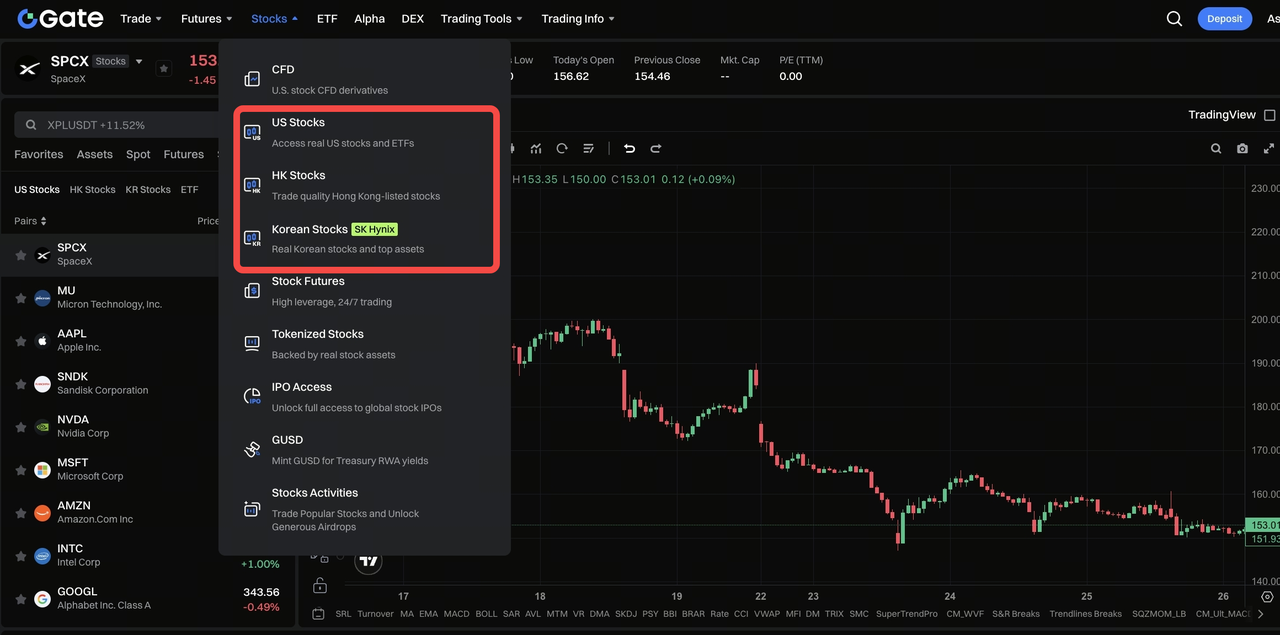
After logging in, go to the "Stocks" module and enter the asset market list (choose US, HK, or KR stocks).
Step 2: Search for target stock
Search by company name or stock code, such as:
-
SpaceX / SPCX
-
Tesla / TSLA
On the details page you'll see:
-
Real-time price
-
K-line chart
-
Basic market data
Step 3: Enter the trading interface
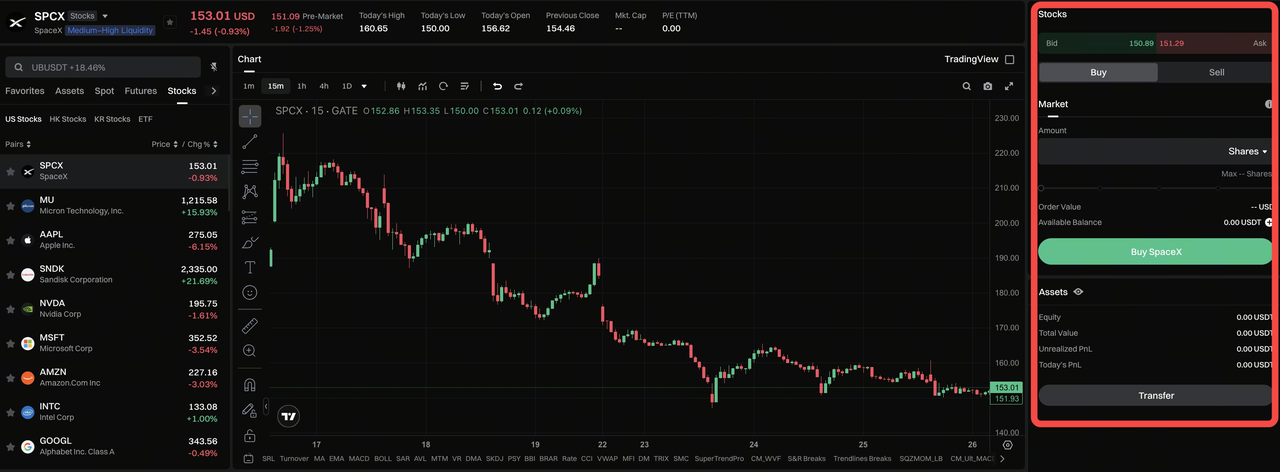
Click Buy/Sell to access the order placement page.
Step 4: Select order type
The system usually offers two options:
Step 5: Enter order quantity
Enter share count or amount; the system auto-calculates required funds and fees.
Step 6: Confirm and submit order
Review details and confirm—the order enters the matching system.
Step 7: Check order status
On the orders page view: Filled (executed), Partial (partially filled), Open (pending).
Step 8: View position results
After execution, go to the positions page to view cost price, current price, and P&L status.
Step 9: Further management actions
You can increase position size, reduce holdings, close out positions, or adjust orders.
7. Order Execution Mechanism
In Gate's system, orders aren't executed instantly—they go through:
Once submitted, orders enter the matching system and are filled according to current market bids/offers and liquidity. If market depth is sufficient, orders fill quickly; during pre-market, after-hours, or low-liquidity periods, fills may split into multiple transactions for better execution probability and less price impact.
The system issues final confirmation after all fills and updates positions; if unfilled, remaining portions are placed as open orders or handled per settings.
8. Position Management: The "Ongoing State" of Investing
Stock trading isn't a one-time act—it's an ongoing management process. In the positions view, users can monitor current holding cost, market price, and P&L in real time. At this stage, investor focus shifts from "whether to buy" to "how to manage positions."
This includes (but isn't limited to): increasing holdings; partial profit-taking; adjusting asset allocation.
For unfilled orders, the system allows cancellation or modification—providing flexibility for short-term strategy changes.
9. Corporate Actions: Variables That Affect Long-Term Returns but Are Easily Overlooked
In stock investing, corporate actions may not show up in daily price moves but directly affect positions. For example, cash dividends generate inflows; stock splits change share count without affecting total value; mergers or delistings may alter asset structure. In Gate's process, these corporate actions are usually handled automatically by the system—no manual user action needed. Understanding this is key since it determines true long-term position returns—not just price fluctuations.
10. Trading Hours and Market Rhythm: The Hidden Barrier of Cross-Market Investing
Global equity markets don't run on a unified schedule—each has its own time zone and rhythm.
US stocks have extended hours including pre-market and after-hours; HK and KR stocks trade during Asian hours.
For cross-market investors, this means adapting to multiple time zones. Gate presents different market statuses through a unified interface so users can track various market cycles in one view—reducing decision-making complexity caused by time differences.
11. Risk Structure: The Core Variable That Truly Determines Long-Term Returns
Stock investment returns are fundamentally determined by risk pricing. Common risks include market volatility risk, single-stock risk, liquidity risk, and currency risk. In cross-market systems, there's also the added variable of funding conversion and valuation differences.
Understanding these risks isn't about avoiding trading—it's about building better position structures and investment cycle judgments. Gate's multi-asset system lowers operational barriers but does not eliminate risk itself—so investors must maintain basic risk awareness such as position sizing and diversification.
Summary
This lesson used Gate's stock trading system as an example to fully demonstrate every step from account entry to trade completion. The core change is that investing is no longer about switching between multiple systems—it's a continuous process within one unified account. The full path can be summarized as: enter Stocks module → search target → enter trade → select order → input quantity → submit order → view execution → manage positions.
In the next course stage, we'll go deeper into strategy—including portfolio construction, watchlist systems, and trade review methods—moving from "knowing how to trade" to "knowing how to manage asset structures."