The Rise of Crypto and the Search for New Opportunities
Over the past decade, the Crypto market has created many new investment opportunities. From the birth of Bitcoin to DeFi, NFT, and new narratives like AI Agent and RWA, digital assets have evolved from a niche market into a major asset class drawing attention from global investors. However, as the market matures, more Crypto investors are asking: Beyond digital assets, what other assets are worth long-term attention?
One answer is U.S. stocks.
Looking at recent years in the global capital markets, an interesting trend emerges: many investors who originally focused on Crypto are gradually allocating part of their funds to the stock market, especially U.S. stocks. From leading AI companies to global consumer brands, from the semiconductor industry to cloud computing services, the U.S. stock market brings together numerous globally competitive companies and has become an important choice for asset allocation among many investors.
So, why are more Crypto investors paying attention to U.S. stocks? What are the differences and connections between stocks and digital assets?
Crypto vs. Stocks: Two Distinct Asset Classes
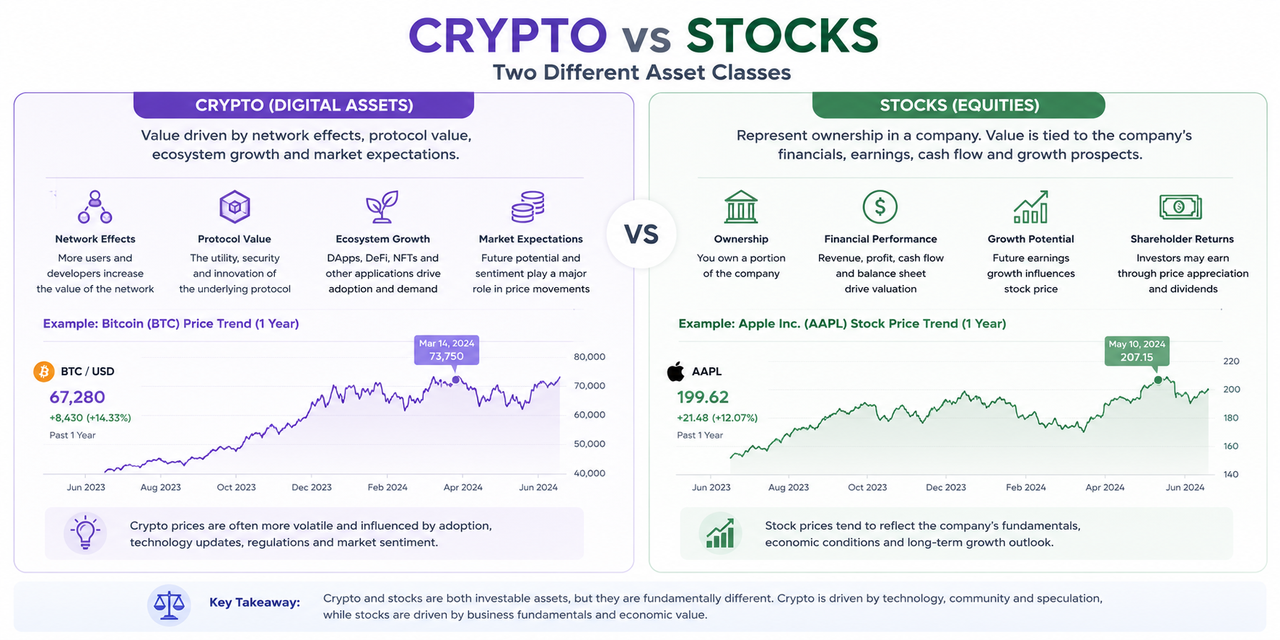
While both Crypto and stocks are traded in markets and influenced by market sentiment, macro conditions, and capital flows, their underlying value logic is not exactly the same.
Digital assets rely more on network effects, protocol value, ecosystem development, and market expectations. For example, a public chain project's value may stem from on-chain user growth, ecosystem prosperity, and tokenomics. In contrast, a stock represents partial ownership of a listed company, with its value typically tied to revenue, profit, cash flow, and future growth potential.
Simply put, when you buy a company's stock, you actually own a portion of that company's equity. The better a company performs and the stronger its profitability, the more likely the market is to assign it a higher valuation, and shareholders may benefit from price appreciation or dividends.
This fundamental-based investment logic is one of the key differences between the stock market and the digital asset market.
Why Does Global Capital Focus on U.S. Stocks for the Long Term?
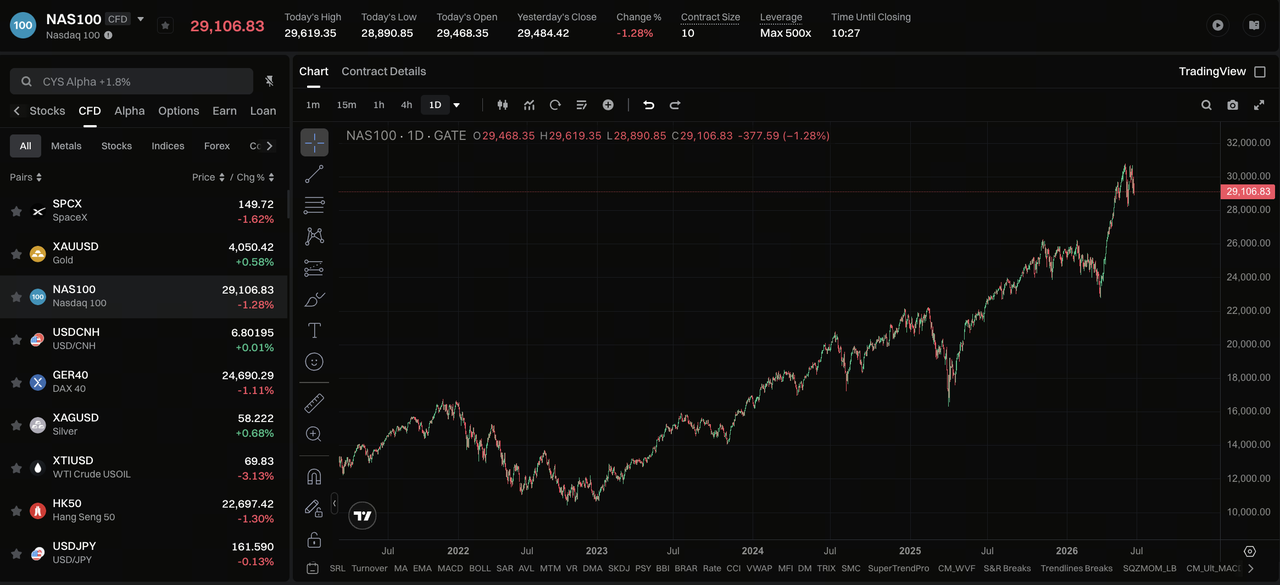
When talking about stock markets, U.S. stocks are often front and center. As the world's largest stock market, U.S. equities are home to many leading global enterprises. From tech giants like Apple, Microsoft, and NVIDIA to consumer leaders like Amazon—and spanning industries such as healthcare, finance, and manufacturing—the U.S. stock market offers a broad range of investment targets and strong liquidity.
At the same time, information disclosure in the U.S. stock market is relatively mature. Listed companies are required to publish regular financial reports disclosing business performance, revenue changes, and future plans. Investors can analyze and evaluate companies based on public information rather than relying solely on market sentiment for investment decisions.
For those interested in long-term investing, this level of transparency and regulation is significant.
Additionally, the U.S. is a hub for global innovation industries. In recent years, artificial intelligence has become one of the hottest themes in capital markets; around AI chips, cloud computing, software services, and robotics technology, numerous listed companies continue to draw investor attention. Many Crypto investors have found that beyond participating in on-chain ecosystems, engaging in long-term trends like AI through the stock market is also a noteworthy investment approach.
From Single Asset to Multi-Asset Allocation
Early Crypto investors often concentrated their funds in digital assets hoping to profit from market cycles.
But as their investment experience grows, more people realize that no single asset class is suitable for all market conditions over the long term. For instance, when the digital asset market is highly volatile, some capital may shift to traditional assets like stocks, bonds, or gold; when technological innovation accelerates, tech stocks may again become a focal point. As a result, more investors are adopting multi-asset allocation strategies—combining different types of assets to diversify risk and seek more long-term growth opportunities.
Stocks and Crypto aren't competitors; rather, they may play different roles. Digital assets offer high growth potential and innovation attributes, while stocks allow investors to share in the long-term achievements of established companies and global industries. A well-balanced allocation helps maintain a more stable investment rhythm across different market environments.
Crypto and U.S. Stocks Are Becoming More Connected
In the past, digital asset markets and traditional stock markets seemed like two separate worlds. In recent years, however, their connection has grown stronger. On one hand, more listed companies are holding digital assets or applying blockchain technology to their businesses; on the other hand, digital asset platforms are expanding into global multi-asset trading services to offer users more diversified investment options.
For Crypto users, barriers to entering the stock market are gradually lowering. From understanding enterprise value to tracking global industry trends and participating in various market opportunities, investors now have richer choices.
This also means that future investment capability isn't just about understanding a single asset class—it's about understanding relationships between different markets and building an asset allocation framework that fits individual needs.
Summary
Moving from Crypto to U.S. stocks isn't about leaving digital assets behind—it's an upgrade in investment perspective.
Stocks represent enterprise value; Crypto represents open networks and the digital economy. Each has different sources of value and serves different investment goals. As global capital markets continue to integrate, multi-asset allocation is becoming an important choice for more investors.
In upcoming lessons, we'll further explain how the U.S. stock market works, why it attracts global capital, and what basic rules and core concepts investors need to know before entering the stock market.