What Do You Actually Own When You Buy a Company's Stock?
After learning about the mechanisms of the US stock market in the previous lesson, a more important question arises: What do you actually own when you buy a company's stock?
Many people new to stocks tend to view them as a constantly fluctuating price curve or a tradable asset that can be bought low and sold high. In reality, stocks primarily represent ownership in a company.
In other words, buying stocks essentially means acquiring a stake in a company's future development.
Stocks Represent Ownership in a Business
Suppose there is an artificial intelligence company. In its early days, all shares are held by the founding team. As the business grows, the company decides to go public and raises funds by selling some shares to public investors. When investors purchase these shares, they become shareholders of the company.
Although ordinary investors may own only a small proportion of shares, legally they still hold part of the company's equity and can share in the results of the business's growth. Therefore, stock value does not appear out of thin air. A company's revenue growth, increased profits, expanded market share, and competitive advantage in the industry gradually reflect in its overall value. Stock prices are a comprehensive representation of this value and future expectations in the market.
This is one of the biggest differences between stocks and many other assets—they are backed by a real, operating business.
How Do Investors Make Money from Stocks?
Generally, there are three main ways investors earn returns from stocks:
-
Capital gains from rising stock prices. If an investor buys a company's stock at a lower price and the price rises as the business improves and market recognition grows, they can earn a profit when selling. For example, if a company keeps launching new products and its revenue and profits continuously grow, the market may see further growth potential and give it a higher valuation, leading to higher stock prices.
-
Dividends, commonly referred to as profit sharing. Some mature companies return part of their operating profits to shareholders. Even if investors don't sell their shares, they may receive regular cash dividends.
-
Gains from price revaluation during the IPO phase. When a company goes public through an Initial Public Offering (IPO), its stock may experience significant valuation increases due to high market expectations for future growth. Investors who participate early or during the offering phase and sell after prices rise may earn "listing premium" returns.
This model has some similarities with earning returns through staking certain digital assets but differs fundamentally. Stock dividends come from real business profits, not protocol incentives or token issuance mechanisms.
Therefore, in stock investing, investors care not only about growth potential but also about earnings quality and sustainability of cash flow. In other words, long-term returns ultimately depend on whether the business can continually create value in real operations.
Market Capitalization: How Does the Market Value a Company?
A commonly used concept in stock investing is market capitalization. Simply put, market capitalization is the total market value of a company. The calculation is straightforward: Market Cap = Stock Price × Total Shares Outstanding
For example, if a company has issued 1 billion shares at $100 per share, its total market capitalization would be $100 billion.
A higher market cap usually means a larger company, but it doesn't necessarily indicate higher investment value. Some large companies grow at a stable pace, while smaller or mid-sized companies may have greater growth potential despite their size.
Therefore, when analyzing companies, investors look beyond market cap and focus on profitability and growth potential.
What Is PE? Why Does the Market Assign Different Valuations?
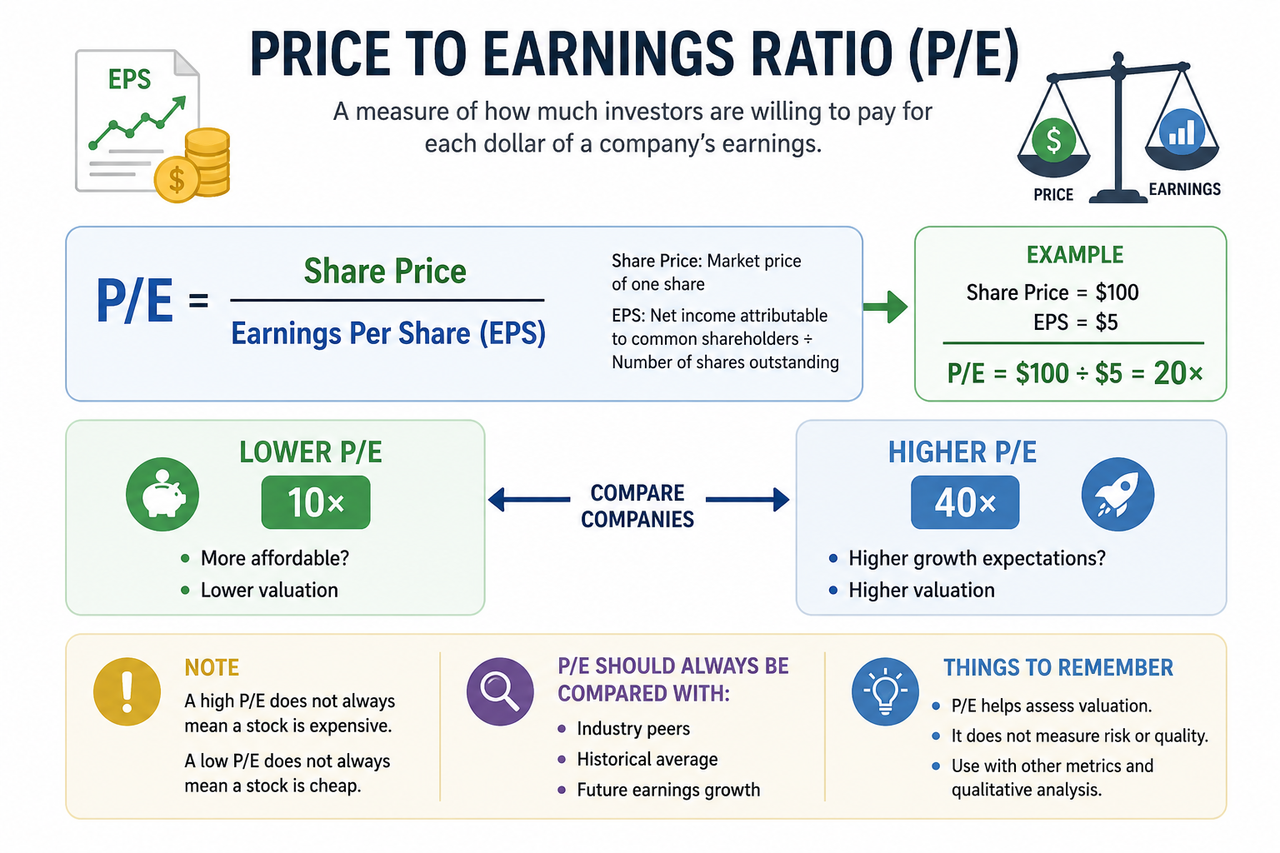
Another important indicator in the stock market is Price to Earnings Ratio (PE). The core logic behind PE is simple—it reflects how much investors are willing to pay for each unit of a company's profit.
If a company's PE is 20, it means the market is valuing the company at 20 years' worth of profit. Why do some companies have high PE ratios while others have low ones? The reason usually lies in market expectations for future growth. If an AI company is rapidly increasing its revenue and profit and investors believe it will get bigger in the future, the market may give it a higher valuation.
Conversely, if a company grows slowly or faces competitive pressure in its industry, the market will be more cautious with its valuation. Thus, PE is not always better when lower or higher—it must be evaluated together with growth ability, industry position, and future development prospects.
Stock Investing Is Essentially Investing in the Future
Often, stock prices don't fully reflect current business performance but rather market expectations for the future. That's why some companies maintain strong stock prices even with modest profits, while others with stable profits may see flat price performance if the market expects limited future growth.
For long-term investors, buying stocks isn't about predicting tomorrow's price movement but about considering:
-
Will this company still have a competitive edge in five or ten years?
-
Does its industry have room for further growth?
-
Can it continually generate profits and maintain its leading position?
When investors start focusing on business value rather than short-term price movements, their investment logic changes.
Stocks vs. Crypto: Two Different Ways to Express Value
For Crypto investors, understanding stocks doesn't mean abandoning digital assets. In fact, both represent judgments about the future—just with different sources of value. Crypto emphasizes open networks, technological innovation, and ecosystem growth, while stocks reflect business operations and profitability.
One asset represents trends in digital economics; the other stands for real-world businesses' ability to create value. As global capital markets become more integrated, more investors are paying attention to both markets—sharing opportunities from technological innovation and economic growth through different assets.
Summary
Buying stocks essentially means acquiring part of a company's future development rights. Stock value comes from the business's ability to generate profits; investors can earn returns from price appreciation or share in business results through dividends. Indicators like market cap, PE ratio, and profitability help investors assess a company's current value and future growth prospects.
After understanding the essence of stocks, our next lesson will discuss a more practical question: Faced with thousands of listed companies, how should investors analyze a business? How can you identify truly outstanding companies with long-term competitiveness?