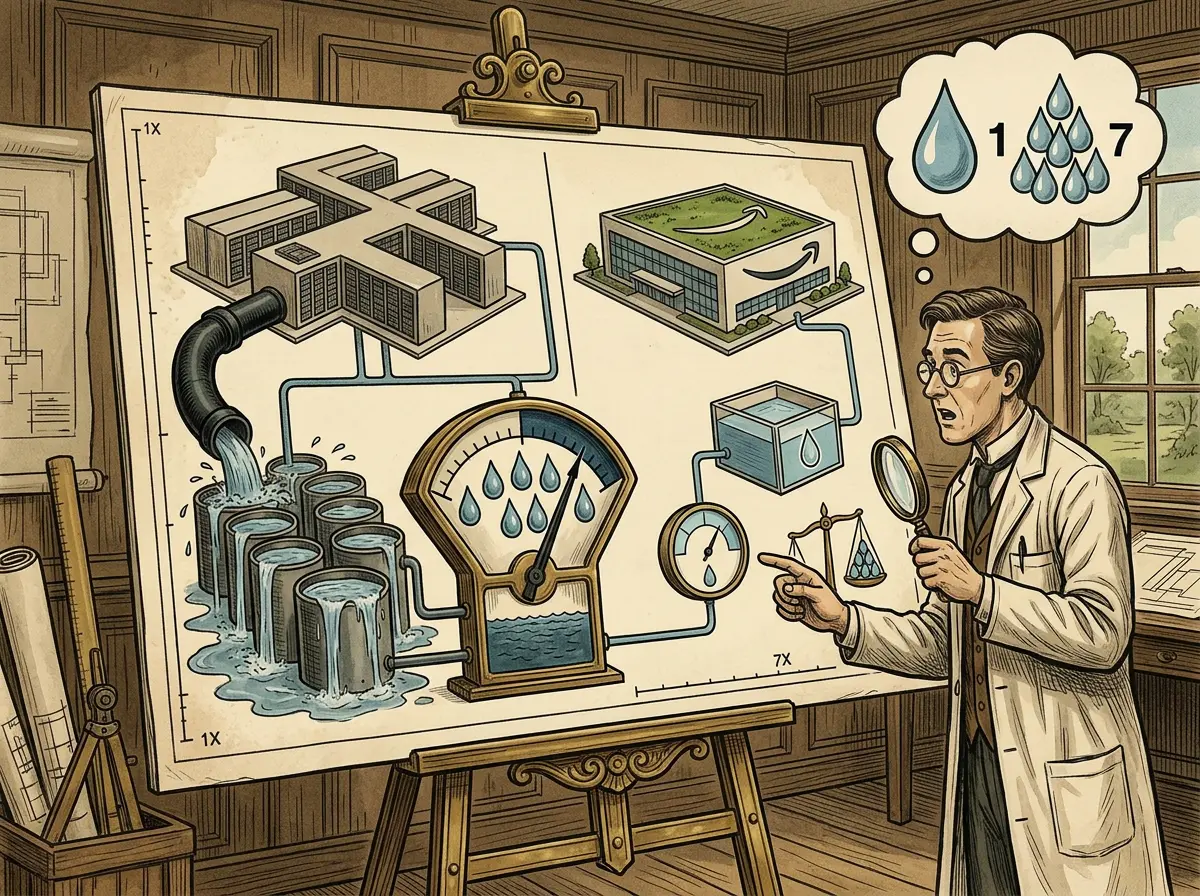
Amazon first publicly disclosed its data center water-use data on June 11: in 2025, global data centers consumed 2.5 billion gallons of water (about 9.5 billion liters), with a water-use efficiency (WUE) of 0.12 liters per kilowatt-hour, down 2% from the prior year while the operating scale continued to expand. Amazon included comparative charts in its report and claimed its efficiency is about 7 times higher than the industry average (0.84 liters per kilowatt-hour).
Limitations of Confirming the Report’s Methodology: Two Types of Water Not Counted
According to the confirmation notes in Amazon’s report, the statistical scope for the 2.5 billion gallons excludes two categories of water:
Indirect water (at the power-plant end): Cooling-water consumption at thermal power plants is typically the single largest item in a data center’s total water use across its entire life cycle, and Amazon’s report does not include it
Water use during new construction: Water use during the construction process for new data centers is also not included
In addition, 0.12 liters per kilowatt-hour is an annual average value, which dilutes the higher water-use figures in peak electricity-demand periods and in data centers located in arid regions.
Differences in Statistical Methodology for Peer Comparisons
The comparative figures cited in Amazon’s report that are unfavorable to Google focus mainly on water use at Gemini AI data centers, while Amazon reports the overall operations of all its data centers, according to analyses of article sources. The two denominators differ: one is for a specific AI workload, the other is for full-business operations. Directly placing numbers with different statistical scopes side by side presents methodological problems.
Industry Comparisons and Research Warnings
Microsoft has confirmed it has deployed closed-loop, zero-evaporation cooling systems across multiple data centers; each site can save more than 125 million liters of water per year. Relevant research has issued warnings: based on current development trends, by 2030 the water consumption of AI data centers is estimated to be equivalent to the annual drinking-water needs of 130 million people (this is a research estimate, not a confirmed figure).
The locality of water resources is also a key consideration: water cannot be dispatched across grids like electricity. Even if a data center built in a water-scarce area has an excellent annual-average WUE, it may still compete with local residents and agriculture for the same groundwater sources or river water rights.
Common Questions
How does Amazon’s WUE of 0.12 liters per kilowatt-hour compare with the industry average?
Amazon’s report confirms its 2025 WUE is 0.12 liters per kilowatt-hour and claims the industry average is 0.84 liters per kilowatt-hour—a gap of about 7 times. However, Amazon’s confirmed methodology excludes indirect water use at the power-plant end, and 0.12 is an annual average that does not represent the actual water use across all sites and all time periods.
Why is there methodological controversy in Amazon vs. Google water-comparison figures?
Based on analyses of article sources, the comparative figures unfavorable to Google in Amazon’s report focus mainly on water use at Gemini AI data centers, while Amazon reports the overall operations of all its data centers. The two statistical denominators differ (specific AI workload vs. full-business operations), so the figures are not directly comparable in methodological terms.
Amazon’s data center water use is disclosed for the first time—why is it revealed now?
Amazon does not explain in its report the specific reasons for disclosing it for the first time or why this timing was chosen. With the expansion of AI compute capacity driving the problem, data center water-use issues have attracted broader attention in recent years, and multiple local governments have reviewed the environmental impacts of data centers. This context is one of the external drivers prompting the industry to strengthen ESG disclosures.


