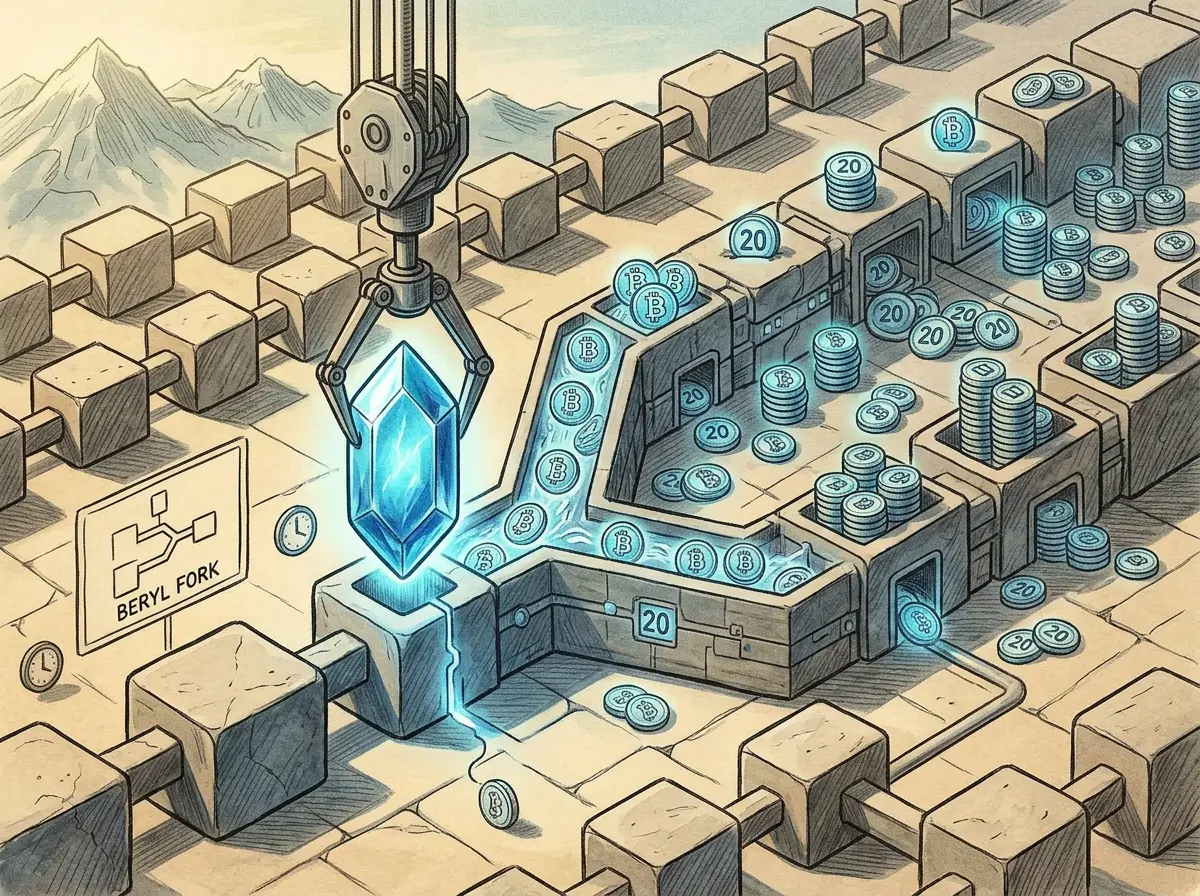
Coinbase’s Layer 2 network Base announced the Beryl hard fork upgrade. It will be launched on the Sepolia testnet at 2:00 Beijing time on June 19, and then activated on the mainnet. Beryl includes three main updates: the B20 native token standard(; the final confirmation window for single-proof withdrawals is shortened from 7 days to 5 days; and Reth V2.
B20 Native Token Standard Features
B20 is Base’s native token standard, an ERC-20 compatible token implemented via Rust precompilation. It is designed specifically for stablecoin, real-world assets (RWA), and long-tail token issuers. It comes with a built-in compliance toolkit that includes the following confirmation features: transfer strategy control, freezing and seizure mechanisms, role-based access control (RBAC), memo functionality, and supply cap settings.
Withdrawal Window Confirmation Change: 7 Days to 5 Days
The final adjudication window for the single-proof dispute resolution process has been shortened from 7 days to 5 days. The dual-proof fast lane (TEE+ZK) introduced by the Azul upgrade remains unchanged at 1 day.
According to Base’s confirmed explanation, the expected effects of shortening the single-proof window include: faster release of funds to liquidity providers for fast bridging, lower fees, and improved reliability for users bridging through third-party partners.
Reth V2 Performance Improvements and Upgrade Requirements
Reth V2’s confirmation technology improvements: up to a 50% reduction in disk space usage; and a rewritten state channel pipeline that brings a 33% increase in throughput.
Node operators must complete the version upgrade before each activation date: the confirmed versions for the Sepolia testnet are base-reth-node v1.1.0+, base-consensus v1.1.0+, and base/node v1.1.0+. The required versions for the mainnet are yet to be determined—stay tuned to Base’s official announcements.
FAQ
How is B20 different from existing ERC-20 tokens?
According to Base’s official documentation, B20 is an ERC-20 compatible native token standard implemented via Rust precompilation (as opposed to ERC-20 contracts written in Solidity). It is additionally built with a compliance toolkit for stablecoin, RWA, and long-tail token issuers, including transfer strategy controls, freezing/seizure mechanisms, and role-based access control—features that are not natively provided in standard ERC-20.
If the withdrawal window is shortened from 7 days to 5 days, is Azul’s 1-day fast lane still valid?
According to Base’s official confirmation, what is shortened is the window for the single-proof dispute resolution process (7 days → 5 days). The 1-day fast lane for the dual-proof scheme (TEE+ZK) introduced by the Azul upgrade remains unchanged. Both coexist and apply to different bridging routes.
When do node operators need to complete the upgrade?
According to Base’s official upgrade requirements, node operators must complete upgrades before each network activation date: the Sepolia testnet deadline is 18:00 UTC on June 18, 2026; the mainnet deadline is 18:00 UTC on June 25, 2026. The specific required version numbers for the mainnet are yet to be determined—keep an eye on Base’s official announcements.


