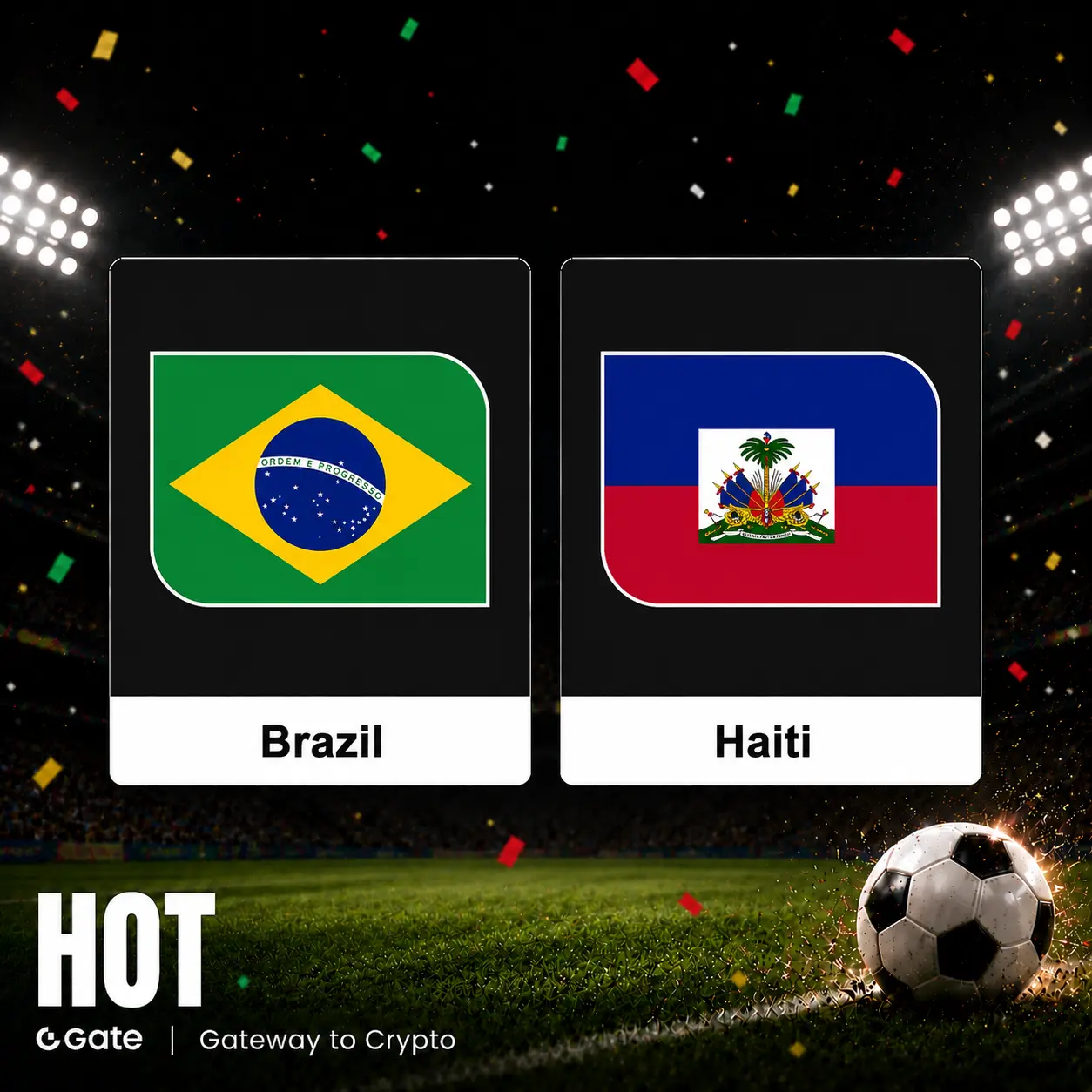
Where does the 89% win rate come from: how data defines “almost certain”
The core mechanism of prediction markets is to aggregate the information and judgments of dispersed market participants into quantifiable probability signals. Every price point is the result of votes cast with real money. An 89% win rate means the market believes Brazil’s probability of winning this match is close to nine-tenths.
This number does not come out of thin air. From fundamental data, Brazil is currently ranked 6th in the FIFA World Ranking, with 1,765 points; Haiti is only ranked 83rd, with 1,293 points. In terms of total squad value, Brazil’s entire team is valued at €920 million, while Haiti’s entire team is worth less than €60 million. The world ranking difference is 77 places, and the value gap is more than 15 times—these are the most basic underlying grounds for prediction market pricing.
The results from the group stage’s first round further reinforce this expectation. Brazil drew 1-1 with Morocco in the opening match, failing to take all three points. With qualification prospects suddenly tightened, it means Brazil has no room for relaxation in the second round—they must fight for victory at full strength. Haiti lost 0-1 to Scotland in their first round, and their offense had not yet found the net. One side is a title favorite that needs a win, the other is a weak team that hasn’t scored yet—after the first round, the market’s expectation for a Brazil win was pushed even higher.
The gap in strength: systematic differences from rankings to squad value
The gap in strength between Brazil and Haiti shows systematic characteristics across nearly every dimension.
Brazil is the most successful team in World Cup history, with five championship titles, and since the inaugural tournament in 1930, they have never missed a single edition. In this year’s Brazil squad, there are world-class attackers such as Vinícius, Rodrygo, and Raphinha. Even if the team’s top star Neymar is confirmed out due to injury for this match, the team’s attacking depth is still enough to overwhelm most opponents.
By contrast, Haiti is only their second appearance in the World Cup final tournament in the team’s history. Their last appearance dates back to 1974. Many Haitian players come from Major League Soccer or second-tier European leagues; overall training intensity and match experience differ in level compared with Brazil.
The two teams have met three times in official matches historically. Brazil won all three, scoring 17 goals and conceding only 1. In the 2016 Centenary Copa América, Brazil defeated Haiti 7-1. Although the historical head-to-head sample is limited, the huge score margin has become an important reference anchor for market pricing.
How prediction markets price football matches: mechanisms and logic
Prediction markets differ fundamentally from traditional sports betting in their pricing mechanism. In traditional betting platforms, the operator sets the odds, while in prediction markets, the price is generated by a trading game between buyers and sellers. The price of each share fluctuates between $0 and $1; in essence, it is the market’s collective valuation of the probability that the event will occur.
This means the 89% win rate is not the judgment of any single institution, but the result of thousands or even tens of thousands of traders collectively “voting” with their capital. In an environment of anonymous wagers with real money, dispersed information is quickly integrated into a price signal weighted by participants’ willingness to allocate funds. When most market participants believe Brazil’s probability of winning is extremely high, money continuously pours into buying “Brazil win” shares, pushing the price up until it approaches $0.89—i.e., a 89% probability.
This mechanism gives prediction markets a unique advantage in information aggregation efficiency. Unlike polls or expert opinions, prediction markets require participants to bear real economic risk, which better filters out noise and false judgments.
What an 89% win rate means: capital consensus and marginal games
An 89% win rate is not a static number, but the outcome of a dynamic game.
The current market pricing is highly aligned on this result—meaning the marginal upside of betting on a Brazil win has been greatly compressed. Under this probability structure, the expected return rate from betting on a Brazil win is only about 12% (1 / 0.89 ≈ 1.12x). By comparison, the potential return for betting on Haiti to pull off an upset exceeds 28x.
Therefore, the true focus of the market game has shifted from “whether Brazil wins” to two more controversial directions: first, whether Brazil can win by a net margin of more than 3 goals; second, whether the total number of goals exceeds 3.5. Gate’s prediction market data shows that the probability Brazil’s total goals exceed 2.5 is 62%, while the probability Haiti’s total goals are under 0.5 is 60%.
These probability distributions in the sub-markets reveal deeper judgments about the match’s progression: Brazil will likely win—but how much they win by, and how many goals they score, is the real battleground for capital competition.
How pre-match variables disturb probabilities: absences, tactics, and will to win
Although the 89% win rate seems steady, there are several pre-match variables that could still shift probabilities.
Neymar’s absence is information the market has already fully digested. But Brazil’s attacking efficiency problem exposed in the opening round—87.4% possession yet only 1 goal—means head coach Carlo Ancelotti must make tactical adjustments in the second round. Judging from Brazil’s mediocre midfield performance in the first round, Brazil may introduce young players like Endrick up front to inject energy. The effect of tactical changes will, to some extent, influence the deviation between the actual score and market expectations.
On Haiti’s side, the absence of their midfield core Leyverton Pijean due to injury makes an already weak midfield even worse. Haiti will almost certainly line up in a rigid 5-4-1 shape, looking for opportunities through deep defending and fast counterattacks. But facing Brazil’s sustained high-pressure attack, it is likely that Haiti’s defensive line will expose vulnerabilities as their stamina drops in the second half.
In addition, Brazil’s pressure to qualify from the group stage is an important will-to-win variable that cannot be ignored. Taking only 1 point in the first round means Brazil has no room for error in terms of goal difference—they not only need to win, but also need to score as many goals as possible. The market has priced part of this will-to-win factor, but the intensity of execution in the actual match remains uncertain.
From single-match probability to industry trends: how prediction markets change sports event pricing
This Brazil vs. Haiti fixture is not an isolated case. It is a microcosm of the explosive growth of crypto prediction markets during the 2026 World Cup.
As of June 16, 2026, Gate’s prediction markets’ cumulative trading volume has exceeded $251 million. Globally, prediction markets have entered a takeoff phase—since 2026 began, nominal trading volume has exceeded $20 billion for four consecutive months, with April alone nearing the historical high of almost $30 billion. Polymarket’s single market for the World Cup champion has already broken $1.9 billion in volume.
Prediction markets are moving from fringe tools to mainstream financial infrastructure. They allow users to trade around real-world future events—from sports events to political elections, from macroeconomic indicators to crypto price trends. The probability curve of each match is not only a tradable asset, but also a real-time intelligence system.
Within this trend, a single-match 89% win rate is no longer just a simple “who wins or loses” question, but a typical sample for understanding how prediction markets price outcomes, aggregate information, and reflect collective wisdom.
Risks and limitations: probability is not prophecy
An 89% probability does not equal 100% certainty. While prediction market pricing is efficient, it is not without limitations.
First, prediction market prices reflect “market consensus,” not “objective facts.” If market participants’ information has systematic bias, the price signal will also be distorted. Second, markets with insufficient liquidity may see price distortions—although World Cup events are high-liquidity, the depth of sub-markets still needs attention. In addition, prediction markets respond with a lag to sudden events (such as pre-match injuries or tactical adjustments), and price updates require trading volume to support them.
For participants, understanding the structural meaning of an 89% win rate is more important than chasing the number itself. When the market has already priced a particular outcome with high agreement, the real opportunities often lie not within mainstream consensus, but in the marginal space beyond consensus.
Frequently Asked Questions (FAQ)
Q: How is the prediction market’s 89% win rate calculated?
The prediction market price is determined by a trading game between buyers and sellers. Each share’s price fluctuates between $0 and $1; in essence, it is the market’s collective valuation of the event’s probability. When large amounts of capital buy “Brazil win” shares, the price rises to near $0.89, which corresponds to an 89% win rate.
Q: Does an 89% win rate mean Brazil can definitely win?
No. 89% is a probability valuation from the market, meaning the market thinks Brazil has an 89% chance to win, but there is still an 11% probability of a draw or Haiti pulling off an upset. Prediction markets reflect consensus, not prophecy.
Q: Why is the payout for betting on a Brazil win so low?
Because an 89% win rate means the market already highly agrees that Brazil will win. At this probability, the expected return rate for betting on Brazil is about 12% (1/0.89 ≈ 1.12x). High certainty necessarily comes with low returns—this is the basic logic of market pricing.
Q: What’s the difference between prediction markets and traditional sports betting?
The core difference is the pricing mechanism. Traditional betting sets odds by the platform, while prediction market prices are generated by the trading game between buyers and sellers. Prediction markets do not preset odds, and they do not take on result risk; they only charge trading fees.
Q: Will Neymar’s absence affect Brazil’s win rate?
The market has already fully priced in Neymar’s absence. Brazil’s squad depth is enough to cover this absence. However, if other key players suffer sudden injuries before the match, probabilities could change.
Q: How can I participate in Gate’s prediction market trading?
Users can use their existing account balances to participate in prediction markets that cover multiple categories, including crypto trends, major sports events like the 2026 World Cup, macroeconomic indicators, and political outcomes. Gate offers two experience modes: “Prediction Mode” and “Trading Mode.”