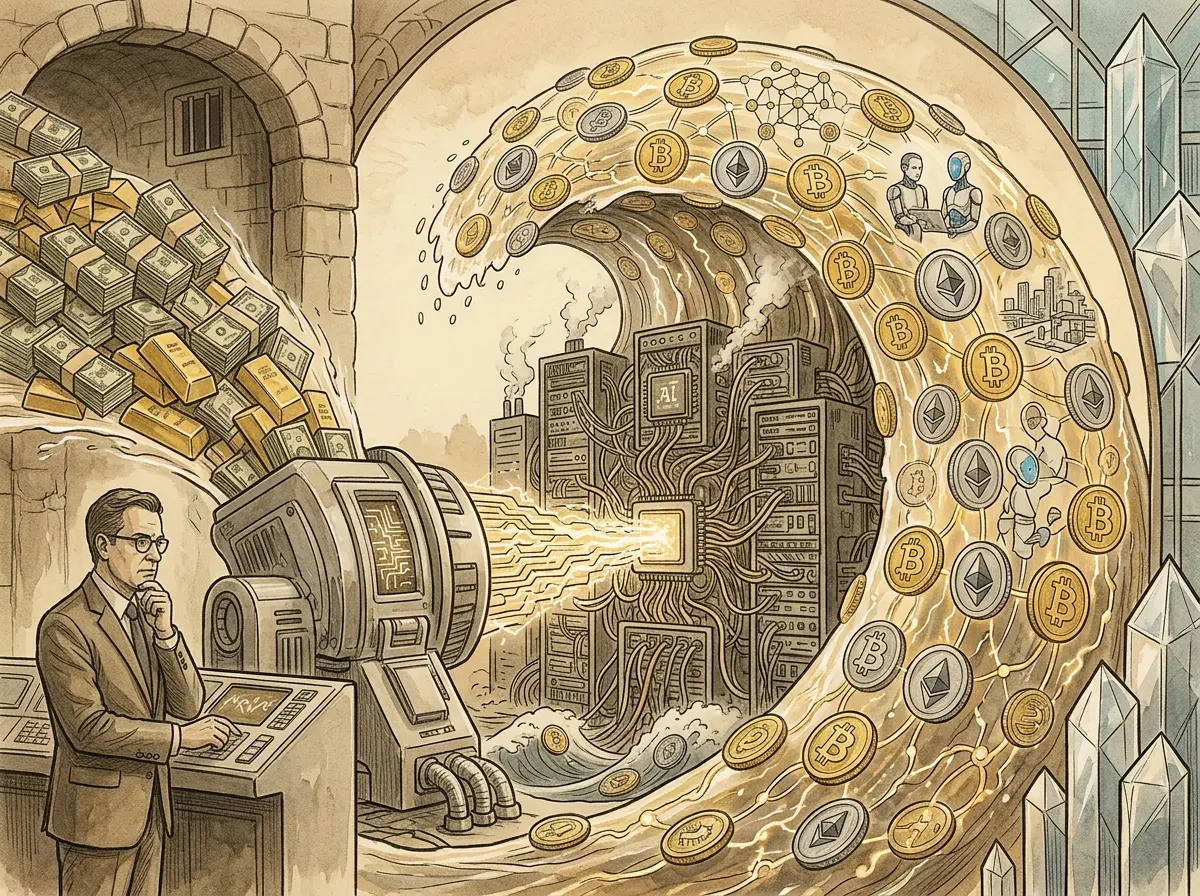
On June 14, macro investor and co-founder of Real Vision Raoul Pal spoke with Wall Street strategist Jordi Visser in a podcast episode, discussing how AI is driving compute power and energy to replace traditional resources, bottlenecks in data center construction, and the AI agent economy and tokenization. Both believe that crypto is in a consolidation phase, digesting gains, and that when AI infrastructure bottlenecks trigger capital rotation, it will form the third wave.
Core arguments: from “labor and capital” to “compute power and energy”
In the conversation, Jordi Visser proposed a core framework: in the past, building a business required borrowing, hiring workers, and renting office space; but in a new world centered on “compute power and energy,” those rules are completely different. If you cannot manufacture the required chips or secure enough electricity, a supply-demand imbalance bottleneck will arise—but the cause of the bottleneck is not insufficient demand, it is demand that is too high.
Raoul Pal added his “Reed’s Law” (the square of exponents) framework: with the addition of GPUs and AI, compute power growth is showing “double exponential” growth on logarithmic charts. His view is that data center construction progress has completed only 30% of what was expected to be announced, and with the tech competition between the US and China, plus the fact that no single leading AI company can monopolize compute power, a “supercycle” is nearly inevitable—one that will be “the largest capital expenditure cycle visible in human history.”
AI agent economy: Jordi Visser’s “invisible marketplace” framework
Jordi Visser used a “thinker” analogy to describe AI agents: if suddenly 7.5 billion people appeared on Earth, resources would be quickly exhausted; but AI agents create tens of billions to even hundreds of billions of new “thinkers,” and they only consume compute power—they don’t need to buy houses or send children to college. Jordi Visser believes this will usher in a “time of abundance,” letting humanity choose whether it still needs to work.
Jordi Visser’s “invisible economy” framework: AI agents will conduct millisecond-level API call transactions with each other. The scale is astonishing, but it is almost invisible under the current framework. He believes the world’s largest market will no longer be humans’ asset market, but the data market that AI is hungry for. Raoul Pal added that OpenAI has 1 billion users, and each user is using a different instance of this massive intelligence—while the intelligence itself compounds with an exponential stacking effect.
Tokenization view: Raoul Pal’s dormant asset framework
Raoul Pal said that about two-thirds of the world’s large assets (such as real estate, private equity, venture capital, and artworks) are illiquid dormant assets. Once tokenized, it brings transparency and faster liquidity, and faster liquidity directly boosts GDP. He views tokenization as a key tool to solve government debt, long-life welfare, and ownership issues, and also one of the preconditions for triggering the crypto market’s “third wave.”
Crypto market outlook: three IPO viewpoints and a framework waiting for the third wave
Jordi Visser’s take on the three major IPOs: He believes that major IPOs like OpenAI, Anthropic, and SpaceX are companies drawing blood from the stock market in the competition for limited capital. His judgment is that these three IPOs “may mark the peak of short-term infrastructure Capex transactions,” but it does not mean the overall market has peaked—capital will rotate into other targets such as software.
Raoul Pal’s 3–6 month digestion view: Raoul Pal said that after just experiencing an “AI capital expenditure buffet,” it needs a 3 to 6 month consolidation digestion period. He proposed two premises for the crypto third wave: first, AI physical infrastructure bottlenecks will push capital toward digital-world targets that require capacity but not physical expansion; second, tokenization will drive institutional capital back into the crypto market.
Jordi Visser’s digestion logic for Bitcoin ETFs: He believes that Bitcoin ETFs effectively front-load and draw down a large amount of demand with approval and presidential support. In a context where global liquidity expands by only about 10% per year, the capital prepaid for a year would need a year to be digested. Right now, it is an unavoidable period of painful consolidation.
FAQ
What source number does Raoul Pal cite for “data centers completed only 30%”?
This is a personal observation number Raoul Pal referenced in the podcast. He said that “data center construction progress has completed only 30% of what was expected to be announced.” This is Raoul Pal’s personal statement, not verified data from an official statistical agency or a research report.
How should we understand Jordi Visser’s “three major IPOs or they may mark Capex at its peak”?
Jordi Visser’s personal view is that the three major IPOs—OpenAI, Anthropic, and SpaceX—represent these companies raising financing from external shareholders in a limited capital market. He believes that this “may” mark the peak of short-term AI infrastructure Capex transactions, but he emphasizes that it does not mean the entire market has peaked. This is Jordi Visser’s personal macro judgment, not a confirmed market analysis conclusion.
What do “crypto third wave” or “Banana Zone” refer to?
In the conversation, Jordi Visser cited Elliott Wave theory, saying he is waiting for the crypto market’s “third wave,” analogous to the time he previously caught the big rally in Micron Technology. “Banana Zone” is Jordi Visser’s personal term, referring to the major breakout phase of the crypto market that he expects. This is based on a personal investment framework using wave theory, not a confirmed market timing analysis.


