Yusfirah

vip
Age 1.2 Yıl
Peak Tier 5
No content yet
#CryptoMarketSeesVolatility
VOLATILITY IS NOT THE PROBLEM. NOT UNDERSTANDING IT IS.
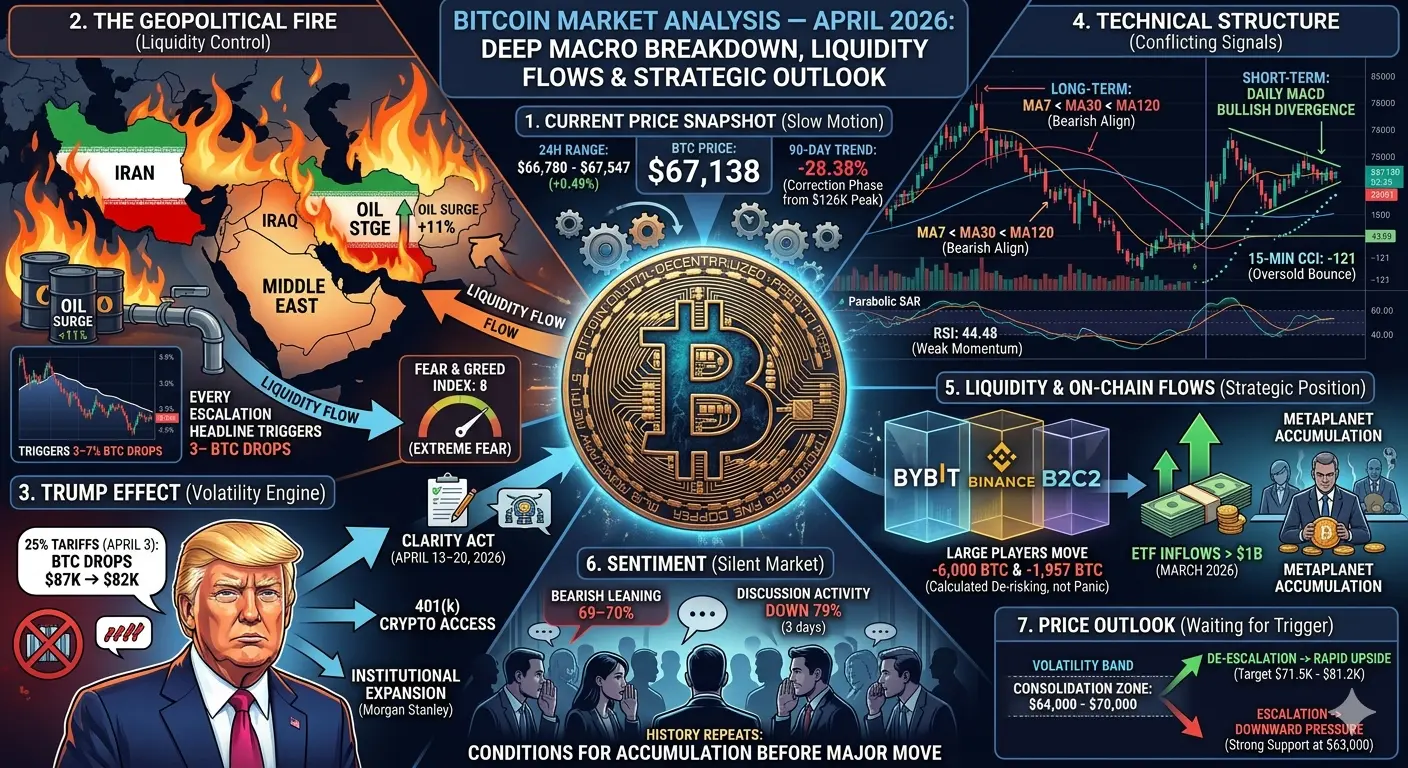
Right now Bitcoin is at $67,081. Ethereum is at $2,052. The fear and greed index is 12 — that is Extreme Fear, and it has been sitting there for weeks. Most people looking at these numbers are asking the wrong question. They are asking "when does it recover?" The better question — the one that actually protects your capital and positions you correctly for what comes next — is "what is specifically driving this volatility, and what would have to change for it to stop?"
This post answers that question with data.
BTC-0,04%
ETH-0,89%
SOL-1,91%
DRIFT3,4%
Luna_Starvip
#CryptoMarketSeesVolatility
VOLATILITY IS NOT THE PROBLEM. NOT UNDERSTANDING IT IS.
Right now Bitcoin is at $67,081. Ethereum is at $2,052. The fear and greed index is 12 — that is Extreme Fear, and it has been sitting there for weeks. Most people looking at these numbers are asking the wrong question. They are asking "when does it recover?" The better question — the one that actually protects your capital and positions you correctly for what comes next — is "what is specifically driving this volatility, and what would have to change for it to stop?"
This post answers that question with data. Not vibes. Not predictions. Data.
The Sentiment Picture Is At A Multi-Week Extreme
Santiment published data today showing that bearish social media chatter around Bitcoin has reached its highest level in five weeks. Their exact words: "FUD has crept back in with the community showing a key lack of optimism." Here is the part most people skip over when they read that headline — Santiment also noted that this level of community pessimism is "usually a common ingredient for prices rebounding." That is not a contradiction. It is how sentiment cycles work. Maximum bearishness does not mean the price goes lower forever. It means the people most likely to sell have already sold, and the remaining holders are the ones with actual conviction. The ratio of bullish to bearish voices on Bitcoin right now is roughly 2:1 — 82 bullish accounts tracked versus 40 bearish, out of 142 active voices. That 2:1 ratio at a fear index of 12 tells you the bulls have not been completely washed out. They are just quiet.
The On-Chain Data Tells A Specific Story
Glassnode data published this week showed that Bitcoin holders in the 100 to 1,000 BTC range — what analysts call "sharks" — and holders in the 1,000 to 10,000 BTC range — the "whales" — have been realizing average daily losses of approximately $188.5 million and $147.5 million respectively. Combined, that is roughly $337 million in realized losses per day from large holders alone. Cumulative realized losses for the year have already hit $30.9 billion — approaching the levels seen during the 2022 bear market bottom.
CryptoQuant's five-data-source analysis published this week reached the same conclusion from multiple angles: Bitcoin demand is contracting at negative 63,000 BTC per month. Large holders have distributed nearly 188,000 BTC over the past year. The Coinbase premium is negative. Mid-sized holder growth is running at 429,000 BTC versus approximately 1 million in late 2025. The market, in CoinDesk's phrasing, is "thinning from the inside" — the structural demand base is narrowing even as institutional names continue buying in public.
In the past 24 hours alone, Coinglass data shows $59.82 million in total liquidations across the market. Short liquidations accounted for $38.93 million versus $20.89 million in long liquidations — meaning the market caught more shorts off-guard than longs in the most recent session, which is a micro-signal worth watching. When short liquidations begin consistently exceeding long liquidations during a period of maximum fear, it is an early indication that the directional pressure is beginning to shift.
The Macro Drivers Are Not Going Away Overnight
Everything happening on-chain is happening inside a macro environment that is genuinely hostile to risk assets right now. The Iran situation remains active and unresolved — Trump has signaled continued military operations while Iran has been in diplomatic talks with Oman over Hormuz traffic management. WTI crude oil has been trading between $110 and $115 per barrel in volatile sessions this week. JPMorgan told CNBC that Iran's maximum economic leverage on global markets would be felt within weeks as the oil shock works through supply chains. Larry Fink said $150 oil means 100% recession probability. The Federal Reserve cannot cut rates into an oil-driven inflation environment without risking overheating. Bitcoin needs global liquidity expansion for a sustained price recovery. Global liquidity remains constrained as long as oil is elevated and the Fed is paralyzed between its two mandates.
Add to that the Drift Protocol exploit — $200 to $285 million drained from a Solana-based derivatives platform in a pre-planned attack with an eight-day preparation window — and the Google quantum computing paper establishing a 2029 deadline for Bitcoin's cryptographic migration. Neither of these is an immediate existential threat to Bitcoin. Both of them add uncertainty premium to positions and contribute to the sustained elevated fear reading that has defined this entire quarter.
What The Structural Support Actually Looks Like
Here is the honest version of where the floor sits. Bitcoin's 200-week moving average is at $59,268. The realized price — the average cost basis of every Bitcoin holder on-chain — is at $54,177. Both levels have held through all of Q1 2026. Some analysts are calling for a potential bottom zone between $40,000 and $50,000 under a severe scenario where ETF outflows accelerate and leverage fully unwinds. That scenario is plausible but requires a sequence of simultaneous failures — oil continuing toward $150, institutional outflows reversing, and leveraged liquidations cascading through multiple sessions — that has not yet materialized.
What has materialized on the other side of the ledger: ETH derivatives recorded their first net positive buy pressure since the 2023 bear market bottom this week — $104 million in net buying. Strategy is buying 44,000 BTC per month regardless of price. Bitmine added 40,000 ETH to its balance sheet this week at current prices. The halving cycle historically points toward recovery in the 12 to 18 months following the April 2024 halving event — which puts the structural window somewhere between mid and late 2026. Long-term holders are still realizing losses at approximately $200 million per day, which sounds bearish until you recognize that in every prior cycle, the point of maximum long-term holder pain has preceded the recovery by approximately one to two quarters.
The One Thing Volatility Always Rewards
Volatility rewards the people who understand it more than the people who fear it. The traders who panic-sold Bitcoin in November 2018 when every data point looked as bad as it does today missed the entire 2019 to 2021 cycle. The ones who held through the fear index readings in the single digits in 2022 were positioned for the recovery into 2024. That is not a guarantee that history repeats identically. It is an observation that the psychological conditions required to shake out weak hands — maximum FUD, sustained fear readings, bearish social media chatter at multi-week highs, whale distribution — have historically coincided more closely with bottoms than with the continuation of downward moves.
The volatility you are watching right now is not chaos. Every movement has a named cause, a documented data source, and a knowable threshold at which it resolves. The Iran situation resolves when Hormuz fully reopens and oil falls below $90. The leverage overhang resolves when open interest returns to neutral and funding rates stabilize. The on-chain distribution pressure resolves when realized losses approach the exhaustion levels seen in prior cycles. None of those thresholds have been reached yet. All of them are visible and measurable in real time.
Watch the thresholds. Not the candles.
#CryptoMarketSeesVolatility #Gate广场四月发帖挑战 #GateSquare

repost-content-media
  • Reward
  • 4
  • Repost
  • Share
User_anyvip:
You're awesome, my friend, this is a really high-quality and informative post. Great work, thank you for the information.

坚定HODL 💎

Diamond Hands 💎

2026 GOGOGO 👊

To The Moon 🌕

LFG 🔥

1000x Vibes 🤑

DYOR 🤓

It's valuable to see content like this, I'm following you. I wish you continued success.
View More
#Gate广场四月发帖挑战
BTC Market Update April 5, 2026
65K Support Test: Consolidation Phase,
Not Reversal:
Bitcoin is currently trading at $66,995, holding within a narrow range between $66,610 and $67,547. The 24-hour change is nearly flat at -0.19%. Despite this calm surface, a key technical and macro battle is ongoing. BTC recently dropped to $65,112, its lowest since late February, before recovering. The market is not trending it is deciding direction.
This is a consolidation phase. The key question is whether this is a pause before further downside or a base for a move higher. Current data pres
BTC-0,04%
Falcon_Officialvip
#Gate广场四月发帖挑战
BTC Market Update April 5, 2026
65K Support Test: Consolidation Phase,
Not Reversal:
Bitcoin is currently trading at $66,995, holding within a narrow range between $66,610 and $67,547. The 24-hour change is nearly flat at -0.19%. Despite this calm surface, a key technical and macro battle is ongoing. BTC recently dropped to $65,112, its lowest since late February, before recovering. The market is not trending it is deciding direction.
This is a consolidation phase. The key question is whether this is a pause before further downside or a base for a move higher. Current data presents a mixed picture and that itself is the signal.
THE PRICE STRUCTURE WHAT THE LEVELS SAY:
BTC sits between clear technical boundaries.
On the downside, $65,000–$66,610 is the active support zone. The recent low at $66,610 held, and the deeper test at $65,112 also bounced. Below this, next support lies at $63,000–$64,000. A daily close below $65K shifts structure bearish.
On the upside, resistance is between $67,500–$69,000. BTC has failed multiple times near $69K, confirming it as strong resistance. The 4H MA30 ($67,310) and MA120 ($69,075) are both above price.
Daily MAs show a bearish structure: MA7 ($67,332), MA30 ($69,208), MA120 ($78,679) all above price. This confirms a bearish trend structure, meaning rallies face resistance.
THE TECHNICAL SIGNALS DIVERGENCE IS KEY:
Signals are mixed, defining this consolidation phase.
Bearish momentum:
Daily RSI at 44.02 and 4H RSI at 47.38 indicate weak bullish strength. Volume shows a decline with expansion, signaling active sellers.
Bullish divergence:
A MACD bullish divergence is forming. Price made a lower low, but histogram improved from -165.09 to -135.96, showing slowing selling momentum.
SAR confirmation:
Parabolic SAR on both 4H and daily is at $66,610, below price — still bullish. A close below this flips the signal bearish.
Short-term stability:
Price is slightly above the 15-min MA20 ($66,947), showing short-term stability.
👉 Summary: momentum bearish, divergence bullish, structure neutral — a decision zone.
THE MACRO OVERLAY WHY CONSOLIDATION IS HAPPENING:
Macro conditions are heavily influencing BTC.
Oil shock & geopolitics:
Brent crude reached $141.37, highest since 2008. U.S.–Iran tensions and Strait of Hormuz closure are driving uncertainty. Rising oil pushes inflation higher, limiting rate cuts and pressuring risk assets.
Fear & Greed Index:
At 12 (Extreme Fear) historically a zone where selling slows and accumulation begins.
Federal Reserve outlook:
No rate cuts expected in 2026 due to inflation pressure.
Equity correlation:
S&P 500 down 4.4% YTD. BTC 90-day change at -28.54%, showing macro pressure impact.
ON-CHAIN & INSTITUTIONAL FLOWS
Conflicting signals continue.
• Over $2B BTC moved to exchanges potential selling pressure
• Miners sold significant BTC (including Riot’s 3,778 BTC)
• Total miner selling exceeds 15,000 BTC
On the bullish side:
• Metaplanet acquired 5,075 BTC, total 40,177 BTC
• Target: 100,000 BTC by year-end
Institutional infrastructure is growing, though not impacting price immediately.
KEY LEVELS TO WATCH
Support:
• $66,610 — SAR level
• $65,000 — key floor
• $63K–$64K — next support
Resistance:
• $67,332 — MA7
• $69,000–$69,208 — key ceiling
• $78,679 — macro resistance
👉 Current range: $65K–$69K
THE BOTTOM LINE CONSOLIDATION:
This is not a reversal it is a consolidation phase.
Bearish factors:
• Weak MA structure
• Selling pressure
• Macro risks
Bullish factors:
• MACD divergence
• SAR still bullish
• Extreme Fear = accumulation zone
• Institutional buying present
👉 Final view:
BTC is in a decision zone, not a trend.
The next move will come from a breakout above $69K or breakdown below $65K.
Until then, the market is waiting.
Deadline: April 15th
Details: https://www.gate.com/announcements/article/50520
#AreYouBullishOrBearishToday?
#OilPricesRise
#GateSquareAprilPostingChallenge
repost-content-media
  • Reward
  • 4
  • 1
  • Share
User_anyvip:
To The Moon 🌕
View More
#GateSquareAprilPostingChallenge
The Crypto Market is Bleeding — But Smart Money is Quietly Positioning. Here’s the Full Picture.
The market right now feels heavy. Sentiment is weak. Confidence is low.
The Fear & Greed Index is sitting at 12 — Extreme Fear, a level that historically reflects panic, uncertainty, and emotional decision-making across the market.
At the same time:
Bitcoin (BTC) is hovering near $66,791
Ethereum (ETH) has slipped below $2,030
Retail sentiment across social platforms is turning bearish
Short-term traders are exiting positions aggressively
On the surface, this looks
BTC-0,04%
ETH-0,89%
HighAmbitionvip
#GateSquareAprilPostingChallenge
The Crypto Market is Bleeding — But Smart Money is Quietly Positioning. Here’s the Full Picture.
The market right now feels heavy. Sentiment is weak. Confidence is low.
The Fear & Greed Index is sitting at 12 — Extreme Fear, a level that historically reflects panic, uncertainty, and emotional decision-making across the market.
At the same time:
Bitcoin (BTC) is hovering near $66,791
Ethereum (ETH) has slipped below $2,030
Retail sentiment across social platforms is turning bearish
Short-term traders are exiting positions aggressively
On the surface, this looks like the beginning of a deeper correction.
But beneath the surface — something very different is happening.
What “Extreme Fear” Really Signals (And Why It Matters)
Most retail traders misunderstand fear.
They see falling prices and assume more downside is coming. But historically, extreme fear is not a warning — it is an opportunity zone.
Let’s look at the data:
March 2020 (COVID crash)
Fear Index dropped to 8 → BTC around $4,000
→ This marked the beginning of a massive bull cycle
November 2022 (FTX collapse)
Fear Index dropped to 6 → BTC around $15,000
→ This became a long-term accumulation zone
In both cases, the majority sold due to panic.
And in both cases, those who accumulated during fear captured the largest upside later.
Fear creates mispricing. Smart money exploits it.
What Smart Money is Doing Right Now
While retail investors are reacting emotionally, institutions are acting strategically.
Here’s what’s happening behind the scenes:
BlackRock continues accumulating crypto exposure through ETFs and structured products
MicroStrategy (Strategy) added 44,000 BTC last month — reinforcing long-term conviction
UBS and Société Générale are actively tokenizing real-world assets on Ethereum
The Coinbase Premium Index turning positive suggests institutional buying pressure in the U.S. market
This is not panic behavior.
This is positioning during weakness.
Institutions don’t chase green candles.
They accumulate when liquidity is available and sentiment is broken.
The Macro Pressure — Why Markets Feel Weak
The current market dip is not random. It is driven by broader global factors:
Rising geopolitical tensions creating uncertainty across financial markets
Oil price volatility impacting inflation expectations
Tight global liquidity conditions reducing risk appetite
Stronger dollar putting pressure on risk assets like crypto
These forces are pushing capital temporarily out of high-risk assets.
But here’s the key insight:
These are short- to mid-term pressures — not long-term invalidations of crypto.
Meanwhile… Adoption is Quietly Accelerating
Even as prices struggle, infrastructure and adoption are growing:
Charles Schwab is preparing to roll out spot crypto trading for retail investors
Bitcoin ETFs are rapidly approaching the scale of gold-based investment products
Over $125 billion in real-world assets (RWAs) are being integrated onto Ethereum
Jack Dorsey has revived the Bitcoin Faucet concept to onboard new users globally
This is the classic divergence:
Price is weak — but fundamentals are strengthening.
That gap is where long-term opportunities are created.
So What Should You Do in This Market?
Instead of reacting emotionally, focus on structured decisions:
1. Zoom Out — Context Matters
Short-term charts (1H, 4H) are noise-heavy and emotionally triggering.
The weekly and monthly trend still reflect a broader upward structure.
One red week does not invalidate a long-term thesis.
2. Pre-Define Your Strategy
Decide your plan before volatility hits:
If you believe in long-term growth → consider DCA (Dollar-Cost Averaging)
If you are a trader → define clear entry/exit levels
If uncertain → staying in stable assets is also a valid strategy
Indecision during volatility leads to losses.
3. Use Systems — Not Emotions
Markets reward discipline, not reaction.
Tools like:
Auto-invest strategies
Yield-generating products
Portfolio diversification
…exist to remove emotional decision-making from your process.
Idle capital without a plan slowly loses value — either to inflation or missed opportunity.
The Bottom Line
The market will never feel “safe” at the bottom.
Confidence always comes after the move — not before it.
Right now:
Sentiment is weak
Prices are under pressure
Fear is dominating behavior
And that is exactly when long-term positioning begins.
Final Thought
The market doesn’t reward comfort. It rewards conviction backed by patience.
Panic sellers react to fear
Smart money absorbs that liquidity
Long-term winners are built during uncomfortable periods like this
The dip buyers write history.
The panic sellers fund it.
Trade smart. Stay patient. Think long-term.
#GateSquareAprilPostingChallenge |
repost-content-media
  • Reward
  • 2
  • Repost
  • Share
discoveryvip:
To The Moon 🌕
View More
To help new ETF users kick-start their ETF trading journey with ease, Gate is launching the "ETF Welcome Rewards" event. During the event, new ETF users can claim exclusive bonuses by participating in ETF trading. Complete your first trade to get a 20 USDT reward, and accumulate trades to share in the prize pool. Limited spots available, first-come, first-served. https://www.gate.com/campaigns/4454?ch=1857&ref=VLJNBLTXUG&ref_type=132
post-image
  • Reward
  • 2
  • Repost
  • Share
discoveryvip:
To The Moon 🌕
View More
#WeekendCryptoHoldingGuide
🔥 Gate Square 4/5 Trending Discussion Holiday Holding Guide A Deep Dive into Balancing Market Awareness Relaxation Strategy and Opportunity During the Qingming Spring Break Experience 🔥
The Gate Square trending discussion for April 5 introduces a timely and thought-provoking theme centered around the Holiday Holding Guide, an idea that resonates deeply with traders navigating the delicate balance between life and the market during the Qingming holiday. This period, often associated with reflection, renewal, and stepping outdoors to embrace the calm beauty of spri
EagleEyevip
#WeekendCryptoHoldingGuide
🔥 Gate Square 4/5 Trending Discussion Holiday Holding Guide A Deep Dive into Balancing Market Awareness Relaxation Strategy and Opportunity During the Qingming Spring Break Experience 🔥
The Gate Square trending discussion for April 5 introduces a timely and thought-provoking theme centered around the Holiday Holding Guide, an idea that resonates deeply with traders navigating the delicate balance between life and the market during the Qingming holiday. This period, often associated with reflection, renewal, and stepping outdoors to embrace the calm beauty of spring, presents a unique psychological and strategic challenge for anyone involved in trading. It raises a simple yet powerful question: should one fully disconnect and recharge, or remain partially engaged to capture potential opportunities unfolding in real time.
This discussion does not attempt to impose a single correct approach. Instead, it opens a space for individuals to explore their own habits, preferences, and emotional responses to the market during a holiday. On one side, there are those who advocate for complete disconnection. For them, the holiday represents a rare chance to reset mentally, to step away from screens, notifications, and the constant noise of price movements. They choose to immerse themselves in nature, spend time with family, or simply enjoy stillness. This approach often leads to improved clarity, reduced stress, and a stronger ability to make rational decisions once they return. It reflects a belief that distance can enhance perspective, and that not every moment needs to be optimized for profit.
On the other side are traders who feel a sense of responsibility or curiosity that keeps them loosely connected. They may not be actively trading every moment, but they check the market periodically, perhaps every thirty minutes or hour, ensuring they are aware of any significant developments. This approach is driven by the understanding that markets do not pause for holidays, and that unexpected movements can create opportunities or risks that require attention. For these individuals, staying informed provides a sense of control and preparedness, allowing them to respond if necessary while still enjoying the holiday in moderation.
Between these two approaches lies a spectrum of hybrid strategies that combine elements of both. Many experienced traders recognize that the key is not constant attention, but structured planning. This is where the concept of “lazy strategies” or set-and-forget systems becomes highly relevant. Tools such as dollar cost averaging allow users to accumulate positions gradually without needing to time the market perfectly. Grid trading strategies enable automated buying and selling within predefined ranges, capturing volatility without constant supervision. Wealth management products or passive earning mechanisms further reduce the need for active involvement, allowing participants to maintain exposure while focusing on their personal time.
These strategies are not about laziness in the literal sense, but about efficiency and discipline. They represent a shift from reactive trading to proactive planning. By setting clear parameters in advance, traders can remove emotional decision-making from the equation and avoid the stress of constant monitoring. This is particularly valuable during a holiday, when attention is divided and the risk of impulsive decisions may be higher. Sharing these approaches within the discussion helps others discover practical ways to maintain balance, turning the holiday into a period of controlled participation rather than complete absence or overwhelming involvement.
Another compelling dimension of this discussion is its forward-looking perspective. As participants reflect on their current positions and strategies, they are also encouraged to think about what comes next. April, as a new phase following the holiday, symbolizes potential growth and fresh opportunities. The idea of identifying which assets might “spring into bloom” invites deeper analysis and speculation. It pushes traders to evaluate trends, narratives, and market sentiment, considering which projects or coins may gain momentum in the coming weeks. This aspect transforms the conversation from a passive reflection into an active exchange of insights, where participants can compare views, challenge assumptions, and refine their expectations.
Equally important is the social and community-driven nature of the discussion. By framing the conversation around everyday moments such as chatting over tea or sharing thoughts during meals, it humanizes the trading experience. It reminds participants that behind every chart and every position is a person with routines, preferences, and emotions. This sense of relatability encourages more authentic contributions, as individuals feel comfortable sharing not only their strategies but also their personal habits and mindsets. The result is a richer and more diverse dialogue that goes beyond technical analysis and touches on the psychological aspects of trading.
The inclusion of rewards further enhances engagement, but it does so in a way that aligns with the overall theme. Rather than focusing solely on competition, the reward system emphasizes participation and quality sharing. The chance for a select group of contributors to receive position experience vouchers adds an element of excitement, motivating users to articulate their thoughts more clearly and contribute meaningfully to the conversation. It reinforces the idea that valuable insights are worth recognizing, and that the act of sharing knowledge can lead to tangible benefits.
At a deeper level, this entire initiative reflects a broader philosophy about trading and life. It challenges the notion that success requires constant activity and instead highlights the importance of balance, preparation, and self-awareness. It acknowledges that markets are unpredictable and that no single approach guarantees success, but it also emphasizes that mindset and discipline play a crucial role in navigating uncertainty. By encouraging participants to think about how they approach holidays, it indirectly prompts them to examine their overall relationship with trading.
For some, this may lead to the realization that they need more structure in their strategies. For others, it may highlight the importance of stepping back and avoiding burnout. For many, it will simply provide an opportunity to learn from others and gain new perspectives. In all cases, the discussion serves as a catalyst for growth, both individually and collectively.
As the Qingming holiday unfolds, the Gate Square community is presented with a unique opportunity to redefine what it means to be an active participant in the market. It is not about choosing between relaxation and vigilance, but about finding a balance that aligns with one’s goals and temperament. Whether one is exploring the outdoors, enjoying quiet moments, or occasionally checking the charts, each approach contributes to a broader understanding of how to integrate trading into daily life.
Ultimately, the Holiday Holding Guide is more than just a trending topic. It is a reflection of the evolving nature of trading communities, where success is not measured solely by profits, but also by the ability to maintain clarity, discipline, and well-being. By sharing experiences, strategies, and expectations, participants are not only engaging in a conversation but also shaping a collective mindset that values both performance and perspective.
repost-content-media
  • Reward
  • 2
  • Repost
  • Share
discoveryvip:
To The Moon 🌕
View More
#CreatorLeaderboard
Crypto Market Deep War, Fear, and the Architecture of a Bottom
The crypto market is not operating in a vacuum today. The fear and greed index has dropped to 12, a reading that sits squarely in Extreme Fear territory one of the lowest readings recorded in recent months. To understand what that number means and where we go from here, you cannot look at the charts in isolation. You have to look at the world around them.
The Macro Backdrop: Geopolitical Shock Is the Dominant Variable
The single most consequential development driving market sentiment today is the escalation o
post-image
post-image
post-image
  • Reward
  • 8
  • Repost
  • Share
discoveryvip:
To The Moon 🌕
View More
#AreYouBullishOrBearishToday?
As of April 5, 2026, the crypto market is sitting in a highly sensitive and indecisive phase, where price action is tight, sentiment is mixed, and both bulls and bears are waiting for confirmation before committing heavily. Bitcoin and Ethereum are not showing strong directional momentum, which is a clear sign that the market is in accumulation and consolidation mode rather than expansion or collapse. In such phases, many traders misread sideways movement as weakness, but in reality, this is often where large players quietly build positions before the next major
BTC-0,04%
ETH-0,89%
post-image
  • Reward
  • 5
  • Repost
  • Share
discoveryvip:
To The Moon 🌕
View More
#Web3SecurityGuide
Web3 Security Guide: A Deep Market Analysis, Risk Landscape, and Practical Insights (As of April 2026)
The Web3 ecosystem in 2026 is no longer experimental—it is a multi-trillion-dollar digital economy where decentralized finance, NFTs, tokenized assets, and DAOs are deeply integrated into global financial infrastructure. With this maturity, however, comes a parallel escalation in security risks. The same innovation that enables permissionless finance also creates complex attack surfaces that bad actors actively exploit.
From a market perspective, Web3 adoption continues to
BTC-0,04%
ETH-0,89%
post-image
post-image
  • Reward
  • 6
  • Repost
  • Share
discoveryvip:
To The Moon 🌕
View More
$BTC
#BitcoinMiningIndustryUpdates
April 5, 2026. Bitcoin is sitting at roughly $67,040 as I write this, essentially flat on the day with a 24-hour range between $66,610 and $67,547
On the surface that looks boring. But I want you to understand what is happening beneath that surface, because the mining industry specifically is going through one of the most significant structural shifts I have seen since the 2020 halving cycle, and if you are involved in this space in any capacity, whether as a miner, an investor in mining stocks, or simply someone who holds Bitcoin and cares about network
BTC-0,04%
post-image
  • Reward
  • 5
  • Repost
  • Share
discoveryvip:
To The Moon 🌕
View More
#MarchNonfarmPayrollsIncoming
The March 2025 U.S. Non-Farm Payrolls report came in at 228,000 new jobs added, significantly beating the consensus estimate of around 140,000. That headline number would normally be cause for celebration in any market. But markets did not celebrate. Dow futures were still down more than 900 points after the print, Treasury yields turned sharply negative, and Bitcoin had already been pushed below 82,000 dollars in the days leading up to the release. To understand why a strong jobs number did not produce a strong market reaction, you have to look at what the data
post-image
post-image
  • Reward
  • 7
  • Repost
  • Share
discoveryvip:
To The Moon 🌕
View More
  • Reward
  • 3
  • Repost
  • Share
discoveryvip:
To The Moon 🌕
View More
#OilPricesRise
The current surge in crude oil prices is not just a reaction to a single geopolitical flashpoint it represents a convergence of structural fragility, strategic rivalry, and market psychology that has been building for months. The escalation between Iran and the United States has acted as the catalyst, but the underlying conditions were already primed for a breakout. Tight global supply, underinvestment in upstream oil production, and increasingly fragmented geopolitical alliances have created an environment where even a localized conflict can trigger disproportionate market rea
BTC-0,04%
ETH-0,89%
DEFI-5,76%
post-image
  • Reward
  • 5
  • Repost
  • Share
Falcon_Officialvip:
To The Moon 🌕
View More
#CryptoMarketSeesVolatility $BTC
The broader cryptocurrency market continues to navigate a deeply unsettled environment today. The Crypto Fear and Greed Index has registered a reading of 12, placing current market sentiment firmly in Extreme Fear territory. That single number captures the mood precisely — participants are cautious, positioning is defensive, and conviction on either side of the trade is in short supply.
Bitcoin: Holding the Line Under Pressure
Bitcoin is currently trading at approximately 66,879 USDT, down a modest 0.15% over the past 24 hours. Intraday, it reached a high of
BTC-0,04%
post-image
[The user has shared his/her trading data. Go to the App to view more.]
  • Reward
  • 2
  • Repost
  • Share
Falcon_Officialvip:
good information
View More
#WeekendCryptoHoldingGuide
On the first question what kind of holiday holder am I I fall ewhere between the two extremes, and I think most serious participants do. The idea of fully disconnecting sounds beautiful in theory. Shutting off notifications, sitting in a field somewhere, letting the market do whatever it wants without me watching is the kind of discipline that monks and the truly wealthy can afford. The rest of us know better. Markets do not take holidays. Liquidity does not evaporate out of respect for cultural calendars. If anything, long weekends with thinner order books are pre
BTC-0,04%
ETH-0,89%
post-image
[The user has shared his/her trading data. Go to the App to view more.]
  • Reward
  • 2
  • Repost
  • Share
Falcon_Officialvip:
To The Moon 🌕
View More
#GateSquareAprilPostingChallenge
April is here, and the market is moving whether you are watching or not. Let us break down what is happening right now across five assets that are worth your attention this month: Bitcoin, GT, XRP, SUI, and Dogecoin. This is a snapshot as of April 5, 2026.
Bitcoin sits at $66,868 as of this writing, down a fraction on the day but relatively composed given the macro noise swirling around global markets. The 90-day picture tells a harder story, with BTC down roughly 28 percent from where it was in January. That said, some of the most interesting signals are actu
post-image
post-image
  • Reward
  • 1
  • Repost
  • Share
Falcon_Officialvip:
To The Moon 🌕
#CryptoMarketSeesVolatility
What Is Crypto Market Volatility?
Volatility means the rapid and unpredictable movement of asset prices — up or down — within a short timeframe. In the crypto market, this is not a rare event. It is the defining characteristic. Understanding WHY it happens and HOW it affects Bitcoin and Ethereum specifically is the foundation of being a better-informed participant in this space.
---
Part 1 — The Fear & Greed Index: The Pulse of the Market
Before diving into individual coins, you must understand the overall market mood. Right now, the Crypto Fear & Greed Index sits
HighAmbitionvip
#CryptoMarketSeesVolatility
What Is Crypto Market Volatility?
Volatility means the rapid and unpredictable movement of asset prices — up or down — within a short timeframe. In the crypto market, this is not a rare event. It is the defining characteristic. Understanding WHY it happens and HOW it affects Bitcoin and Ethereum specifically is the foundation of being a better-informed participant in this space.
---
Part 1 — The Fear & Greed Index: The Pulse of the Market
Before diving into individual coins, you must understand the overall market mood. Right now, the Crypto Fear & Greed Index sits at 12 out of 100, which is classified as Extreme Fear.
This single number tells a very important story:
When fear dominates, retail investors panic-sell
Weak hands exit positions, forcing prices lower
Institutional players often use these exact moments to accumulate
Historically, extreme fear has preceded major recovery phases
This is the environment BTC and ETH are currently operating in.
---
Part 2 — Bitcoin (BTC): The Institutional Battle Zone
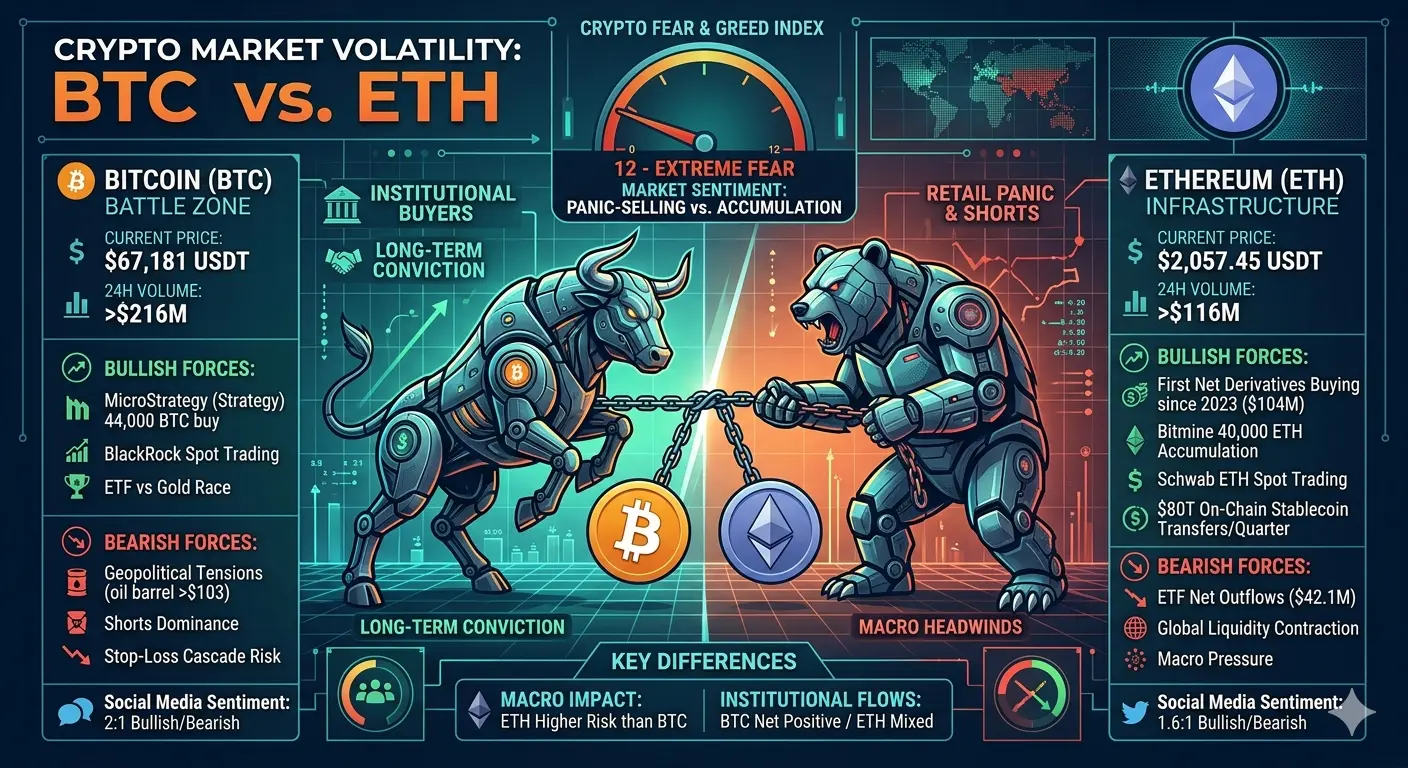
Current Price: $67,181 USDT
24-Hour Range: $66,848 — $67,547
24-Hour Change: +0.48%
24-Hour Volume: Over $216 million
What Is Driving BTC Volatility Right Now?
Bullish Forces Pushing Price Up:
1. Institutional Accumulation at Scale — Strategy (formerly MicroStrategy) purchased 44,000 BTC through its preferred stock program. This is not a speculative trade. This is a long-term conviction bet worth billions of dollars.
2. BlackRock and Charles Schwab Entering Spot Trading — When trillion-dollar traditional finance giants build infrastructure for BTC spot trading, it permanently changes the demand structure of the asset. Supply stays capped at 21 million. Demand channels are multiplying.
3. Bitcoin ETF vs. Gold ETF Race — Bitcoin ETFs are approaching the asset size of Gold ETFs. This is a historic milestone. It signals that institutional allocation to BTC is no longer experimental — it is becoming standard portfolio practice.
4. Innovation Validating the Thesis — At the BOSS Summit, Mesh Radio demonstrated Bitcoin transactions with zero internet connectivity. This reinforces BTC's core identity as uncensorable, unseizable money — a narrative that attracts capital during periods of geopolitical uncertainty.
5. Jack Dorsey Reviving the Bitcoin Faucet — A symbolic but meaningful signal. Grassroots adoption efforts being revived by a high-profile figure keeps BTC in public conversation.
Bearish Forces Pushing Price Down:
1. Geopolitical Tensions — Global instability is pushing oil prices above $103 per barrel. When macro uncertainty rises, risk assets across all categories — stocks, crypto, commodities — face selling pressure as investors move toward perceived safe havens.
2. Derivatives Market Dominated by Short Sellers — In the futures and options market, short positions currently outnumber long positions. This creates downward price pressure and raises the risk of long liquidations if prices dip below key support levels.
3. Retail Stop-Loss Cascade Risk — Many retail traders set automatic stop-losses at round numbers like $65,000 or $64,000. If price touches those levels, automated selling triggers — amplifying the move downward dramatically.
BTC Market Sentiment on Social Media
Bullish voices: 83 unique accounts, 183 posts
Bearish voices: 41 unique accounts, 65 posts
Total engaged accounts: 144
The bullish-to-bearish ratio is roughly 2:1. Despite extreme fear in the overall index, BTC has a relatively resilient social sentiment — more people are defending the bull case than attacking it.
---
Part 3 — Ethereum (ETH): The Infrastructure Under Pressure
Current Price: $2,057.45 USDT
24-Hour Range: $2,044 — $2,083
24-Hour Change: +0.33%
24-Hour Volume: Over $116 million
What Is Driving ETH Volatility Right Now?
Bullish Forces:
1. First Net Buying in Derivatives Since 2023 — This is a technically significant signal. ETH derivatives markets recorded $104 million in net buying — the first positive net position since 2023. This suggests institutional and professional traders are beginning to build long exposure, which typically precedes a price recovery.
2. Bitmine Continuously Accumulating ETH — Bitmine has now added 40,000 ETH to its treasury, worth over $82 million. Sustained corporate buying reduces the circulating supply available on exchanges — a structurally bullish development.
3. Charles Schwab Launching ETH Spot Trading — Similar to what is happening with BTC, ETH is gaining new institutional on-ramps. When traditional brokerage accounts can hold ETH directly, a massive new pool of capital becomes accessible.
4. $80 Trillion in On-Chain Stablecoin Transfers Per Quarter — This number is the most underrated ETH metric. The Ethereum network processes $80 trillion in stablecoin value every quarter. This is the actual economic output of the network — and it is larger than the GDP of most countries. ETH as infrastructure is not theoretical. It is producing real economic utility at scale.
Bearish Forces:
1. ETF Net Outflows of $42.1 Million — While some institutions are buying directly (Bitmine), ETH ETFs saw $42.1 million in net outflows. This shows that institutional sentiment is divided — some are accumulating, others are reducing exposure. This split creates uncertainty and price instability.
2. Global Liquidity Contraction — When central banks tighten monetary policy and oil prices rise, the total amount of money flowing into risk assets shrinks. ETH, being a risk asset, suffers disproportionately compared to BTC, which has stronger "digital gold" narrative protection.
3. Macro Pressure Is Heavier on ETH Than BTC — In risk-off environments, capital tends to rotate from altcoins and smart contract platforms toward Bitcoin first. ETH typically underperforms BTC during periods of extreme fear — exactly the environment we are in right now.
ETH Market Sentiment on Social Media
Bullish voices: 26 unique accounts, 35 posts
Bearish voices: 16 unique accounts, 21 posts
Total engaged accounts: 60
ETH sentiment is noticeably quieter than BTC. Engagement volume is lower, and while bulls still outnumber bears, the margin is tighter. This reflects the current reality — ETH is in a consolidation phase with less conviction on either side.
---
Part 4 — The 5 Core Causes of Crypto Volatility (Applied to This Moment)
Cause How It Affects BTC Right Now How It Affects ETH Right Now
Macro Events Oil at $103 creates risk-off pressure Heavier impact — ETH seen as higher risk than BTC
Institutional Flows Net positive — Strategy, BlackRock building Mixed — Bitmine buying, ETF outflows offsetting
Derivatives & Leverage Shorts dominant, liquidation risk is real First net buying since 2023 — potential turning point
Regulatory Clarity ETF approvals building confidence ETF product expansion starting
Social Sentiment 2:1 bullish-to-bearish ratio Quieter, closer to neutral
---
Part 5 — What Does This All Mean Practically?
For BTC:
The market is caught between institutional buyers who see long-term value and short-term traders who are fearful. The $66,800 — $67,500 range is a short-term equilibrium zone. A break above $67,600 with volume could signal short-term momentum. A drop below $66,800 risks triggering stop-loss cascades.
For ETH:
The $2,044 support level has held so far. The first net derivatives buying since 2023 is a meaningful technical signal. However, macro headwinds and ETF outflows create a ceiling. Watch the $2,100 level — if ETH can reclaim and hold above it with volume, sentiment may shift.
For the Overall Market:
A Fear & Greed Index of 12 is historically uncommon. The last time this index was this low, it preceded significant recoveries — but timing the exact bottom is impossible. What it does tell you clearly is that the market is in capitulation territory, not euphoria territory. Risk-reward, from a long-term perspective, tends to favor buyers at extreme fear readings more than at extreme greed readings.
---
Final Summary
The hashtag #CryptoMarketSeesVolatility is not just a trending phrase. It captures a real, multi-layered moment where institutional money is moving in, macro fear is pushing retail out, and both BTC and ETH are caught in a tug-of-war between long-term structural strength and short-term macro pressure. Volatility is not the enemy — confusion about what is causing it is
repost-content-media
  • Reward
  • 4
  • Repost
  • Share
Falcon_Officialvip:
2026 GOGOGO 👊
View More
#AreYouBullishOrBearishToday?
April 2, 2026 — Bullish or Bearish? The Full Honest Picture
The One Number That Defines Today's Market
Fear & Greed Index: 12 / 100 — Extreme Fear.
Not "a little scared." Not "cautious." Extreme. The market is operating on pure panic mode right now. Hands are shaking, people are selling first and thinking second, and the mood on social media is exactly what you'd expect after Bitcoin's worst quarter since 2022. That single number is your compass before you even look at a single chart.
OVERALL APRIL 2026 VERDICT
Short-Term: BEARISH. No debate.
Medium-Term (weeks a
HighAmbitionvip
#AreYouBullishOrBearishToday?
April 2, 2026 — Bullish or Bearish? The Full Honest Picture
The One Number That Defines Today's Market
Fear & Greed Index: 12 / 100 — Extreme Fear.
Not "a little scared." Not "cautious." Extreme. The market is operating on pure panic mode right now. Hands are shaking, people are selling first and thinking second, and the mood on social media is exactly what you'd expect after Bitcoin's worst quarter since 2022. That single number is your compass before you even look at a single chart.
OVERALL APRIL 2026 VERDICT
Short-Term: BEARISH. No debate.
Medium-Term (weeks ahead): Cautiously watching for reversal.
Long-Term fundamentals: Still intact — but that's not a trading signal, that's a holding conviction.
The bears own this market right now. The bulls have conviction on paper but the price action is not backing them up yet. Until that changes, respecting the downtrend is not weakness — it is discipline.
BITCOIN (BTC) — $66,350 | -3.3% Today
Bearish Points — What the Sellers See
Every single moving average — on the 15-minute, 4-hour, and daily chart — is stacked bearishly (MA7 below MA30 below MA120). This is called a "full bear stack." There is not one timeframe giving bulls clean ground to stand on.
Trading volume is surging on the way DOWN. Panic selling with rising volume is one of the most reliable bearish signals in technical analysis. It says the exits are crowded.
ETF net outflows hit $173.7 million in a single day. Institutional money is not rushing in to save this dip.
BTC is down 8.7% over 30 days and down a painful 26.8% over 90 days. Q1 2026 was Bitcoin's worst quarter since 2022. The trend on higher timeframes is not friendly.
Several corporate Bitcoin holders — including MARA, Genius Group, Cango Inc. — are actively selling BTC to repay debt. That is real, consistent sell pressure hitting the market every day.
Key support at $67,000 is already broken and sitting below. The next meaningful floor is around $61,500, and below that the psychological wall at $60,000.
Bullish Points — Why the Smart Money Is Not Running
The 4-hour CCI and Williams %R are both deep in oversold territory. Technically, a bounce is overdue. "Oversold" does not guarantee a reversal, but it does mean the risk/reward for shorts is deteriorating.
A 15-minute MACD bullish divergence is forming — price printed a new low but the MACD histogram is ticking higher. This is an early, early warning of a potential short-term bounce.
MetaPlanet (Japan) just bought 5,075 more BTC, bringing their total to 40,177 BTC. These are not traders. These are institutions making decade-long bets.
Strategy (Michael Saylor) accumulated over 44,000 BTC in March alone and is still buying. The largest corporate holder on earth is not flinching.
Morgan Stanley just filed amendments for a spot Bitcoin ETF at only 14 basis points — the cheapest fees in the entire market. A new institutional distribution pipe is being built, not dismantled.
Coinbase partnered with Fannie Mae to launch Bitcoin-backed mortgages in the US. BTC is becoming financial infrastructure. That does not happen in a dying asset.
Social sentiment for BTC is actually 55% bullish vs 33% bearish — meaning despite the price drop, more people are holding conviction than panic-selling on social media.
April Price Range to Watch
Support: $65,000 (break here opens $61,500)
Resistance: $68,500 to $70,000 (ceiling before bulls can breathe)
If ETF flows turn positive and macro headlines calm down, a bounce toward $70,000 is realistic. If $65,000 breaks cleanly on volume — do not fight it. The $61,500 level becomes the next conversation.
ETHEREUM (ETH) — $2,034 | -4.78% Today
The Uncomfortable Truth First
ETH is underperforming BTC today by nearly 1.5%. In a down market, losing MORE than Bitcoin is a relative weakness signal. Over 90 days, ETH is down 34.9% — more than BTC's 26.8%. The crowd knows this, which is why ETH sentiment is almost perfectly split at 40% bullish vs 45% bearish — the crowd is leaning negative.
Bearish Points
Same full bearish MA alignment as BTC across all timeframes.
Volume on the drop is expanding — confirming panic, not controlled selling.
An ICO-era whale that held ETH since the beginning woke up and sold 11,552 ETH for roughly $20 million. Original holders cashing out is not a bullish signal.
ETH ETF flows were in outflow territory for most of March.
Bullish Points — And These Are Genuinely Interesting
Bitmine now holds 4.73 million ETH — 3.92% of the entire ETH supply. A single entity is systematically removing nearly 4% of circulating supply. That is extraordinary accumulation by any measure.
The Ethereum Foundation itself staked 22,517 ETH worth $46.25 million — the largest staking event in its history. The organization building Ethereum is locking coins up, not selling.
Daily active addresses on the Ethereum network hit 788,000 — one of the highest readings on record. The network is being used more, not less. Fundamentals are not broken.
BlackRock's ETH spot ETF showed net inflows even while others were outflowing. The biggest asset manager on earth is accumulating quietly.
4-hour Williams %R is in oversold territory — a short-term bounce setup is technically building.
April Price Range to Watch
Support: $2,000 (critical psychological floor — break here and $1,850 comes fast)
Resistance: $2,200 (first meaningful level bulls need to reclaim)
The $2,000 level is the line in the sand for ETH in April. Above it, ETH has a shot at stabilizing. Below it, the conversation shifts to $1,800 territory.
GT (Gate Token) — $6.51 | -0.76% Today
The One Bright Spot in Today's Market
While BTC falls 3.3% and ETH falls 4.78%, GT is only down 0.76%. In a bloodbath, holding better than both major coins is called relative strength — and that matters.
Bearish Points (Being Honest)
Daily MA alignment is fully bearish, same story as BTC and ETH.
A 4-hour MACD death cross just triggered — that is a short-term negative signal.
GT is down 37.7% over 90 days — it has shed more in percentage terms than even BTC during this bear run.
Bullish Points
The daily MACD is showing a bottom divergence — price made a new low but the indicator did not follow. This is one of the cleaner early reversal signals in the technical playbook.
CCI on the 4-hour and Williams %R on both the daily and 15-minute are all flashing oversold simultaneously. Multiple timeframes screaming oversold at once is a setup that traders watch closely.
Community sentiment for GT sits at 57% bullish vs 43% bearish — the most positive of the three coins discussed here.
As Gate's native token, GT carries real utility: fee discounts, VIP mechanics, HODLer Airdrop participation, and exchange growth backing. That is a floor that meme coins simply do not have.
April Price Range to Watch
Support: $6.50 (holding this level is critical — it is also where the SAR is sitting)
Resistance: $7.00 to $7.20 (first target on any bounce)
What Are Traders Actually Thinking Right Now?
The market has essentially divided into three camps, and understanding which camp is actually right will determine how April plays out:
Camp 1 — The Active Sellers
They see a broken macro backdrop: geopolitical conflict pressuring energy and supply chains, inflation expectations being repriced upward, multiple corporate BTC holders liquidating to cover debt, and a chart that has not broken its bearish structure in over three months. These people are in stablecoins or cash and they are comfortable waiting.
Camp 2 — The Silent Accumulators
Saylor. MetaPlanet. Bitmine. The Ethereum Foundation. BlackRock. These entities are not posting on X about being scared. They are quietly buying what panic sellers are throwing overboard. They measure time in years, not hours. If they are right, April's prices will look like a gift in 2027.
Camp 3 — The Fence-Sitters (the majority right now)
Most traders are doing nothing aggressive in either direction. They are watching. Waiting for one of two things: a confirmed breakdown below key support to enter short, or a confirmed reversal candle on high volume to start building a long position. Patience is not weakness — in a Fear & Greed index of 12, patience is strategy.
Final Trading Framework for April 2026
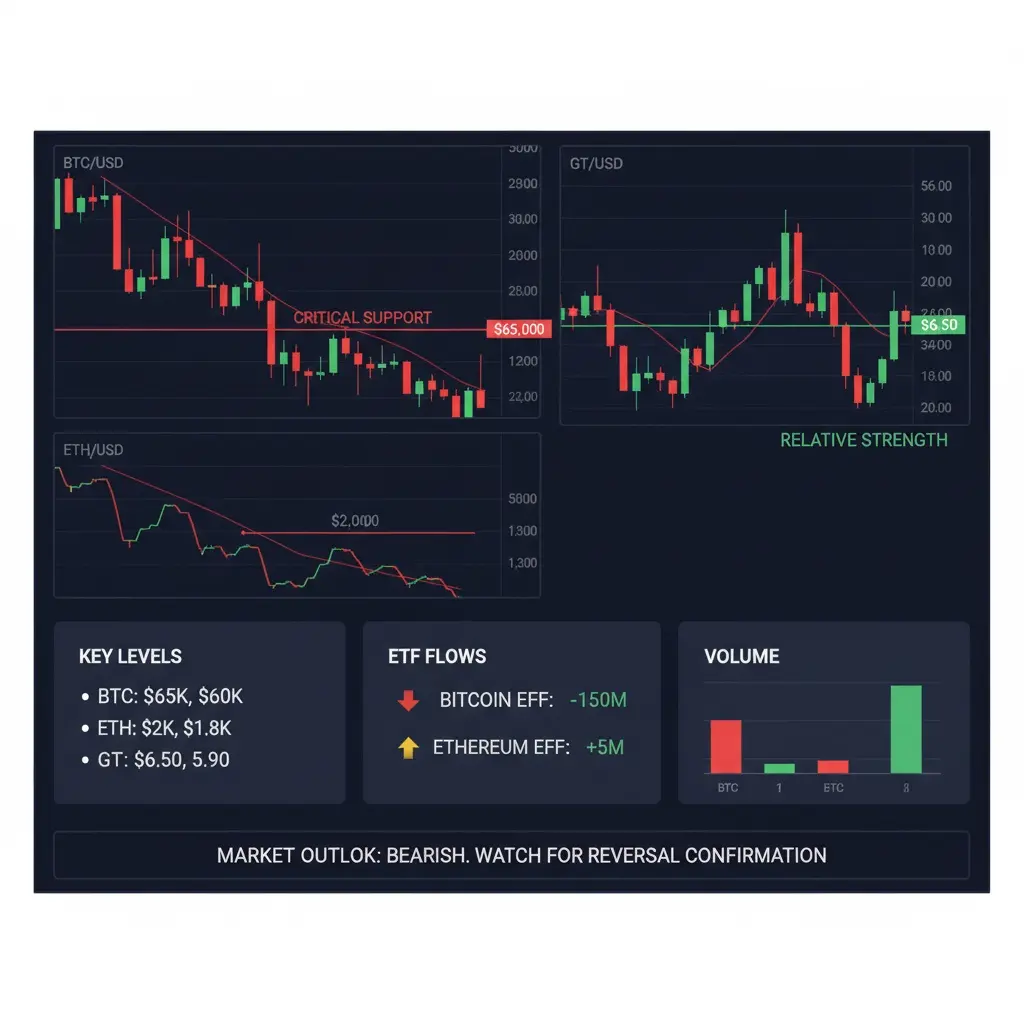
For Bitcoin (BTC), the short-term bias is clearly bearish. The critical support level to watch is $65,000, and if this breaks, the next key floor is around $61,500. Resistance sits between $70,000, where bulls need to reclaim momentum. Traders should closely monitor ETF flows and whether BTC holds or breaks the $65K level, as this will define the immediate market direction.
For Ethereum (ETH), the market is also bearish in the short term. The $2,000 psychological floor is the line in the sand — holding above it gives ETH a chance to stabilize, but a break could push prices rapidly toward $1,850. Resistance for a potential bounce sits around $2,200, and traders should pay attention to whether ETH can defend its key support while also gauging any accumulation signals.
Gate Token (GT) shows mild bearishness but is exhibiting relative strength compared to BTC and ETH. Critical support sits at $6.50, which coincides with the SAR indicator and is important for preventing further downside. Resistance for any bounce is $7.00 to $7.20, and traders should watch for the daily MACD divergence to play out or fail, as this will indicate whether a short-term reversal is possible.
In short, BTC and ETH are under pressure, GT is showing resilience, and across all three, the main focus is on support levels holding, key resistance levels testing, and flow/volume signals confirming any reversal. Patience and confirmation are more important than aggression in this environment.
The Honest Answer for Your Trading, HighAmbition
The market is bearish right now. The price action is bearish. The trend is bearish. Respect that first — no amount of bullish fundamentals stops a falling chart in the short term.
But here is the other side: when Fear & Greed hits 12, historically this is the zone where the best long-term entries are built — not the worst. The smart money knows this. The retail crowd does not, which is exactly why they panic at 12 and feel confident at 80.
If you must trade right now:
Keep position sizes smaller than usual
Define your stop-loss before you enter, not after
Wait for confirmation of a reversal — a strong green candle on elevated volume — rather than guessing the exact bottom
Do not let oversold readings on indicators talk you into a trade before price confirms the direction change
The market rewards patience right now far more than aggression. The setup for a strong April bounce exists — but it needs to be earned by the price action, not assumed.
This analysis is based on live market data as of April 2, 2026. Crypto markets are highly volatile. Nothing here is financial advice. Always trade within your risk tolerance and never deploy capital you cannot afford to lose.
repost-content-media
  • Reward
  • 3
  • Repost
  • Share
MrFlower_XingChenvip:
To The Moon 🌕
View More
good information
HighAmbitionvip
#WeekendCryptoHoldingGuide
Gate Square | #假期持币指南 — HighAmbition's Complete Holiday Trading Discussion
A full, honest, step-by-step breakdown of every question Gate asked — plus a deep analytical dive on my two favorite coins: XAUT and GT. Written for the Qingming Holiday 2026 activity.
Opening Thoughts
Spring is here. The mountains are calling. The K-line is also calling — louder, honestly. But here is what separates a serious trader from someone who just calls themselves a trader: the serious one builds a system that works whether they are watching or not. That is the entire philosophy behind how I trade, how I hold through holidays, and why I chose XAUT and GT as my two core positions. Everything below is real — my actual approach, my actual reasoning, no fluff.
Holiday Mindset
My answer is neither extreme. Going completely offline during a holiday sounds peaceful, but crypto never sleeps. The Qingming holiday in China pauses traditional markets, but crypto continues running 24/7, reacting instantly to global macro triggers like oil shocks, Federal Reserve signals, geopolitical escalations, and tariff announcements. If you hold XAUT, which is tied directly to gold, ignoring the market completely is not an option because gold reacts immediately to these macro events.
On the other side, checking the market every 30 minutes is equally dangerous. It destroys mental clarity, ruins your holiday experience, and leads to emotional decisions. A red candle triggers panic selling, a green candle triggers impulsive buying, and both usually result in losses, especially during holidays when liquidity is thinner and spreads are wider.
My approach is structured awareness with pre-set automation. Before the holiday starts, I spend around 25 minutes setting price alerts for every asset I hold. For XAUT, alerts are placed at $4,620 on the downside and $4,660 on the upside. For GT, alerts are set at $6.20 and $6.70. Then I ensure every open position has a stop-loss in place, because risk control is non-negotiable.
I define two check windows only — one quick glance in the morning at 08:30 local time, and one structured review at 21:00 where I look at macro headlines and system performance. Outside of those windows, I disconnect completely and trust the system. That trust is the real edge.
Lazy Person’s Secret
The real advantage during holidays comes from automation. My system runs on three layers simultaneously, each designed to remove emotion and maintain efficiency.
The first layer is weekly DCA into GT. A fixed USDT amount buys GT every week regardless of price. GT has already declined around 39% over the past 90 days, so this strategy allows accumulation at lower average prices without trying to time the bottom. If GT trades at $6.50 one week and $6.20 the next, the average entry naturally improves. Over time, this creates a strong position built through consistency rather than prediction.
The second layer is a grid trading bot on XAUT/USDT. XAUT trades at $4,636, with a 24-hour range between $4,631.7 and $4,645.8. This tight movement creates ideal conditions for grid trading. By setting a range between $4,600 and $4,680 with 10 grid levels, the bot automatically buys on dips and sells on rises, capturing small profits repeatedly. Because XAUT follows gold, its movement is more structured and less chaotic than typical altcoins, making it ideal for this strategy.
The third layer is Simple Earn on idle USDT. Any unused capital is placed into flexible yield products, generating daily returns instead of sitting idle. Even during a short holiday period, this ensures that all capital remains productive.
All of this preparation takes about 25 minutes before the holiday begins. After that, the system runs independently while I focus on real life.
April Outlook
My focus remains on XAUT and GT, both chosen based on clear reasoning rather than speculation.
XAUT Deep Analysis
XAUT represents tokenized gold, backed 1:1 by physical reserves stored in Switzerland under LBMA standards. It is not a speculative asset but a digital representation of real gold, combining stability with blockchain flexibility.
Currently, XAUT is trading at $4,636 USDT, with a 24-hour range between $4,631.7 and $4,645.8. It has gained +2.88% over the last 7 days, declined -9.87% over 30 days, and still holds a +3.26% gain over 90 days. Its market cap stands at -$2.59 billion with a rank of #38, and social sentiment remains strongly positive at 83%.
From a technical perspective, the short-term structure shows recovery signs, while the medium-term trend remains cautious due to the prior correction. This creates a setup where short-term strength meets longer-term opportunity. A nearly 10% correction in a gold-backed asset during global instability is not weakness — it is positioning opportunity.
The macro case strengthens this view. Rising geopolitical tensions, particularly around the Strait of Hormuz, create inflation fears and drive capital into safe-haven assets like gold. At the same time, equity market weakness pushes institutional money toward defensive positions. If the dollar weakens due to potential monetary easing, gold benefits further.
Additionally, ecosystem expansion has increased XAUT utility, with new collateral options, trading pairs, and derivatives products being introduced. This increases accessibility and demand within the crypto ecosystem.
My strategy is to hold XAUT as a macro hedge while running a grid bot within the $4,600—$4,680 range. The upside target remains $4,700+, while risk is controlled with a stop-loss below $4,610.
GT Deep Analysis
GT functions as the native token of the Gate ecosystem, effectively acting as a form of platform equity. Its value is tied directly to platform growth, user expansion, and ecosystem development.
GT is currently trading at $6.50 USDT, with a 24-hour change of +0.61% and a range between $6.39 and $6.51. Volume has surged to -369,000 USDT compared to a 7-day average of -68,300 USDT, representing a 5.4x spike. Meanwhile, price has declined -0.76% over 7 days, -6.88% over 30 days, and -38.79% over 90 days, placing it at rank #89.
The most important observation is the volume spike. A 5.4x increase in volume with stable price movement indicates accumulation rather than selling. This suggests that larger players are positioning quietly.
Short-term technical structure shows bullish momentum, while higher timeframes still reflect prior bearish pressure. However, early signs of trend exhaustion are visible, especially with improving structure and strong volume support.
Fundamentally, GT benefits from continuous ecosystem growth, including trading fee discounts, Launchpool access, and participation in platform campaigns. The ongoing Gate x Red Bull F1 tournament is driving user engagement, increasing trading activity, and expanding brand exposure.
My strategy involves consistent DCA accumulation, fee optimization through GT holdings, and participation in ecosystem rewards. The upside target remains in the $7.50—$8.00 range, while risk is managed through proper position sizing.
Final Philosophy
Everything comes down to one principle: systems beat willpower. Emotional decisions destroy portfolios, while structured systems create consistency. By automating DCA, grid trading, and yield generation, I remove emotional interference and allow the system to operate efficiently.
During this Qingming holiday, my portfolio continues working through automated strategies while I step away. XAUT provides macro protection and stability, while GT offers growth potential tied to platform expansion.
The market continues moving regardless of holidays. The goal is not to control the market, but to build a system that works without constant attention.
The spring light is here. I am outside.
But the system is still running.
repost-content-media
  • Reward
  • Comment
  • Repost
  • Share
#GateSquareAprilPostingChallenge
1 — The Big Picture: Why These Three Assets Are Now One System
April 2026 is not a typical market environment. What we are witnessing is a macro convergence, where Bitcoin, Crude Oil, and Gold are no longer trading independently — they are reacting to the same global force:
Geopolitical instability.
The ongoing tensions involving United States–Iran conflict dynamics, disruptions in the Strait of Hormuz, and attacks in the Red Sea have created a chain reaction across all markets.
The Core Relationship:
Oil drives inflation
Gold reflects fear
Bitcoin reacts to l
BTC-0,04%
XAUT-0,59%
HighAmbitionvip
#GateSquareAprilPostingChallenge
1 — The Big Picture: Why These Three Assets Are Now One System
April 2026 is not a typical market environment. What we are witnessing is a macro convergence, where Bitcoin, Crude Oil, and Gold are no longer trading independently — they are reacting to the same global force:
Geopolitical instability.
The ongoing tensions involving United States–Iran conflict dynamics, disruptions in the Strait of Hormuz, and attacks in the Red Sea have created a chain reaction across all markets.
The Core Relationship:
Oil drives inflation
Gold reflects fear
Bitcoin reacts to liquidity
Understanding today’s market means understanding how these three interact as a system, not as separate trades.
2 — Crude Oil (XTI): The Primary Driver of Everything
Right now, oil is the starting point of the entire macro chain.
With XTI trading around the $105 range, markets are pricing in serious supply disruption risk, mainly due to instability near the Strait of Hormuz — a route responsible for nearly 20% of global oil flows.
Step-by-Step Impact:
1. Supply Shock Risk
Any escalation involving Iran threatens global oil supply. Even the fear of disruption pushes prices higher.
2. Inflation Transmission
Higher oil prices increase:
Transport costs
Manufacturing costs
Energy bills globally
This directly pushes inflation higher, especially in economies like the United States.
3. Central Bank Constraint
When inflation rises, the Federal Reserve cannot ease policy easily.
Result: Interest rates stay high → liquidity tightens
4. Liquidity Shock to Risk Assets
When liquidity contracts:
Crypto markets weaken
Equities struggle
Investors move to safer assets
Scenario Mapping:
$105 Oil → Uncertainty, sideways crypto
$110–$120 Oil → Strong risk-off pressure
$120+ Oil → Panic environment, aggressive capital rotation into gold
👉 Key Insight:
Oil is not just another asset — it is the trigger variable controlling global liquidity in April 2026.
3 — Gold (XAUT): The Market’s Fear Gauge
Gold is currently behaving exactly as expected in a geopolitical crisis — strong, bid, and heavily accumulated.
With XAUT near $4,637 and bullish sentiment above 80%, the market is clearly positioning for continued instability.
Why Gold Is Rising:
1. Safe Haven Demand
During conflict, institutions reduce exposure to volatile assets and rotate into gold. This is a decades-proven behavior.
2. Currency Dynamics
If inflation rises but central banks hesitate to tighten further, the US dollar weakens — which boosts gold prices (since gold is USD-denominated).
3. Strategic Positioning
Large funds are not just hedging — they are positioning for prolonged uncertainty.
4. Structural Shift in Crypto Platforms
Platforms like Gate.io introducing XAUT and oil derivatives shows something deeper:
👉 Macro assets are becoming part of crypto-native trading ecosystems
Technical Insight:
Gold is currently in a short-term bullish structure within a broader consolidation phase:
Higher timeframe shows exhaustion after strong Q1 rally
Lower timeframes show continued buying pressure
Forward Outlook:
If tensions escalate → $5,000 becomes realistic
If tensions ease → expect sharp profit-taking
👉 Key Insight:
Gold is already pricing in risk that crypto has not fully reacted to yet.
4 — Bitcoin (BTC): Stuck Between Two Identities
Bitcoin is currently in a conflicted state.
It is trying to evolve into “digital gold” — but in reality, it still behaves like a high-risk tech asset.
What’s Happening:
1. Strong Correlation With Tech Markets
BTC maintains high correlation with equity indices like the Nasdaq-100, especially during macro shocks.
👉 When oil rises → inflation fears rise → tech sells off → BTC follows.
2. Liquidity Sensitivity
Bitcoin is extremely sensitive to global liquidity:
Tight liquidity → BTC drops
Easy liquidity → BTC rallies
3. De-Risking Behavior
In crisis moments:
Investors sell liquid assets first
BTC becomes a source of quick liquidity
4. Institutional Transition Phase
Despite short-term weakness, long-term fundamentals are improving:
Charles Schwab planning crypto trading
Corporate accumulation continues
Infrastructure is expanding
Technical Position:
Bearish structure on higher timeframe
Early reversal signals forming (divergence, SAR flips)
Key levels:
Support: $66,700
Resistance: $67,500–$68,000
👉 Key Insight:
BTC is not failing — it is reacting exactly as a liquidity-driven asset should in a macro tightening environment.
5 — The Transmission Mechanism (The Real Market Engine)
Everything connects through a simple but powerful chain:
Geopolitical Conflict

Oil Prices Rise (XTI)

Inflation Increases

Federal Reserve Stays Tight

Liquidity Contracts

Bitcoin Weakens (Short-Term)
Meanwhile:
Same Conflict

Safe Haven Demand

Gold (XAUT) Rises
6 — What Traders Must Watch (Critical Signals)
Focus on these real-time triggers:
Developments near the Strait of Hormuz
Federal Reserve policy tone
Oil breaking above key levels ($110, $120)
Gold momentum continuation or reversal
Correlation breakdown between BTC and equities
7 — Final Conclusion: The Real Insight for April 2026
This market is no longer about isolated charts — it is about macro reactions.
Oil controls inflation and liquidity
Gold reflects fear and capital preservation
Bitcoin reacts to liquidity cycles while building long-term strength
👉 The most important shift:
Crypto is now fully integrated into the global macro system.
Every headline involving Iran, every move by the Federal Reserve, and every spike in oil is directly influencing BTC price action.
Final Trading Insight
This is not a trend market — it is a reaction market.
Watch oil as your leading indicator
Use gold as your risk sentiment gauge
Treat BTC as a liquidity-sensitive instrument
repost-content-media
  • Reward
  • 2
  • Repost
  • Share
MrFlower_XingChenvip:
To The Moon 🌕
View More
🔹 Bitcoin price volatility puts liquidation pressure on major ce
1.475 views
2026-04-05 03:05
  • Reward
  • 5
  • Repost
  • Share
Luna_Starvip:
LFG 🔥
View More
  • Pin