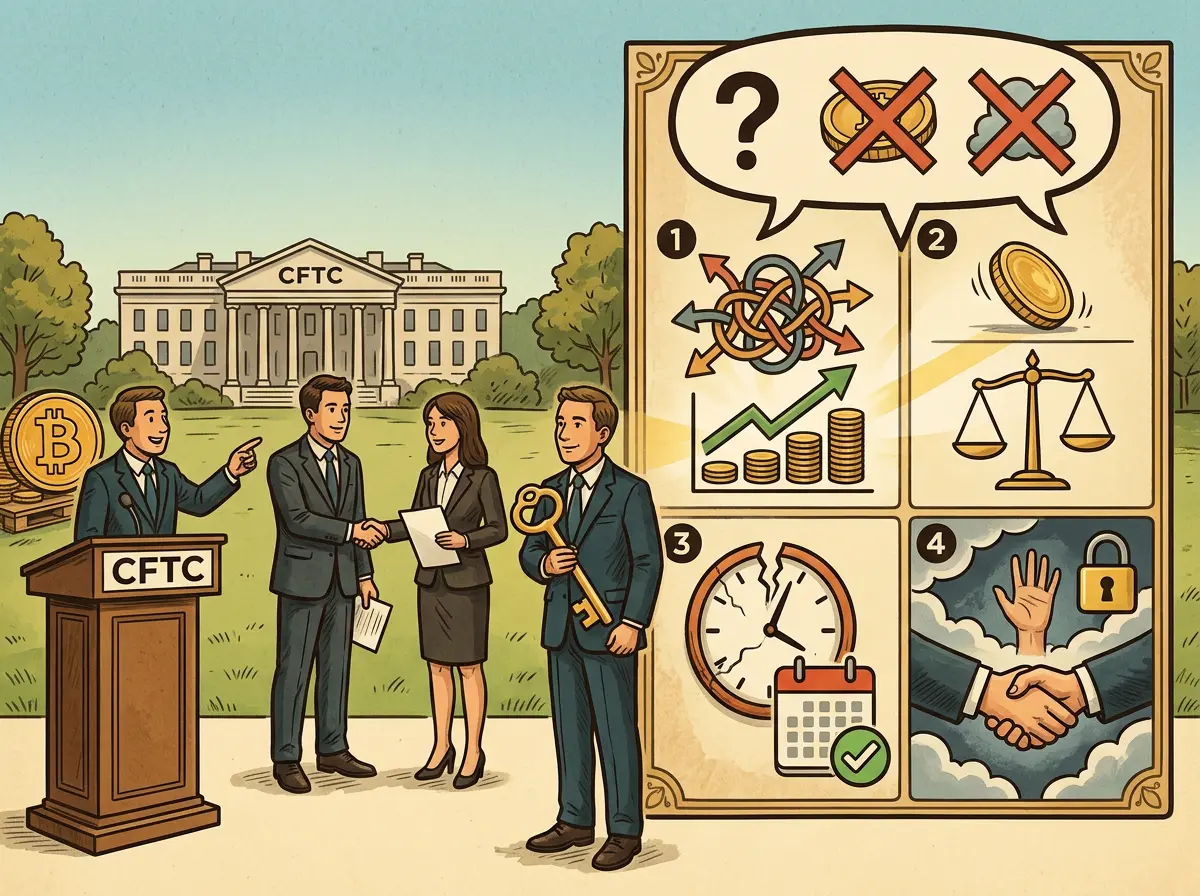
On June 16, Michael Selig, Chairman of the U.S. Commodity Futures Trading Commission (CFTC), posted on X to clarify four major misconceptions about perpetual futures contracts one by one. At the same time, on Monday, the CFTC confirmed two leadership personnel appointments: Donald Battle as Chief Data Innovation Officer, and J. Matthew Haws as Senior Advisor to the Chairman and Director for the Chicago Region.
The four major perpetual contract misconceptions clarified by Selig: a record of the statements
According to Selig’s public statement on X on June 16, 2026:
Misconception 1: Perpetual contracts do not meet the definition of “futures contracts.” Selig confirmed that the Commodity Exchange Act and CFTC regulations do not provide a clear definition of the term “futures contracts,” nor do they require a fixed expiration date or settlement date. The criteria are provided by case law and the Commission’s interpretation, and neither requires a fixed expiration date.
Misconception 2: The CFTC approved contracts allowing 250x leverage. Selig confirmed that high leverage is a feature of perpetual contracts traded on offshore venues, not something inherently built into the contract structure itself. The CFTC-regulated perpetual contracts are subject to the same leverage limits as other CFTC-regulated futures contracts.
Misconception 3: The CFTC did not give the public an opportunity to provide input. Selig confirmed that the CFTC issued a notice-and-comment draft in April 2025 regarding “perpetual contracts” and “7x24-hour trading,” receiving more than 100 comments, including many registered entities regulated by the CFTC.
Misconception 4: The funding rate mechanism encourages market misconduct. Selig confirmed that after accounting for costs related to opening positions and rolling over positions into contracts with expiration dates, the annualized cost of holding comparable positions with expiration-dated contracts is roughly equivalent to that of perpetual contracts. The funding rate mechanism is a constraint tool that keeps the contract tethered to the underlying spot market.
Two personnel appointments announced on June 15
Donald Battle (Chief Data Innovation Officer): Previously a senior adviser to Hester Peirce, a commissioner on the SEC’s Crypto Working Group, as well as Assistant Director of the Data Science Group within the SEC’s Enforcement Division. He also served at the U.S. Treasury’s FinCEN as a virtual currency enforcement official. At the CFTC, he will oversee the Data Division and the Innovation Working Group.
J. Matthew Haws (Senior Advisor to the Chairman and Director for the Chicago Region): Over 13 years of derivatives regulatory experience. Most recently, he served as Senior Legal Counsel at Marex. Previously, he was a partner at Katten Muchin Rosenman LLP.
Status of CFTC’s litigation in eight states
As of June 16, 2026, the CFTC has filed lawsuits in the following eight states over the issue of federal jurisdiction for prediction markets: Arizona, Connecticut, Illinois, Minnesota, New Mexico, New York, Rhode Island, and Wisconsin. The CFTC seeks declaratory judgments confirming that federal law grants it exclusive jurisdiction over the relevant contracts.
According to Cryptopolitan, during the current administration the CFTC has brought only two crypto-related enforcement actions, while during the Biden administration it brought more than 80. An investigation reported last month by The New York Times claimed that multiple senior CFTC officials were suspended after expressing regulatory concerns about Polymarket, Crypto.com, and Gemini-associated companies; the above companies have all been accused of having ties to the Trump family.
FAQ
Four major misconceptions clarified by the CFTC—what specific contract were they aimed at?
Selig’s X platform statement came in the form of clarifications made in response to external criticism after the CFTC approved a Bitcoin perpetual futures contract (BTCPERP). In the statement, he addressed specific allegations about fixed expiration dates, high leverage, public input solicitation, and funding rates one by one.
What special background do the appointments of Donald Battle and J. Matthew Haws have?
The appointments of the two were among at least eight senior role appointments Selig made after taking office as the sole sitting commissioner of the CFTC starting in January 2026. During his tenure, he handled the chairman’s responsibilities, and the intended five-member commission currently has only him serving.
How many responses did the April 2025 notice-and-comment draft mentioned in the CFTC clarification receive?
Based on Selig’s confirmation statement, the CFTC’s April 2025 notice-and-comment draft on perpetual contracts and 7x24-hour trading received more than 100 comments, with sources including a wide range of stakeholders and many registered entities regulated by the CFTC.


