1. Starting Point: Automation Is Not "Smarter Order Placement"
The first four lessons defined AI within research-related tasks such as information processing, hypothesis formulation, backtesting support, and event interpretation. Once execution is involved, the risk profile changes: errors are no longer just summary mistakes—they can lead to repeated orders, incorrect leverage, or funds transfer. Common incidents are often not due to model misjudgment but to excessive permissions, missing checkpoints, insecure environments, and confusing "automatic operation" with "unattended operation."
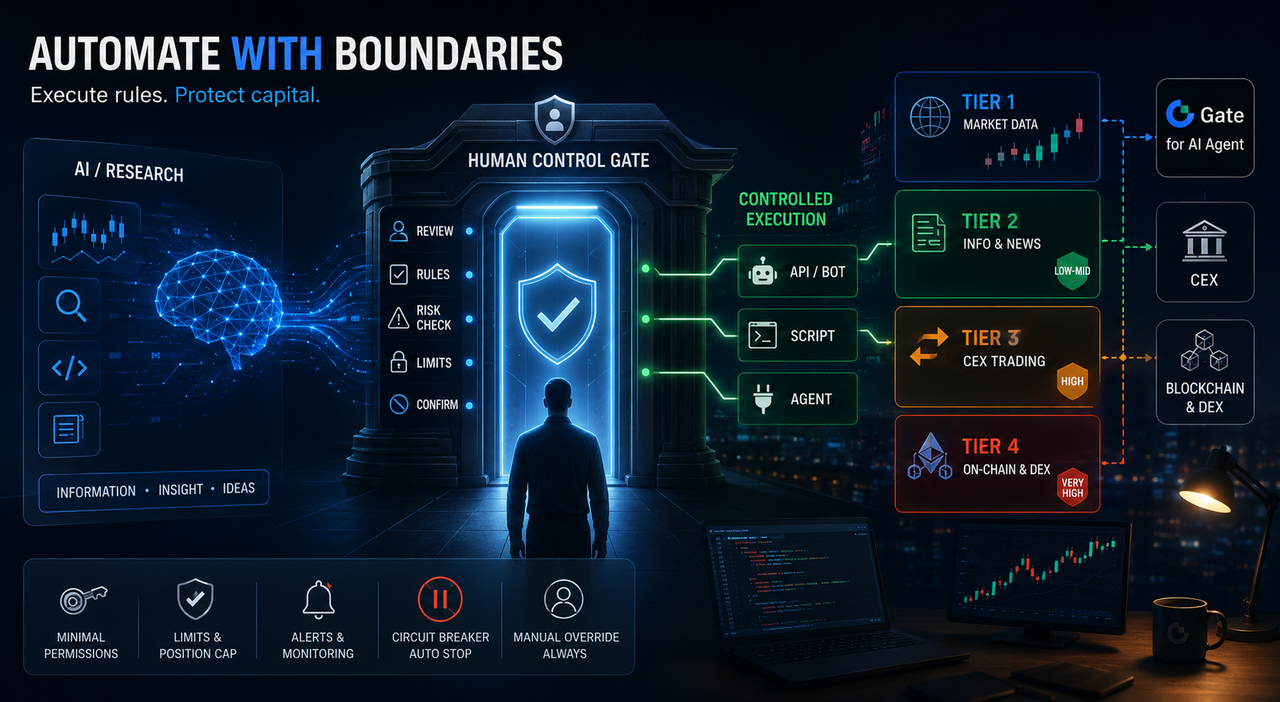
This lesson focuses not on writing more complex scripts but on which hard boundaries should be retained during automation integration. The core principle can be summarized as: automation is responsible for executing predefined rules, not redefining them; rule changes, environment anomalies, and fund boundaries must always retain human veto power.
2.API Permissions: Minimum Necessary, Not All at Once
Exchange API Keys are usually segmented by permission, such as read-only, spot trading, derivatives trading, and withdrawals. Common incident paths include: enabling too many permissions for convenience; using the same Key for research scripts and live trading; storing Keys in code repositories or shared documents; failing to rotate or bind IP whitelists.
A more robust permission design includes:
-
Read-only Keys for market data retrieval, reconciliation, and monitoring—physically separated from trading Keys.
-
Trading Keys should not enable withdrawals by default; if withdrawals are needed, use independent Keys, limits, and approval processes.
-
Production and test environments use different Keys to prevent test scripts from connecting to live trading.
-
Keys are rotated regularly and invalidated immediately upon personnel or device changes.
API permissions should follow the principle of minimum necessity: grant only the permissions required for the current task—not "enable now in case it's needed later."
3. Script Execution: Distinguish "Can Run" from "Should Run"
Typical programmatic scripts perform three types of tasks: market monitoring, signal alerts, and rule-based order placement. The first two carry relatively controllable risk; the third—when combined with leverage, market orders, or position scaling logic—significantly increases tail risk.
A safer execution structure can be set in three tiers:
-
Tier 1: Outputs signals only—does not access trading interfaces.
-
Tier 2: Accesses interfaces but only submits planned or limit orders with hard caps on individual trades and total position size.
-
Tier 3: Allows market or higher-risk instructions but requires manual confirmation or secondary verification.
Scripts should also embed circuit breaker conditions, such as: stop after daily losses reach a threshold; stop after N consecutive failed orders; stop if spread or volatility exceeds a threshold; stop if API returns abnormal status. Circuit breakers are not pessimistic—they prevent errors from self-replicating unnoticed.
4. AI and Automation Boundaries: Models Should Not Have Direct Order Rights
A common robust practice is to use AI for code generation, log interpretation, and risk checklist comparison, then have independent, rule-based programs execute. It is not recommended for large models to directly output "buy/sell" in live trading and immediately trigger orders because of unstable outputs, context contamination risks, lack of deterministic output for identical input, and insufficient constraints on latency or slippage.
If AI is used to assist in generating trading scripts, manual review should be fixed before release: check for hardcoded keys, bypassed limits, continued scaling in abnormal branches, or missing circuit breakers. Code that runs only proves syntax validity—not production readiness.
5. On-Chain Agents and Wallet Permissions: More Irreversible Than CEX APIs
On-chain automation or Agent wallets involve signing authority, token approvals (Approve), contract calls, and multisig structures. Once confirmed on-chain transactions typically cannot be reversed or appealed like on centralized platforms.
Special attention is needed: excessive token approval may allow malicious contracts to drain funds in one go; Agent wallets with high-permission private keys or session keys face immediate and irreversible consequences if leaked. "Smart execution" products often lead people to overlook that on-chain errors lack a customer service buffer.
Safer practices include: minimizing approval amounts, regular revoking, routing high-value operations through multisig, keeping only operational limits in hot wallets, separating large assets from daily operation addresses. Agent capabilities should be treated as high-risk modules—not default "advanced features."
 Source: Gate for AI Agent official site
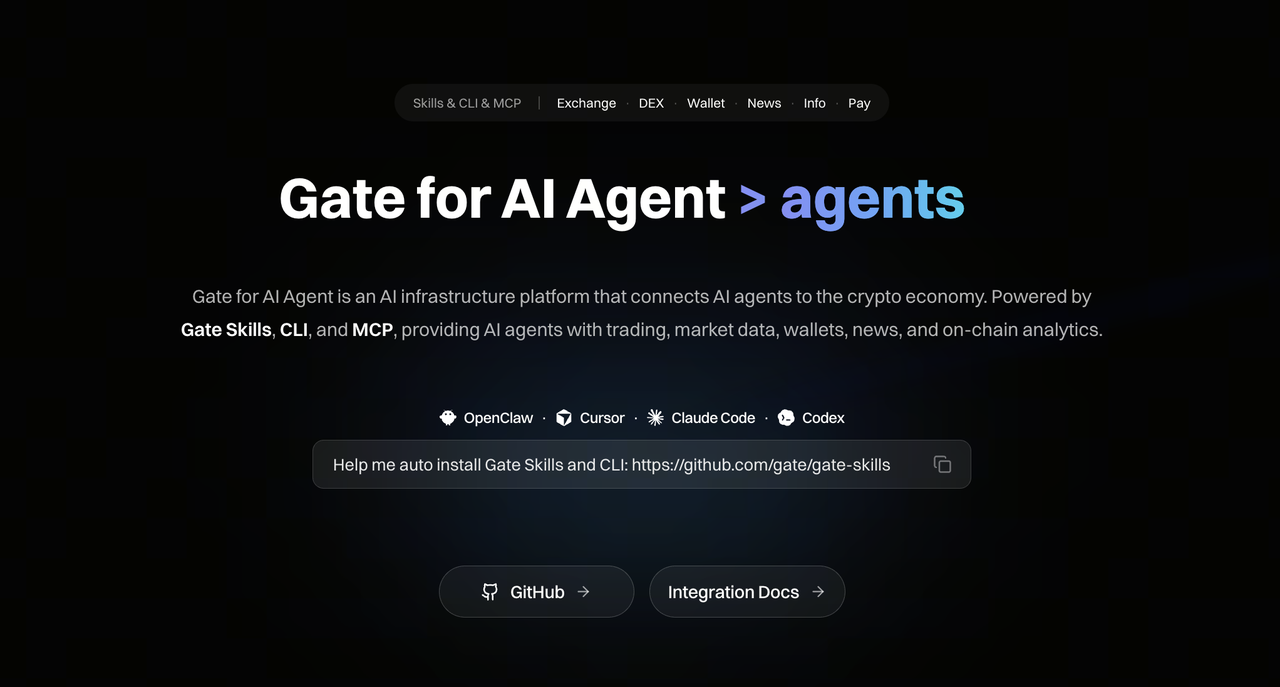
In the Gate ecosystem, products related to "AI helps you check markets or even place orders" mainly refer to Gate for AI Agent (integrated via MCP or CLI with Cursor, Claude, etc.). This is not the same as Gate.AI Chat Assistant: Chat Assistant focuses on Q&A; Agent path lets AI directly call Gate's market data, account info, trading capabilities—improper authorization can actually move funds.
Gate for AI Agent can be understood as four capability levels arranged from low to high. Which level you choose depends on whether you're researching or ready to trade.
Level 1: Public Market Data Only (Lowest Risk)
Purpose: Price checks, K-lines, depth charts, product lists—no Gate account login required.
Suitable for: Daily monitoring, weekly reports, cross-checking facts from Lesson 2.
Discipline: Tool returns "quote snapshots," not "verified facts." You must still check timeframes, pairs, spot vs. derivatives; don't skip source verification just because AI retrieves prices.
Level 2: Token Info and News (Low Risk but Prone to Misbelief)
Purpose: Token introductions, technical indicators, announcement searches, sentiment info.
Suitable for: Discovering clues, event calendars, preparing macro/launch context from Lesson 4.
Discipline: This level essentially "helps collect materials"—quality ranges from media reports to community rumors. For listings, partnerships, regulatory news—always verify via project websites, Gate announcements, block explorers; never open positions based on summaries alone.
Level 3: Centralized Account Operations (High Risk—Equivalent to Live API)
Purpose: Balance checks, order placement/modification/transfers/sub-accounts—requires Gate OAuth login authorization.
Suitable for: Documented strategies validated by backtesting/paper trading and willing to accept execution consequences.
Discipline: Saying "buy some BTC" in natural language may turn into real orders. OAuth eliminates manual API Key entry but does not reduce risk: authorization scope must be reviewed and revoked regularly in Gate API management; single trade caps, total position limits, market order allowance should be written into your own rules—not left to improvisation. This level aligns with the "execution layer" in this lesson—circuit breakers and pre-trade checks from Lesson 6 must be applied.
Level 4: On-Chain Wallet & DEX Operations (High Risk—Even Harder to Revoke)
Purpose: On-chain swaps, wallet operations, DApp interactions—usually requires extra Google or Gate OAuth.
Suitable for: Users already running on-chain strategies familiar with Approve/multisig/gas.
Discipline: On-chain mistakes (wrong transfers/over-approval/malicious contracts) typically cannot be appealed like centralized support. Risks here mirror the earlier "on-chain Agent": prefer less approval/fewer limits/address separation—never enable large/long-term approvals just because "AI can one-click swap."
How to Choose
-
Use only Levels 1 & 2: Usually no login needed—configure MCP as research assistant role.
-
Using Level 3: Remote MCP typically prompts browser authorization on first trading function call; Local MCP requires API Key setup on local machine—suitable for those who prefer not cloud authorizations and can manage their own keys. Either way—revoke authorization or disable Keys when not in use.
-
Using Level 4: Treat as on-chain fund operations—do not mix with relaxed habits like "just checking prices."
What Are MCP and Skills
-
MCP is a "single tool": price checks, order placement, balance reading.
-
Skills are "bundled multi-step processes": e.g., scanning opportunities or evaluating ranges. The more streamlined the bundle—the more you must remember it speeds up operation but cannot replace backtesting validity checks/event risk reductions/manual pre-trade confirmation.
Three Baselines for Using Gate for AI Agent
-
Always start with "market data only"; only enable trading/on-chain levels once strategy and risk controls are clearly defined.
-
If trading authorization is enabled—manage OAuth like API Keys: who can use it/what actions are allowed/when to revoke.
-
Can place orders ≠ should place orders; Agent solves "connects to Gate"—not whether a trade is justified.
7. Operating Environment & Key Management
Key and script security depend equally on permission design and environment. Do not store API Keys/mnemonics/private keys in Git repositories/cloud notes/chat logs/screenshots. Production scripts should run in restricted environments; logs must mask Keys. On the device side: dedicated trading machines/2FA/phishing prevention should be planned alongside automation permissions. In team scenarios—roles must be separated: who modifies strategies/releases versions/holds Keys/approves withdrawals.
8. Event Windows & Automation: Default Downgrade—Not Acceleration
Lesson 4 emphasized information noise during macro and major on-chain event windows. In such periods automation is more prone to poor execution due to abnormal volatility/spread widening/API delays/news mis-triggers. The safer discipline is: proactively shut down or downgrade auto-ordering around events—retain only monitoring/alerts; resume rule-based execution once volatility normalizes/spreads return to baseline. If connected to Gate /mcp/exchange—event periods should default prohibit new automated trading instructions unless the strategy is specifically designed for post-event handling with hard limits.
9. Lesson Summary
Lesson 5 condenses automation risks into three lines: minimum permissions for general API/scripts; tiered execution & circuit breakers; irreversibility & minimized authorization for on-chain Agents. Using Gate for AI Agent as an example—MCP endpoints should be tiered by risk: market/info endpoints serve research; trading/DEX endpoints require OAuth review/manual confirmation/event window downgrades. AI can boost efficiency—but cannot replace validation/risk control/execution responsibility. Next lesson will consolidate position chain logic/input discipline/backtest auditing/event boundaries/rules from this lesson into a repeatable research-trade-review SOP—including weekly checklist items for Gate MCP connections.