Mastering "AI for summarization," "backtesting for coding," and "API for order placement" individually does not constitute a system. Without a fixed workflow, common outcomes include: over-reliance on chat conclusions during calm markets, skipping checks when volatility increases, changing rules temporarily during event periods, and being unable to review using the same standard afterward. The task of Lesson 6 is to condense the previous five lessons into a repeatable SOP, ensuring AI remains an assistant and never replaces discipline under pressure.
2.SOP Overview: How Six Steps Fit Into a Week
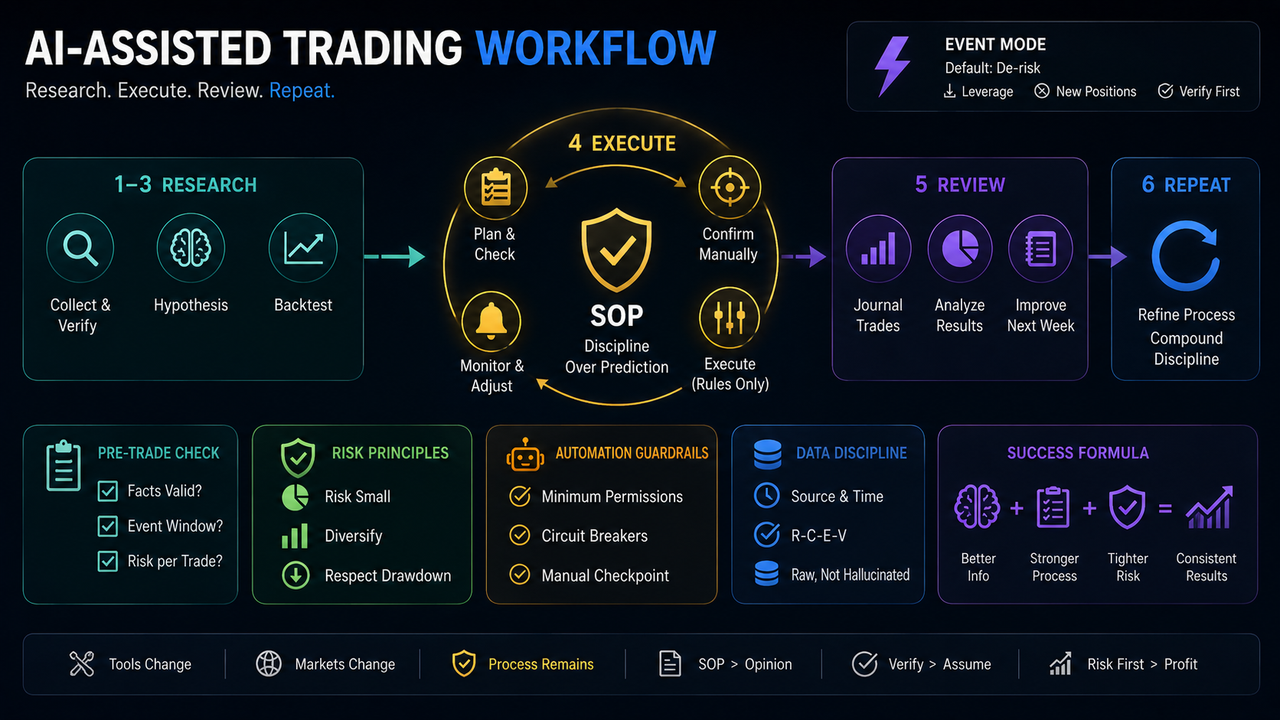
The workflow can be divided by time into three segments: Research Period (Steps 1–3), Execution Period (Steps 4 & 6), Review Period (Step 5). The Event Period (Lesson 4) acts as a cross-cutting rule covering before and after execution.
Research Period
Organize information and calendars; use tiered sources and R-C-E-V constraints to generate points to verify; conduct backtesting or paper tracking for testable hypotheses, recording costs and out-of-sample conclusions. Outputs: Fact Sheet (verified items only), Hypothesis List (with invalidation conditions), initial judgment on whether to enter observation/small position.
Execution Period
Complete risk control checklist and terminal checks before opening positions; handle event windows according to downgrade rules; run automation scripts only when rules are clear and circuit breakers are effective.
Review Period
Import actual trade records; compare plan versus reality; update error types and next week's improvement items; check if concentration limits have been breached.
3. Daily Workflow: Minimum Closed Loop Before Opening Positions
On each planned trading day, the following steps can be completed in fixed order within ten to twenty minutes (depending on position complexity).
-
Step 1: Check if the Fact Sheet is still valid (any changes in announcements, fees, on-chain parameters, platform rules).
-
Step 2: Confirm if today is within an event window; if so, check if leverage has been reduced or new positions paused according to rules.
-
Step 3: Restate trading plan: direction, rationale, invalidation conditions, stop-loss, target or time exit, maximum tolerable loss.
-
Step 4: Cross-check risk control checklist: single trade risk, total exposure, margin mode, conflicts with existing positions.
-
Step 5: Terminal manual confirmation of trading pair, direction, quantity, position type (reduce/open only).
-
Step 6: After execution, log both plan and actual results in journal fields to avoid post-fact memory-based entries.
AI can assist in generating checklists and restatement texts in Steps 3 and 4; Steps 5 and 6 must not be outsourced.
4. Weekly Workflow: Fixed Rhythm for Research and Review
It's recommended to schedule a complete research and review session weekly (e.g., weekends or low-volatility periods), structured as follows:
Research Segment (about 30–45 minutes)
Update macro and crypto-linked observations (interest rates, USD, risk appetite proxies, BTC/ETH structure); update event calendar; clean Fact Sheet by deleting expired items; list 1–3 testable hypotheses for the next week, rejecting unverifiable narratives.
Review Segment (about 30–45 minutes)
Import trades from the week; calculate gross P&L and fees; annotate execution issues (slippage, misclicks, unplanned stop-losses); categorize error types; determine one actionable improvement for next week (e.g., "no leverage adjustment before event days," "no new strategies without OOS backtest").
AI is suitable for formatting and categorizing; numbers and trade records must come from exported data.
5. Event Period SOP: Hard Rules Aligned with Lesson 4
Write event period rules as default strategies instead of ad hoc decisions:
-
24 Hours Before Event: No new high-leverage positions; no deployment of new automated order rules; confirm available margin and stablecoin ratio.
-
During Event: No chasing trades based on AI instant summaries; rely on official data and expectation deviation; only allow reduction or hedging actions (if strategy is designed for this).
-
After Event: Reassess only after spreads and volatility structure normalize; record actual path and differences from scenario planning in the review.
6. Automation SOP: Launch Checklist Aligned with Lesson 5
Before launching any new script or Agent capability, run through a brief checklist:
-
Is permission minimized?
-
Is it separated from read-only monitoring?
-
Are there circuit breakers for single-day losses and consecutive failures?
-
Is withdrawal or high-privilege on-chain authorization prohibited?
-
Are keys kept out of repositories and chats?
-
Is automated order placement disabled by default during event periods?
-
Is there a manual confirmation point?
Any failed items mean no launch or signal-only operation retained.
7. Common Failure Patterns and Countermeasures
Workflow failures usually stem from identifiable patterns:
Pattern 1: Research outputs go directly into live trading
Countermeasure: Separate Fact Sheet from Hypothesis List; unverified items cannot enter execution checklist.
Pattern 2: Backtest looks good so position size increases
Countermeasure: Enforce OOS pessimistic scenario for costs; no position upgrades before passing paper tracking.
Pattern 3: Rules broken temporarily during event periods
Countermeasure: Pre-write event rules into SOP; exceptions must be recorded and included in review.
Pattern 4: Automation covers up lazy execution
Countermeasure: Automation only executes documented rules; rule changes require documentation update before code changes.
Pattern 5: Review logs feelings but not data
Countermeasure: Journal fields are fixed; AI only organizes but never fabricates trade records.
8. Role of AI in Assisted Trading
AI improves information processing and engineering efficiency, but humans retain responsibility for verification, risk control, and execution. The six-position map solves "where to use"; input discipline solves "don't start from faulty data"; backtest auditing solves "don't get fooled by curves"; event boundaries solve "don't gamble under pressure"; automation safety solves "don't let a single mistake persist"; this lesson's SOP solves "can I do the same next week."
For experienced traders, implementation doesn't require completing every field at once. Start with "Fact Sheet + Six Pre-Trade Steps + Weekly Review," then gradually add tiered backtesting, event downgrades, and automation checklists after running for 4–8 weeks. The value of workflow is repeatability; only repeatability allows you to judge if improvements are real.
9. Lesson Summary
Lesson 6 refines AI-assisted crypto trading from concept to workflow: research period focuses on verification and falsifiability; execution period emphasizes checklists and terminal confirmation; review period prioritizes accurate records and single actionable improvement; event period and automation constrain tail risks through downgrade rules and permission circuit breakers. Tools change, models change, but workflow can remain stable. Sticking to workflow is more effective than chasing new prompts for long-term consistency under market pressure. This course concludes here; if platform features or market structure change in the future, update Fact Sheet and checklists rather than abandon the workflow itself.