1. Starting Point: Why Discuss "Boundaries" Before "Models"
The crypto market's high volatility, multiple data sources, and fast-paced execution make information processing consistently costly. With the introduction of artificial intelligence to this field, it is often assigned two opposing expectations: either seen as an "intelligent trader" capable of replacing research and timing, or dismissed as a chat tool irrelevant to live trading. Both extremes hinder the development of sustainable workflows.
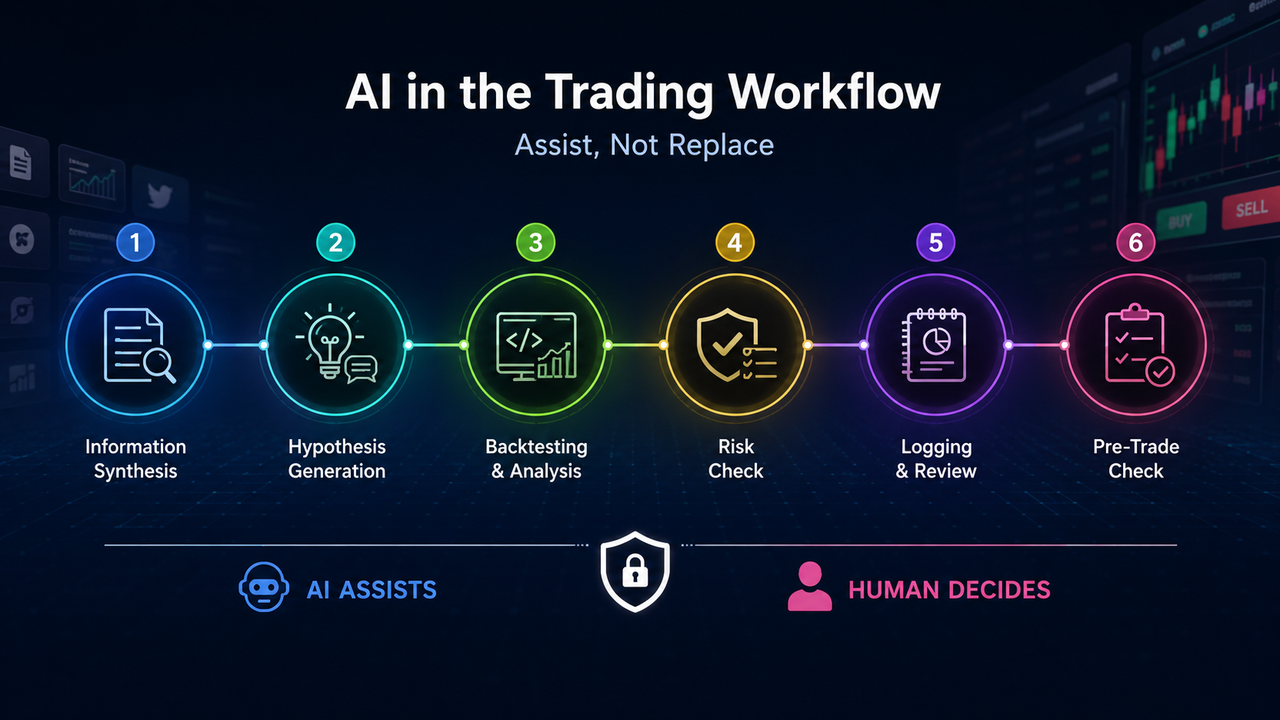
A more practical perspective is to view AI as an auxiliary node within the trading process, not as the primary decision-maker. Nodes can accelerate information organization, help turn intuition into testable hypotheses, generate backtesting code frameworks, cross-check risk control lists, organize review records, and reiterate plans before placing orders. However, verifying source authenticity, validating statistics, assuming position responsibility, and executing trades should remain on the human side. The goal of this lesson is not to introduce specific products or provide tips, but to first map out the workflow to avoid excessive delegation in the wrong steps.
2.Workflow Breakdown: Six Positions and Their Functional Attributes
If we break down a cycle from research to execution and review, AI fits best in the following six positions. Each position corresponds to different inputs, outputs, and risk types.
-
Position 1: Information Organization. Market information is scattered across exchange announcements, project documents, on-chain data, macro calendars, and social media. AI can aggregate by timeline, summarize, and juxtapose statements from different sources. The output here is always a "draft pending verification," not factual confirmation. Summaries must trace back to original sources and include dates and context; statements without sources should not be used as trading rationale.
-
Position 2: Hypothesis Generation. Trading often starts with a debatable judgment—such as rising volatility in a certain macro environment or relative strength in a particular asset class. AI can turn vague ideas into structures like "If A holds, expect B; if C occurs, hypothesis fails," and list required data fields. The value of a hypothesis lies in its falsifiability; narratives that cannot be tested with data within a certain period should remain in research and not inform position decisions.
-
Position 3: Backtesting and Statistical Support. AI is suited to generate backtesting code, explain indicators like Sharpe ratio and maximum drawdown, and highlight common statistical pitfalls. But whether data cleaning is correct, whether delisted assets are included, if fees and funding rates are accounted for, and whether there is look-ahead bias—all require independent audit. Code running only confirms syntax correctness; it does not validate strategy soundness.
-
Position 4: Risk Control Check. Risk limits per trade, leverage caps, proximity to major data windows—these can be compiled into a pre-trade checklist for AI to scan against current positions and plans. Risk control is fundamentally about hard constraints; AI can remind and enumerate but should not auto-approve without long-term validation. Whether parameters fit current volatility or if veto rights are exercised in adverse conditions must remain with human judgment.
-
Position 5: Logging and Review. Scattered notes can be organized into a unified format, categorized by error type, and compared against "plan vs. actual." Reviews should be based on actual transaction records rather than memory; improvements should be few and actionable, distinguishing between strategy failure and execution failure. The goal of review is workflow iteration—not post hoc rationalization.
-
Position 6: Pre-Execution Verification. Before placing an order on the terminal, reiterate direction, quantity, stop-losses, margin mode, and whether only reducing positions; check for conflicts with event calendars or current holdings. Execution errors carry the highest cost; AI can reduce omissions but cannot replace clicking or bearing responsibility.
3. Assistance vs. Replacement: Institutional Implications of Division of Labor
The six positions collectively form a principle: AI can expand information and computational capabilities but should not assume account control. The table below reflects not technical limitations but responsibility structure.
-
In information organization, AI handles summarizing and formatting; humans verify authenticity and timeliness.
-
In hypothesis generation, AI provides structured statements; humans decide whether to trade and set position limits.
-
In backtesting, AI supplies frameworks and explanations; humans manage data, fees, and out-of-sample validation.
-
In risk control, AI scans checklists; humans exercise veto rights and judge parameter suitability.
-
In review, AI formats records; humans ensure record authenticity and take improvement actions.
-
In execution, AI reiterates plans; humans confirm at the terminal.
Skipping verification and directly adopting model-driven conclusions usually substitutes fluent language for evidence chains; trusting "great backtests" without attached data or fee assumptions treats narrative as outcome; granting APIs or automation scripts unlimited access without confirmation multiplies operational risk. These misuse patterns will be discussed in later lessons.
4. Why Boundary Issues Are Amplified in Crypto Scenarios
Compared to traditional stock research, crypto data has higher noise levels—on-chain tags mixed with social media information, fake news and reused old images are common. The market moves quickly; liquidity and rules can change within short windows. Toolchains span exchanges, on-chain platforms, and derivatives; metrics may differ across platforms. Automation thresholds are lower—once script permissions are excessive, errors can repeat consecutively.
Thus in crypto scenarios, "Is the model strong enough?" is not the primary question; "At which steps do we use it—and which manual gates do we keep?" matters more. This lesson establishes the groundwork for later discussions on data quality, backtesting discipline, event interpretation, and automation safety.
5. Lesson Summary
-
The proper role of AI in trading is workflow assistance—not decision replacement;
-
The six positions correspond to information organization, hypothesis generation, backtesting support, risk control checks, logging/review, and pre-execution verification—with distinct responsibility division;
-
High noise levels and fast pace in crypto markets make boundary management more important than model selection.
Understanding this division structure is essential for integrating AI into workflows without amplifying errors. The next lesson will further discuss how to grade input data, constrain output formats with prompts, and avoid using unverified summaries as trading bases.