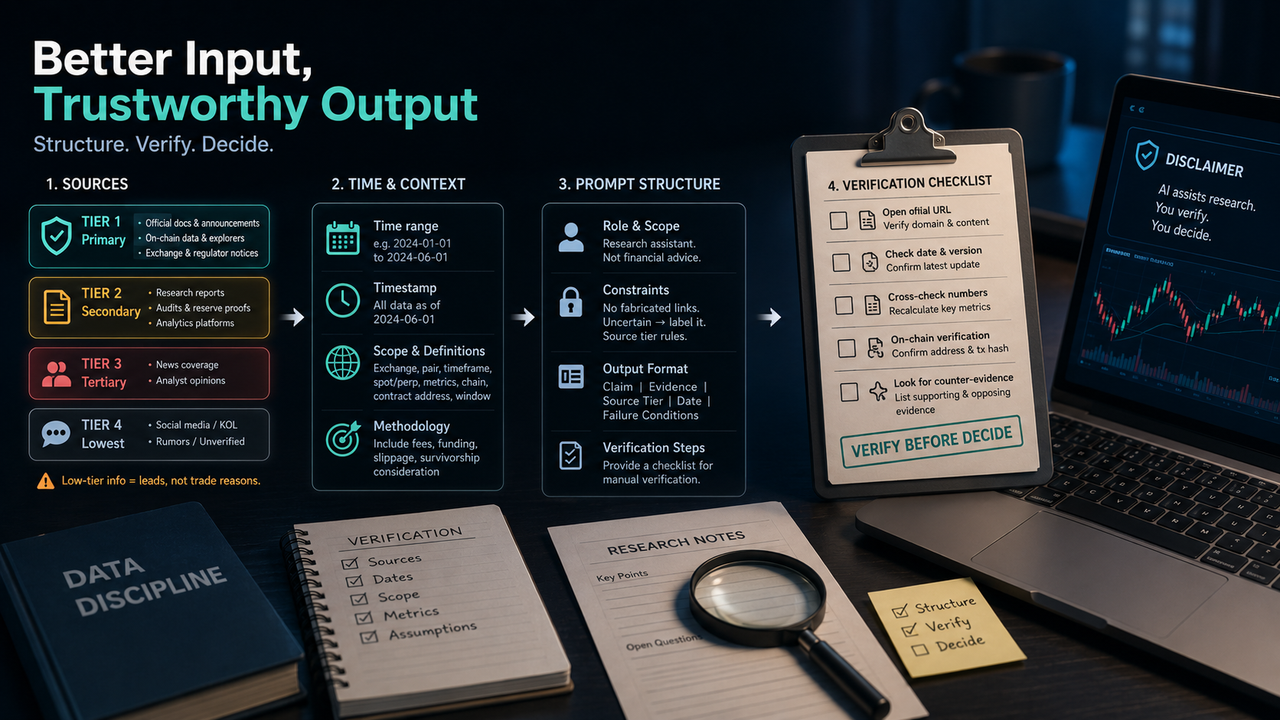
Lesson 1 outlined six positions where AI fits within the trading workflow, with information organization at the very front. If summaries are inaccurate, dates are mixed up, or sources cannot be traced, then subsequent hypothesis generation, backtesting discussions, and risk control checklists only amplify initial biases. Therefore, Lesson 2 does not prioritize techniques for "asking better questions," but rather discusses the structural discipline required at the input stage so that model outputs are treated as subject to verification by default, rather than as established facts.
In trading contexts, hallucinations usually do not mean the model is deliberately fabricating, but that it generates fluent and confident content that cannot be matched to verifiable primary sources. Common forms include: inventing announcements or links, confusing market cap with circulating supply, applying outdated data to current issues, using phrases like "on-chain data shows" without providing addresses, time windows, or statistical standards. The solution is not to reject AI altogether, but to specify the source level, time boundary, and validation steps for every piece of information entering the decision chain.
2.Source Grading: Building an Actionable Classification Framework
Before submitting materials to AI, it is advisable to grade information sources and require the model to label each key point by grade in the prompt. The purpose of grading is not formalism but to clarify which content can be stated as fact and which can only serve as leads or unverified judgments.
-
Primary sources include official project websites, GitHub release records, exchange and regulatory announcements, blockchain explorers, and exportable transaction data. These materials are relatively reliable but still require vigilance against phishing pages and forged announcements—links and domains should be manually verified.
-
Secondary sources include reports from research institutions, audit documents, and proof-of-reserve pages; they help with understanding mechanisms but require checking whether the publication date and audit scope cover the current structure.
-
Mainstream media interpretations of policy can be referenced, but key conclusions should be cross-checked against primary documents.
-
Social media, KOLs, and community content are suitable only as entry points for problem discovery and should not independently justify a trade. Anonymous screenshots and "insider information" are by default excluded from trading logic.
Prompts may require: only high-grade sources may be used for factual statements; mid- or low-grade sources must be labeled as "reportedly" or "unverified"; items lacking source or date should uniformly be marked for verification. Even if the model still makes mistakes, this output format facilitates manual filtering.
3. Timestamps and Standards: Crypto Data Is Prone to "Old Data in New Contexts"
Model training and retrieval lag behind real-time developments, and project mechanisms often upgrade. When querying, specify time ranges—for example, analyze only materials after a certain date; flag potentially outdated information as "as of [date]." When comparing prices or metrics, specify candlestick interval, exchange, trading pair, spot or perpetual, etc. For on-chain statistics, indicate chain name, contract address, statistical window, and whether exchange inflows/outflows are included. The same question under different standards may yield opposite conclusions; standards should be a fixed prompt field rather than an afterthought.
4. Survivor Narratives and Contradictory Evidence
Crypto discussions often showcase only profitable cases, use only bull market samples, or cite backtests from rising periods. AI narratives tend to make stories sound complete while ignoring failed contemporaneous samples. Countermeasures include: requiring both supporting and opposing evidence; specifying sample size and time frame; explicitly answering "cannot determine" when evidence is insufficient rather than forcing a conclusion. Research-oriented dialogue is better suited to presenting scenarios and failure conditions rather than directly outputting long/short recommendations.
Effective prompts usually include four parts:
-
Scope statement — research assistant role, no token recommendations, no guaranteed returns
-
Constraint conditions — no fabricated links, mark uncertainties, source grading rules
-
Output format — argument, basis, source grade, date, invalidation conditions
-
Validation steps — manual checks required—e.g., opening announcement URLs or verifying on-chain transaction hashes
At the end of each conversation, generate a validation checklist to be completed manually before moving on to hypotheses or trading steps. Prompt length is not key; what matters is whether source, time frame, and standards are locked in.
6. Data Division of Labor: Numbers Provided by Humans, Model Handles Interpretation
A more robust division of labor is: market and on-chain data should be exported from APIs, exchanges, or explorers and pasted for AI in raw tables or with clear fields; the model interprets meanings, identifies inconsistencies, and helps structure hypotheses—but does not independently generate critical values. If the model participates in calculations, require it to display formulas and intermediate steps, with core conclusions manually recalculated. Long conversations risk context drift; important topics should start new threads, verified facts should be archived separately for reference only in subsequent interactions to reduce context contamination.
7. Lesson Summary
This lesson addresses the step before using AI: where materials come from, whether they include dates and standards, and whether low-grade sources can be used as trading rationale. Hallucinations and survivor narratives are usually not the model "talking nonsense," but result from unverifiable statements, outdated data, or cherry-picked success stories in the input. By incorporating source grading, time boundaries, and validation checklists into a fixed process, outputs default to drafts that require verification before entering hypothesis or position discussions. The next lesson will cover strategy validation: after cleaning up inputs, it is necessary to separately scrutinize data, costs, and out-of-sample results—backtest curves alone do not validate a strategy.