
As of May 22, 2026, the contract on prediction platform Polymarket for “When will OpenAI conduct its IPO?” has become a hot prediction topic, with total trading volume exceeding $1.5 million. Market funds are significantly tilted toward the fourth-quarter window: the probability of listing before September 30 stands at 41%, while the probability of listing before December 31 rises to 71%.
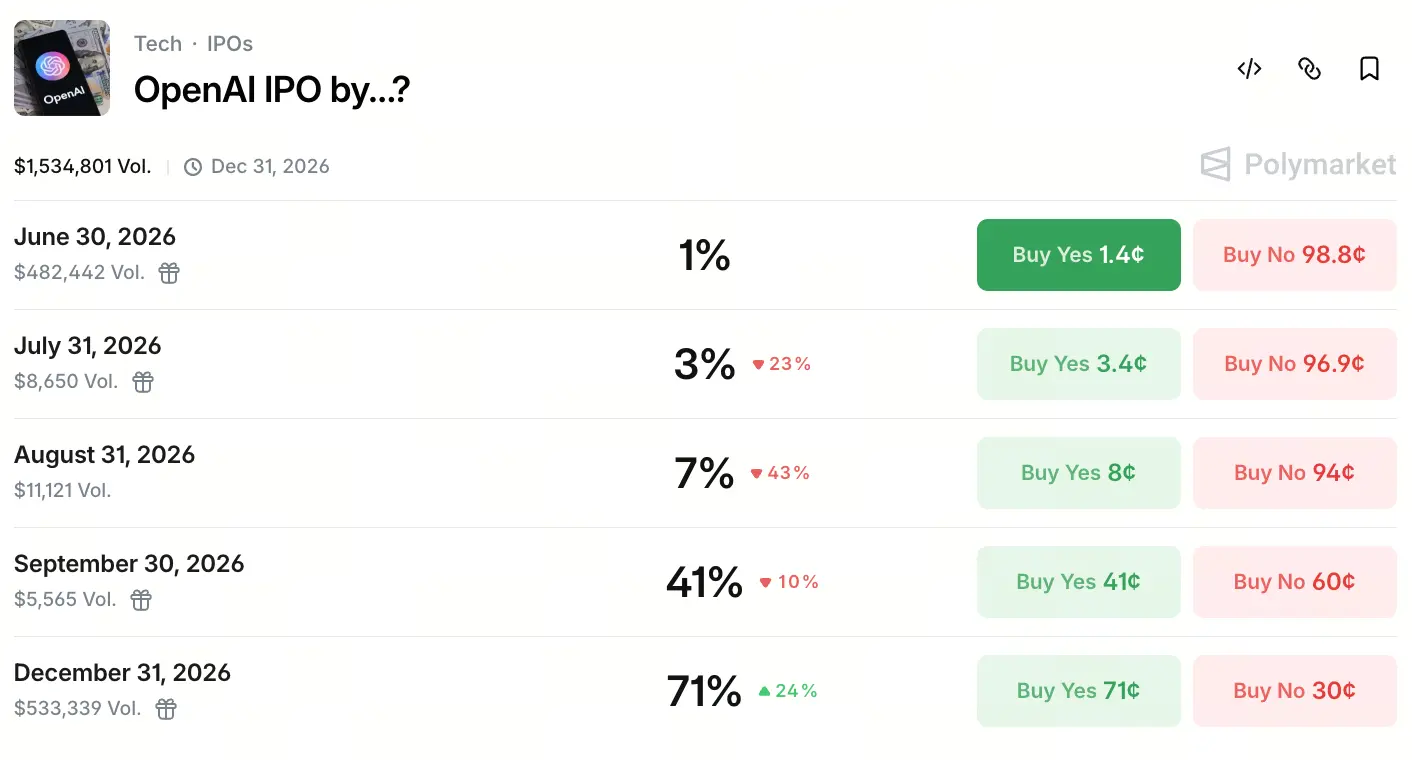 Click to participate in the prediction
This expectation did not come out of thin air. In mid-May, SpaceX officially filed its IPO prospectus, with a market-cap target of about $1.75 trillion, greatly fueling market expectations for the AI giant’s timeline. On the same day, multiple media outlets disclosed that OpenAI is working with Goldman Sachs and Morgan Stanley, with the earliest filing of draft IPO documents to the SEC on May 22 in secret, aiming to be IPO-ready by September 2026. Although there has been no official SEC announcement as of the time of writing, the involvement of investment banks has already led the market to perceive substantive progress.
Prediction markets generally believe the trading probability of a formal listing in 2026 Q4 is higher. CNBC, citing data from the Kalshi platform, said traders believe the probability that OpenAI files for an IPO this year is as high as 92%. This figure strongly echoes Polymarket’s year-end expectations.
Mandatory IPO: Capital logic and cash-flow pressure under an AI arms race
OpenAI’s push to go public is rooted in the fact that its massive capital expenditures have surpassed what the private market can bear. As revealed by company co-founder and president Greg Brockman in court testimony, the essence of OpenAI’s IPO is not a cash-out exit after the company’s maturity, but that capital expenditure for AI training and inference has become too large; the private market is no longer enough, so the public market must ultimately take over.
Financial data validates this view. In Q1 2026, OpenAI generated revenue of about $5.7 billion, but its adjusted operating profit margin was only -122%, meaning that for every $1 of revenue, the company loses $1.22. In the first half of 2025, the company’s net loss reached $13.5 billion; R&D costs were the main expense, at $6.7 billion, largely for developing new AI models and the infrastructure such as servers required to run ChatGPT.
In terms of burn rate, the company’s cumulative fundraising has exceeded $180 billion. OpenAI’s monthly revenue has climbed to $2 billion, with revenue growth at 4 times the pace of Alphabet and Meta in the same period. But high growth comes with higher capital consumption—amid ongoing spending on server expansion, model iteration, and enterprise infrastructure, the marginal impact of private-market funding is declining. The public market has become the only outlet for capital replenishment.
From non-profit to for-profit: OpenAI’s governance transition and the IPO-eligibility battle
The institutional cost of OpenAI transitioning from a non-profit lab to a for-profit enterprise is its most unique structural obstacle on the IPO path. Since starting as a non-profit in 2015, OpenAI’s governance model has been led by a non-profit board, with primary beneficiaries defined as “all of humanity” rather than investors.
To comply with the IPO listing and regulatory requirements of public markets such as NASDAQ, OpenAI has been discussing major reorganization plans internally. Reports say the company is considering adopting a for-profit holding company structure similar to Alphabet (Google’s parent company), planning to split its robotics and hardware divisions into independent businesses to simplify the IPO process for its core AI operations.
On equity governance, a leaked-looking capitalization table shows Microsoft holding about 26.79%, the OpenAI Foundation holding 25.8%, SoftBank holding about 11.66%, and current and former employees combined holding about 20%. CEO Sam Altman still does not directly hold any OpenAI equity, which is considered a structural variable that still needs further clarification in governance expectations. Despite outside doubts about its governance mechanisms, internally it is further推进 optimizing governance by moving toward “public-company-ization”—as CFO Sarah Friar put it: “A company like OpenAI needs to look more like a public company in governance and external image.”
Can a trillion-dollar valuation be realized? The tug-of-war between revenue, user stagnation, and a deep-loss pit
Despite high IPO expectations, OpenAI’s financial fundamentals still show significant imbalance, and the market has always had doubts about the ability to cash in a trillion-dollar valuation.
On the revenue side, OpenAI’s Q1 revenue is about $5.7 billion, and it is expected to stay near $30 billion for the full year. By 2030, the company expects that even just the advertising business alone could contribute about $102 billion in revenue. On the user side, ChatGPT’s weekly active users have reached 905 million, but growth is stagnating and has not broken through the 1 billion target. Enterprise revenue already accounts for more than 40%, and is expected to match the scale of the consumer segment by the end of 2026. The API processes over 15 billion tokens per minute, and progress is relatively steady in operating the commercialization infrastructure.
But the biggest threat is the scale of losses. Based on current profit margins, for every $5.7 billion in revenue created, the company needs to absorb about $6.95 billion in losses; if the盈利 model is not significantly improved before listing, investor-relations maintenance pressure in the public market will likely persist long term. Cash consumption in the first half of 2025 reached $2.5 billion, and R&D expenses became the biggest line item. For institutional investors seeking stable EBITDA and EPS-based assessment, this kind of deep-loss structural condition becomes an important valuation discount factor.
Valuation halving and a cool secondary market: investors’ real sentiment and divergence
While IPO expectations are surging, OpenAI shares in the secondary market have shown a clear contrast. After completing a $122 billion fundraise in March this year, the official valuation was pushed to $852 billion, but secondary-market buy-side interest is significantly below historical levels.
According to media reports, about $17.5k worth of OpenAI shares face pressure from insufficient buy-side demand in the secondary market. Even with an about 10% discount versus the official valuation, buyers’ price expectations have been further lowered. Goldman Sachs and Morgan Stanley have even launched zero-commission promotional modes to attract investors.
In sharp contrast, competitor Anthropic has triggered a “premium frenzy” in the secondary market—subscription orders have continued to break through $1.6 billion, and a large number of investors are bidding for shares at a premium. Secondary-market valuation has been raised to $600 billion, up nearly 50% from the valuation of the previous round of financing.
This split between “official valuation holds firm vs secondary-market cold reception” reveals institutions’ core doubts about the sustainability of the profit model. The investment community’s concerns mainly center on several points: OpenAI’s capital expenditure for AI infrastructure being too high, the enterprise-side transition speed being slower than market expectations, and—against the backdrop of Anthropic’s enterprise customer structure with stable growth and expanding profit space—the pressure from competitors may continue to intensify.
Racing ahead of the listing window: the competitive pressure brought by Anthropic’s synchronized sprint
The biggest variable in the 2026 AI-sector IPO race comes from Anthropic’s synchronized listing schedule.
Anthropic not only surpasses OpenAI in secondary-market popularity, but is also actively preparing to apply for a NASDAQ listing in the second half of 2026. Its rapid rise in enterprise AI and AI programming markets has brought its enterprise customer base to more than 300k. According to recent reports, Anthropic’s valuation is about $380 billion, and it is in talks for a new funding round, with a target valuation expected to reach $900 billion.
In the prediction-market layer about “who lists first,” market views have shifted noticeably. Before news about OpenAI’s listing timetable was exposed, traders believed OpenAI’s probability of getting there first was only about 32%; after the news came out, on the Kalshi platform the probability that OpenAI would list earlier jumped to 83%. In the same period, Polymarket believed the probability of “Anthropic listing before OpenAI” fell from 69% to 20%.
However, whether this race channel will be smoothly opened still depends on uncertain factors such as the pace of regulatory review, the internal reorganization rhythm, and remaining litigation risks. But the signal is already clear—since the listing time windows of two leading companies overlap, 2026 Q4 will become the most concentrated IPO window in the AI sector’s history.
The significance of AI companies going public for the digital asset market
For the crypto market, the IPO timing of top AI companies such as OpenAI creates important signal value.
First, an IPO wave means that the traditional financial system is providing systematic, institutional recognition to AI—a digital track that relies heavily on hashrate and data-center infrastructure. When companies such as SpaceX and OpenAI enter Nasdaq core index constituent sequences, capital will flow more systematically into crypto tracks such as AI tokenization, hashrate-rental RWA (Real World Assets), and DePIN (decentralized physical infrastructure networks). OpenAI itself does not directly issue tokens, but its demonstration effect from going public will push more AI infrastructure projects to adopt structural designs toward blockchain RWA.
Second, active trading on prediction-market platforms such as Polymarket around OpenAI’s IPO timeline expands the application boundary of the crypto industry. Stable liquidity for IPO-probability prediction contracts provides crypto users with a data-centered entry point to game the outcome. The total trading volume of the contract breaking through the $1.5 million level is not accidental—it reflects the crypto industry’s ability to participate in traditional tech narratives.
Third, after an AI titan with a marketcap in the $852 billion to $1 trillion range completes its listing, its weight in the economic system will effectively force crypto assets to establish a new valuation-coordinate framework anchored to the AI track. Projects in the crypto market that are directly related to AI hashrate, allocation of computing resources, and AI data-market infrastructure will gain clearer and more direct macro reference benchmarks.
FAQ
Q1: Will OpenAI definitely be listed in 2026?
Not yet formally confirmed. Although media reports say OpenAI is working with Goldman Sachs and Morgan Stanley to prepare draft IPO prospectus materials, with the goal of being IPO-ready in September 2026, as of now the SEC has not received any publicly released formal documents. Polymarket’s prediction market shows the probability of completing an IPO by the end of 2026 is about 71%, but the exact timing may still change.
Q2: What is OpenAI’s IPO valuation roughly?
The latest official funding round (March 2026) has a post-money valuation of $852 billion. Market rumors place the target IPO valuation in the $1 trillion to $1.25 trillion range. Polymarket user data shows that there is about a 65% probability that OpenAI will close above $1.4 trillion by the end of its first day of public trading.
Q3: Can OpenAI’s financial situation support going public?
Pros and cons. Q1 2026 revenue is about $5.7 billion, but the operating profit margin is -122%, and it is still in deep-loss territory. Net loss in the first half of 2025 reaches $13.5 billion. However, the company’s revenue growth rate is 4 times that of Alphabet and Meta in the same period; monthly revenue has nearly reached $2 billion, giving it substantial potential for structural growth.
Q4: Will Anthropic list before OpenAI?
The likelihood has dropped significantly. After the mid-May news that OpenAI plans to quickly submit IPO documents was released, Polymarket’s “Anthropic first” probability fell sharply from 69% to 20%. Currently, the market generally expects OpenAI to hold a relatively leading position in the IPO window competition.
Q5: What impact will OpenAI’s IPO have on the crypto market?
It mainly brings three impacts: first, it will push traditional capital to systematically allocate to the AI infrastructure track, benefiting crypto projects such as hashrate RWA and DePIN; second, prediction-market applications such as Polymarket will use these kinds of hot IPO contracts to accelerate the expansion of ecosystem boundaries; third, once an AI giant completes its listing, it will drive the overall valuation system of the AI track to provide references, indirectly affecting valuation logic for projects in the crypto market related to AI, computing resources, and data-infrastructure.


